Thomas K. Adamson
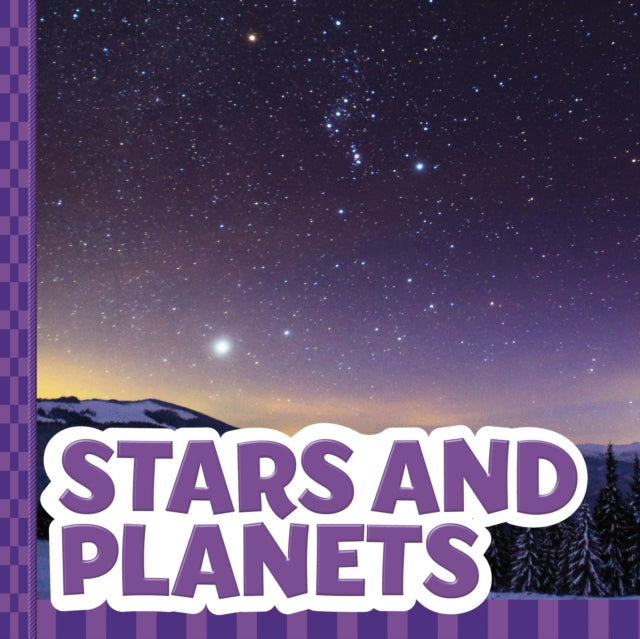
Stars and Planets
Stars and Planets
💎 Earn 33 Points (£0.33) on this item.
YOU SAVE £1.39
- Condition: Brand new
- UK Delivery times: Usually arrives within 2 - 3 working days
- UK Shipping: Fee starts at £3.89. Subject to product weight & dimension
Bulk ordering. Want 15 or more copies? Get a personalised quote and bigger discounts. Learn more about bulk orders.
Couldn't load pickup availability
- More about Stars and Planets
Stars are celestial objects that emit light and heat, while planets are large, celestial bodies that orbit around stars. Some stars are brighter than others due to their size, age, and composition. We can see some planets from Earth with the naked eye, while others require telescopes to observe. This title provides an introduction to the science behind stars and planets.
Format: Paperback / softback
Length: 24 pages
Publication date: 18 January 2024
Publisher: Capstone Global Library Ltd
Stars are celestial objects composed primarily of hydrogen and helium, which are generated through the process of nuclear fusion. They are the dominant source of energy in the universe and play a crucial role in shaping its evolution.
Stars are celestial objects composed primarily of hydrogen and helium, which are generated through the process of nuclear fusion. They are the dominant source of energy in the universe and play a crucial role in shaping its evolution.
Planets, on the other hand, are celestial bodies that orbit around stars. They come in various sizes, shapes, and compositions, ranging from gas giants like Jupiter to small rocky planets like Earth. Planets are essential for the survival of life on Earth, as they provide the necessary conditions for water to exist, and they are also home to a wide range of organisms.
One of the most striking features of stars is their brightness. Stars are classified based on their temperature, which is measured in Kelvin (K). The hotter a star is, the brighter it is. For example, the Sun is a star with a temperature of around 5,772 K, which makes it the brightest star in the Milky Way galaxy.
The brightness of stars is determined by a variety of factors, including their size, mass, and distance from Earth. Larger stars, which have more mass, are brighter than smaller stars. Stars that are closer to Earth are also brighter than those that are farther away.
In addition to their brightness, stars also exhibit a range of other characteristics, such as their color and spectral type. The color of a star is determined by the temperature of its surface, which ranges from red (hotter) to blue (cooler). Spectral types are used to classify stars based on their emission spectra, which reveal the different types of atoms and molecules present in their atmospheres.
One of the most interesting aspects of stars is their life cycle. Stars are born, live, and die. They are born in massive clouds of gas and dust known as nebulae, which collapse under the gravitational force of their own mass. The resulting protostar is a hot, glowing ball of gas that undergoes a series of changes as it ages.
As a protostar ages, it undergoes a process known as nuclear fusion, which converts hydrogen into helium. This process releases a tremendous amount of energy, which heats the protostar and causes it to grow. Eventually, the protostar becomes a star, which is a stable, self-sustaining object that radiates energy through its surface.
Stars can also undergo a variety of other changes as they age, such as becoming a supernova or a black hole. A supernova is a massive explosion that occurs when a star reaches the end of its life cycle and collapses under its own gravitational force. A black hole is a region of space that is so dense that even light cannot escape.
Planets, too, have their own life cycles. They are born in the same way that stars are born, but they are much smaller and less massive. Planets can range in size from small, rocky planets like Earth to gas giants like Jupiter. Planets also have their own atmospheres, which are composed of various gases, such as oxygen, nitrogen, and carbon dioxide.
The life cycle of a planet is determined by a variety of factors, including its distance from the star, its size, and its composition. Planets that are closer to their stars are hotter and more volatile than those that are farther away. Planets that are larger and more massive are also more likely to have a thicker atmosphere and to be able to support life.
One of the most interesting aspects of planets is their ability to support life. Life on Earth is unique in that it is able to exist in a wide range of environments, from the hot, acidic conditions of the deep ocean to the dry, arid conditions of the desert. However, life on other planets may be able to exist in a wide range of environments, including the atmospheres of gas giants, the surfaces of ice giants, and even the interiors of planets.
In addition to their ability to support life, planets are also important for the study of astronomy and astrophysics. Planets provide a natural laboratory for studying the behavior of stars and the evolution of the universe. By studying the properties of planets, scientists can gain a better understanding of the processes that drive the formation and evolution of stars and galaxies.
There are many planets in the universe that are visible to the naked eye from Earth. The most famous of these is the Moon, which is the fifth-largest planet in the solar system and is visible from almost every part of the world. Other planets that are visible to the naked eye include Venus, Mars, Jupiter, and Saturn.
In addition to these planets, there are many other planets in the universe that are not visible to the naked eye. These planets are known as exoplanets, and they are located in a wide range of star systems, including our own solar system. Exoplanets are typically discovered through the use of telescopes and other instruments, such as the Hubble Space Telescope.
In conclusion, stars are celestial objects composed primarily of hydrogen and helium, which are generated through the process of nuclear fusion. They are the dominant source of energy in the universe and play a crucial role in shaping its evolution. Planets, on the other hand, are celestial bodies that orbit around stars. They come in various sizes, shapes, and compositions, ranging from gas giants like Jupiter to small rocky planets like Earth. Planets are essential for the survival of life on Earth, as they provide the necessary conditions for water to exist, and they are also home to a wide range of organisms.
One of the most striking features of stars is their brightness, which is determined by a variety of factors, including their size, mass, and distance from Earth. Stars also exhibit a range of other characteristics, such as their color and spectral type. The life cycle
cycle of a star is determined by a variety of factors, including its distance from the star, its size, and its composition. Planets, too, have their own life cycles
cycles, which are determined by a variety of factors, including their distance from the star, their size, and their composition.
In addition to their ability to support life, planets are also important for the study of astronomy and astrophysics. Planets provide a natural laboratory for studying the behavior of stars and the evolution of the universe. By studying the properties of planets, scientists can gain a better understanding of the processes that drive the formation
formation and evolution of stars and galaxies.
There are many planets in the universe that are visible to the naked eye from Earth. The most famous of these is the Moon, which is the fifth-largest planet in the solar system and is visible from almost every part of the world. Other planets that are visible to the naked eye include Venus, Mars, Jupiter, and Saturn.
In addition to these planets, there are many other planets in the universe that are not visible to the naked eye. These planets are known as exoplanets, and they are located in a wide range of star systems, including our own solar system. Exoplanets are typically discovered through the use of telescopes and other instruments, such as the Hubble Space Telescope.
Weight: 82g
Dimension: 198 x 204 x 3 (mm)
ISBN-13: 9781398247994
UK and International shipping information
UK and International shipping information
We deliver throughout the United Kingdom and to 128 countries and territories worldwide, including the United States, Australia, Canada, Germany, Spain and France.