Andrew Yeo
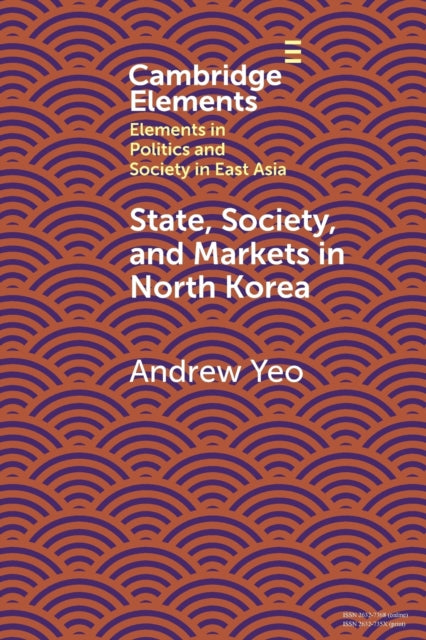
State, Society and Markets in North Korea
State, Society and Markets in North Korea
💎 Earn 84 Points (£0.84) on this item.
We can order this item for you. Delivery usually takes about 4 to 6 weeks.
This item is not held in our immediate stock. We will order it for you after checkout.
Estimated delivery: About 4 to 6 weeks
YOU SAVE £1.01
- Condition: Brand new
- UK Delivery times: Usually arrives within 2 - 3 working days
- UK Shipping: Fee starts at £3.89. Subject to product weight & dimension
Bulk ordering. Want 15 or more copies? Get a personalised quote and bigger discounts. Learn more about bulk orders.
Couldn't load pickup availability
- More about State, Society and Markets in North Korea
North Korea has experienced growing economic markets, a emerging nouveau riche, and modest levels of urban development, but the relationship between state, society, and markets is shifting. If the regime implements controlled economic measures, extracts rent, and subsumes the market economy into its ideology, it will likely retain strong authoritarian control. If it fails to incorporate markets into its legitimating message, more fundamental changes in state-society relations are in order.
Format: Paperback / softback
Length: 75 pages
Publication date: 04 November 2021
Publisher: Cambridge University Press
Under the leadership of Kim Jong-un, North Korea has witnessed a remarkable transformation in its economic landscape, with the emergence of growing economic markets, a burgeoning nouveau riche class, and modest levels of urban development. This shift has led to significant changes in North Korean politics and society, posing important questions about the extent to which the country is evolving and the impact of market growth on state-society relations.
The growth of markets in North Korea has had a profound impact on the relationship between the state and society. On the one hand, the regime has sought to harness the potential of markets to promote economic development and improve the lives of its citizens. This has included implementing policies such as market-oriented reforms, opening up to foreign investment, and promoting private enterprise.
However, the growth of markets has also created tensions and challenges for the regime. As private actors emerge and engage in economic activities, they develop informal trust networks, share information, and collude with state bureaucrats. This can lead to the erosion of state control and the emergence of a more decentralized and informal economic system.
One of the key questions is whether the regime can successfully incorporate markets into its legitimating message and maintain strong authoritarian control. If the regime implements controlled economic measures, extracts rent, and subsumes the market economy into its ideology, it is likely to retain strong authoritarian control. However, if it fails to incorporate markets into its legitimating message, as private actors build informal trust networks, share information, and collude with state bureaucrats, more fundamental changes in state-society relations are in order.
To understand the evolving relationship between state, society, and markets in North Korea, it is important to examine the country's political and economic system. North Korea is a deeply authoritarian state that relies on a centralized command economy to control its citizens and resources. The regime maintains a tight grip on power, with a powerful military and a centralized bureaucracy that controls all aspects of society.
However, the growth of markets has created opportunities for some individuals and groups to engage in economic activities outside of the state's control. This has led to the emergence of a black market economy, which is estimated to account for a significant portion of North Korea's GDP. The black market economy is characterized by informal trade, the sale of illegal goods, and the exploitation of labor.
Despite the challenges posed by the black market economy, the regime has sought to harness its potential for economic development. This has included implementing policies such as the "New Economic Policy," which aimed to promote private enterprise and encourage foreign investment. However, these policies have been met with mixed success, with some private entrepreneurs facing restrictions and challenges from the state.
In addition to the black market economy, there has been a growing trend towards urbanization in North Korea. As the regime seeks to modernize its economy and improve the lives of its citizens, it has invested in infrastructure development, including the construction of new cities and the expansion of existing ones. This has led to the emergence of a new class of urbanites, who have access to a range of goods and services that were previously unavailable to them.
However, urbanization has also created challenges for the regime. As more people move to cities, they become more exposed to outside influences and ideas, which can challenge the regime's control over the narrative and ideology of society. This has led to a crackdown on dissent and the suppression of political opposition, with many activists and journalists facing imprisonment or exile.
In conclusion, the growth of markets in North Korea has had a profound impact on the relationship between the state and society. While the regime has sought to harness the potential of markets for economic development, it has also faced challenges from private actors who have developed informal trust networks and colluded with state bureaucrats. The regime's ability to maintain strong authoritarian control over society will depend on its ability to incorporate markets into its legitimating message and manage the tensions and challenges posed by the growth of markets.
As North Korea continues to evolve, it will be important to monitor the changing relationship between state, society, and markets and to assess the impact of these changes on the country's political and economic system. By opening the "black box" of North Korea, this Element reveals how the country manages to teeter forward and where its domestic future may lie.
Weight: 144g
Dimension: 152 x 228 x 8 (mm)
ISBN-13: 9781108744799
Edition number: New ed
UK and International shipping information
UK and International shipping information
We deliver throughout the United Kingdom and to 128 countries and territories worldwide, including the United States, Australia, Canada, Germany, Spain and France.