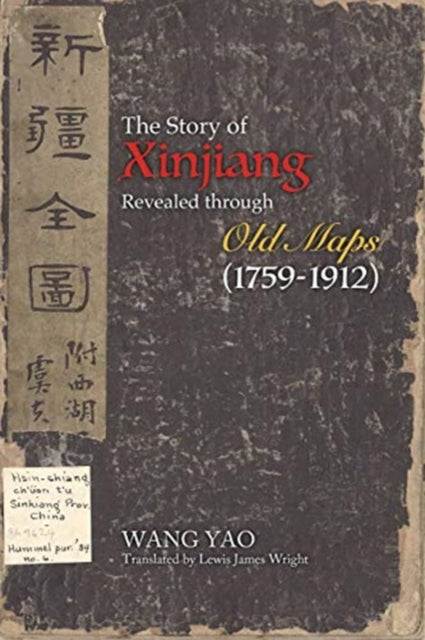
Yao Wang
Story of Xinjiang Revealed through Old Maps (1759-1912)
Story of Xinjiang Revealed through Old Maps (1759-1912)
💎 Earn 129 Points (£1.29) on this item.
YOU SAVE £4.16
- Condition: Brand new
- UK Delivery times: Usually arrives within 2 - 3 working days
- UK Shipping: Fee starts at £3.89. Subject to product weight & dimension
Bulk ordering. Want 15 or more copies? Get a personalised quote and bigger discounts. Learn more about bulk orders.
Couldn't load pickup availability
- More about Story of Xinjiang Revealed through Old Maps (1759-1912)
Xinjiang, named in 1759 by Emperor Qianlong, was ruled by the Qing from the Dzungar-Qing Wars until 1912. The book explores the region's history through rare ancient maps and archives, featuring stories of Emperor Qianlong, Fragrant concubine, Lady Catherine, Swedish missionaries, and Guan Gong temples.
Format: Paperback / softback
Length: 160 pages
Publication date: 01 September 2021
Publisher: Bridge21 Publications, LLC
Xinjiang, a region with a rich history, was named in 1759 by Emperor Qianlong (乾隆 1711-1799) of the Manchu-led Qing dynasty of China. Ruled by the Qing from the final phase of the Dzungar-Qing Wars, which saw the conquest of the Dzungar Khanate, Xinjiang endured until the fall of the imperial dynasty in 1912. This captivating book, based on rare ancient maps and historical archives, delves into the stories of Xinjiang during the Qing era. It explores the lives of Emperor Qianlong, the Fragrant concubine (xiangfei 香妃), Lady Catherine (the wife of the British consul-general in Kashgar at the end of the 19th century), Swedish missionaries, and Guan Gong temples, among others.
The Qing dynasty's rule in Xinjiang began after the Dzungar Khanate was conquered in the final phase of the Dzungar-Qing Wars. This period lasted until the fall of the imperial dynasty in 1912. During this time, Xinjiang experienced significant changes and development under Qing rule.
Emperor Qianlong, the fifth emperor of the Qing dynasty, was instrumental in the establishment of Xinjiang as a province. He named the region in 1759 and sent several missions to explore and govern it. The Fragrant concubine, Xiangfei, was a Uyghur concubine married to Emperor Qianlong. She played a significant role in the cultural exchange between the Qing dynasty and the Uyghur people. Lady Catherine, the wife of the British consul-general in Kashgar at the end of the 19th century, lived in Xinjiang for nearly two decades. She was a keen observer of the region's culture and society and wrote extensively about her experiences.
Swedish missionaries were another group that played a significant role in Xinjiang during the Qing era. They persisted in spreading Christianity for 38 years among Uyghurs who believed in Islam. Despite facing opposition and persecution, the missionaries persevered in their mission and made significant contributions to the Christianization of the region.
Guan Gong temples were also an important aspect of Xinjiang's religious landscape during the Qing era. These temples were dedicated to Lord Guan, a religious figure who was revered by both the Han and Manchus. The temples played a significant role in the cultural and social life of the region's Han and Manchu communities.
In conclusion, Xinjiang, named in 1759 by Emperor Qianlong, was ruled by the Qing dynasty of China from the final phase of the Dzungar-Qing Wars until the fall of the imperial dynasty in 1912. This period saw significant changes and development in the region, including the establishment of Xinjiang as a province, the cultural exchange between the Qing dynasty and the Uyghur people, the Christianization of the region by Swedish missionaries, and the significance of Guan Gong temples in the religious landscape of the region. The book, based on rare ancient maps and historical archives, provides a valuable insight into the history and culture of Xinjiang during this period.
Weight: 228g
Dimension: 153 x 228 x 16 (mm)
ISBN-13: 9781626430747
UK and International shipping information
UK and International shipping information
We deliver throughout the United Kingdom and to 128 countries and territories worldwide, including the United States, Australia, Canada, Germany, Spain and France.