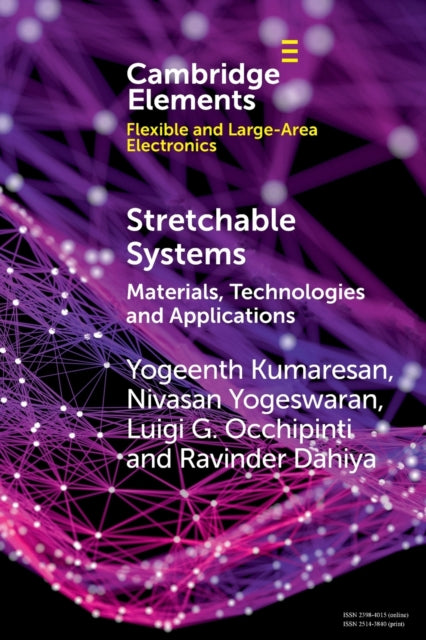
YogeenthKumaresan,NivasanYogeswaran,Luigi G.Occhipinti,RavinderDahiya
Stretchable Systems: Materials, Technologies and Applications
Stretchable Systems: Materials, Technologies and Applications
💎 Earn 84 Points (£0.84) on this item.
We can order this item for you. Delivery usually takes about 4 to 6 weeks.
This item is not held in our immediate stock. We will order it for you after checkout.
Estimated delivery: About 4 to 6 weeks
YOU SAVE £1.01
- Condition: Brand new
- UK Delivery times: Usually arrives within 2 - 3 working days
- UK Shipping: Fee starts at £2.39. Subject to product weight & dimension
Bulk ordering. Want 15 or more copies? Get a personalised quote and bigger discounts. Learn more about bulk orders.
Couldn't load pickup availability
- More about Stretchable Systems: Materials, Technologies and Applications
Stretchable electronics is a transformative pillar of future flexible electronics, with research on new materials, designs, and engineering approaches focusing on integrating high-performance materials to accommodate electronics on stretchable substrates. Recent advances in material research and integration techniques have enabled the development of stretchable systems with strain invariant electrical response. Applications, challenges, and opportunities associated with stretchable electronics are discussed.
Format: Paperback / softback
Length: 75 pages
Publication date: 27 January 2022
Publisher: Cambridge University Press
Stretchable electronics hold immense potential as a transformative pillar of the future of flexible electronics. Consequently, there has been a significant surge in research focused on developing new passive and active materials, innovative designs, and engineering approaches. Recent studies have underscored the significance of exploring novel strategies that enable the integration of high-performance materials, such as organic and inorganic compounds, carbon-based and layered materials, and composites, into conductors, semiconductors, or insulators capable of accommodating electronics on stretchable substrates. This Element serves as a comprehensive discussion on the strategies employed to achieve stretchable systems, with a particular emphasis on various stretchable geometries aimed at achieving strain invariant electrical response. Furthermore, it provides a summary of the recent advancements in material research, diverse integration techniques for high-performance electronics, and explores some of the applications, challenges, and opportunities associated with the development of stretchable electronics.
Stretchable electronics represent a groundbreaking advancement in the field of flexible electronics, offering the promise of unprecedented adaptability and functionality. By integrating high-performance materials into stretchable systems, researchers aim to create electronic components that can conform to the intricate shapes and movements of human bodies and other flexible substrates. This Element explores the key aspects of stretchable electronics, including the development of new materials, innovative designs, and engineering approaches.
One of the critical challenges in stretchable electronics is the selection of suitable materials. Traditional electronic components, such as silicon and copper, are rigid and inflexible, making them unsuitable for applications that require flexibility and conformability. Therefore, researchers have been exploring a wide range of materials, including organic polymers, carbon nanotubes, and nanocomposites, which have the potential to be both flexible and conductive.
In addition to material selection, innovative design strategies are essential for achieving stretchable electronics. One approach is the use of stretchable interconnects, such as flexible printed circuits (FPCs) and stretchable electrodes, which can enable the seamless integration of electronic components on stretchable substrates. Another design strategy is the integration of stretchable batteries and power management systems, which can provide power to stretchable devices while maintaining their flexibility.
Engineering approaches are also crucial in the development of stretchable electronics. One approach is the use of micro- and nano-fabrication techniques, such as micro-electromechanical systems (MEMS) and nanotechnology, which can enable the precise control of material properties and the integration of complex electronic components on small scales. Another approach is the use of stretchable electronic components, such as stretchable displays and sensors, which can be integrated into garments, medical devices, and other flexible applications.
Despite the significant progress made in stretchable electronics, there are still several challenges that need to be addressed. One challenge is the scalability of stretchable systems, as the integration of high-performance materials and complex electronic components can be challenging on a large scale. Another challenge is the durability of stretchable systems, as the materials used may be susceptible to damage or degradation over time.
Despite these challenges, stretchable electronics hold immense potential for a wide range of applications. For example, stretchable electronics can be used in wearable devices, such as smartwatches and fitness trackers, which can conform to the shape of the wearer's body and provide real-time data and notifications. Stretchable electronics can also be used in medical devices, such as stretchable sensors and imaging systems, which can be used to monitor and diagnose medical conditions in real-time.
In conclusion, stretchable electronics represent a transformative pillar of the future of flexible electronics. By integrating high-performance materials into stretchable systems, researchers aim to create electronic components that can conform to the intricate shapes and movements of human bodies and other flexible substrates. While there are still challenges to be addressed, the significant progress made in material research, innovative design strategies, and engineering approaches has opened up new opportunities for the development of stretchable electronics in a wide range of applications.
Weight: 192g
Dimension: 152 x 230 x 15 (mm)
ISBN-13: 9781108794824
Edition number: New ed
This item can be found in:
UK and International shipping information
UK and International shipping information
UK Delivery and returns information:
- Delivery within 2 - 3 days when ordering in the UK.
- Shipping fee for UK customers from £2.39. Fully tracked shipping service available.
- Returns policy: Return within 30 days of receipt for full refund.
International deliveries:
Shulph Ink now ships to Australia, Belgium, Canada, France, Germany, Ireland, Italy, India, Luxembourg Saudi Arabia, Singapore, Spain, Netherlands, New Zealand, United Arab Emirates, United States of America.
- Delivery times: within 5 - 10 days for international orders.
- Shipping fee: charges vary for overseas orders. Only tracked services are available for most international orders. Some countries have untracked shipping options.
- Customs charges: If ordering to addresses outside the United Kingdom, you may or may not incur additional customs and duties fees during local delivery.