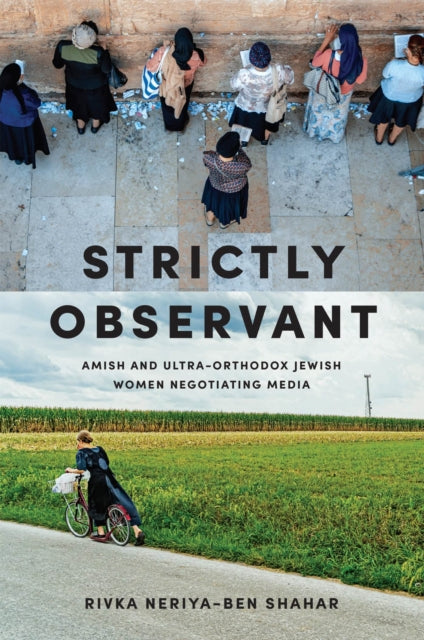
Rivka Neriya-Ben Shahar
Strictly Observant: Amish and Ultra-Orthodox Jewish Women Negotiating Media
Strictly Observant: Amish and Ultra-Orthodox Jewish Women Negotiating Media
💎 Earn 156 Points (£1.56) on this item.
YOU SAVE £3.76
- Condition: Brand new
- UK Delivery times: Usually arrives within 2 - 3 working days
- UK Shipping: Fee starts at £2.39. Subject to product weight & dimension
Bulk ordering. Want 15 or more copies? Get a personalised quote and bigger discounts. Learn more about bulk orders.
Couldn't load pickup availability
- More about Strictly Observant: Amish and Ultra-Orthodox Jewish Women Negotiating Media
The Amish and ultra-Orthodox Jewish communities have traditionally been associated with strict religious observance, a renunciation of worldly things, and obedience of women to men. However, Womens relationship to media in these communities reveals a more nuanced picture of the boundaries at play and womens roles in negotiating them. Strictly Observant is a compelling ethnographic study that explores the complex dynamic between women in these communities and contemporary media technologies, challenging gender hierarchies and prompting us to reconsider our understanding of these communities and our own relationship to media.
Format: Paperback / softback
Length: 220 pages
Publication date: 12 January 2024
Publisher: Rutgers University Press
The Amish and ultra-Orthodox Jewish communities have long been associated with strict religious observance, a renunciation of worldly things, and the subordination of women to men. However, the relationship between women and media in these communities reveals a more nuanced picture of the boundaries at play and the roles that women play in navigating them.
In her book, Strictly Observant: Women and Media in the Amish and Ultra-Orthodox Jewish Communities, anthropologist Rachel Harris explores the complex interplay between women and media in these two communities. Through in-depth interviews and participant observation, Harris examines how women use media to establish valuable social, cultural, and religious capital, challenge gender hierarchies, and navigate the complexities of their communities.
One of the key findings of the book is that women in these communities are not passive recipients of media but active agents of change. Women use media to connect with others, share their experiences, and advocate for their rights and interests. For example, Harris notes that women in the Amish community use social media to connect with other members of their community, share information about their faith and traditions, and organize community events. Women in the ultra-Orthodox Jewish community also use media to connect with other women, share information about their religious practices and beliefs, and advocate for women's rights within their community.
However, the use of media by women in these communities is not without its challenges. Women face pressure to conform to traditional gender roles and to avoid media that could potentially challenge their religious beliefs or undermine their social standing. Harris notes that women in the Amish community are often discouraged from using technology, including cell phones and computers, and are expected to focus on their domestic responsibilities and their roles as mothers and wives. Women in the ultra-Orthodox Jewish community are also expected to adhere to strict dress codes and to avoid media that could potentially expose them to secular influences or encourage immorality.
Despite these challenges, women in these communities are finding ways to use media to their advantage. Women are using social media to share their stories and experiences, to advocate for their rights and interests, and to connect with others who share their values and beliefs. Women are also using media to educate others about their communities and to challenge stereotypes and misconceptions about their faith and traditions.
In conclusion, Strictly Observant provides a compelling ethnographic study of the complex dynamic between women and media in the Amish and ultra-Orthodox Jewish communities. Through her in-depth research, Harris challenges our assumptions about these communities and the roles that women play in them. She demonstrates that women in these communities are not passive recipients of media but active agents of change who use media to establish valuable social, cultural, and religious capital, challenge gender hierarchies, and navigate the complexities of their communities. The book provides valuable insights into the ways in which women are using media to shape their lives and the broader social and cultural landscape.
Weight: 313g
Dimension: 235 x 156 x 15 (mm)
ISBN-13: 9781978805217
This item can be found in:
UK and International shipping information
UK and International shipping information
UK Delivery and returns information:
- Delivery within 2 - 3 days when ordering in the UK.
- Shipping fee for UK customers from £2.39. Fully tracked shipping service available.
- Returns policy: Return within 30 days of receipt for full refund.
International deliveries:
Shulph Ink now ships to Australia, Belgium, Canada, France, Germany, Ireland, Italy, India, Luxembourg Saudi Arabia, Singapore, Spain, Netherlands, New Zealand, United Arab Emirates, United States of America.
- Delivery times: within 5 - 10 days for international orders.
- Shipping fee: charges vary for overseas orders. Only tracked services are available for most international orders. Some countries have untracked shipping options.
- Customs charges: If ordering to addresses outside the United Kingdom, you may or may not incur additional customs and duties fees during local delivery.