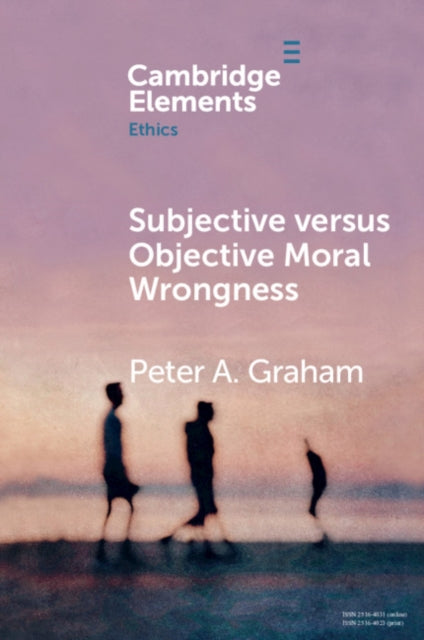
Peter A.Graham
Subjective versus Objective Moral Wrongness
Subjective versus Objective Moral Wrongness
We can order this item for you. Delivery usually takes about 4 to 6 weeks.
This item is not held in our immediate stock. We will order it for you after checkout.
Estimated delivery: About 4 to 6 weeks
YOU SAVE £1.58
- Condition: Brand new
- UK Delivery times: Usually arrives within 2 - 3 working days
- UK Shipping: Fee starts at £3.89. Subject to product weight & dimension
Bulk ordering. Want 15 or more copies? Get a personalised quote and bigger discounts. Learn more about bulk orders.
Couldn't load pickup availability
- More about Subjective versus Objective Moral Wrongness
The debate between Subjectivists and Objectivists about moral wrongness centers around whether our actions' moral status is grounded in subjective circumstances or objective circumstances. Objectivists argue that the moral status of our actions is grounded in objective facts, while Subjectivists argue that it is grounded in subjective beliefs and evidence. This Element offers a tentative defense of Objectivism about moral wrongness.
\n Format: Paperback / softback
\n Length: 75 pages
\n Publication date: 15 April 2021
\n Publisher: Cambridge University Press
\n
The debate between Subjectivists and Objectivists regarding moral wrongness is a lively and ongoing one in the philosophical realm. Subjectivism, as the view suggests, holds that the moral status of our actions is determined by our subjective circumstances, encompassing our beliefs and evidence about the world around us. On the other hand, Objectivism posits that the moral status of our actions is grounded in our objective circumstances, which include all facts other than those that are influenced by our subjective experiences.
A third perspective, known as Ecumenism, proposes that the moral status of our actions is influenced by both our subjective and objective circumstances. In this essay, we will outline and evaluate the various arguments presented by both Subjectivists and Objectivists, before offering a tentative defense of Objectivism regarding moral wrongness.
One of the central arguments against Subjectivism is that it fails to provide a clear and consistent basis for determining moral wrongness. Subjectivists argue that the moral status of an action depends on the individual's beliefs and experiences, which can vary widely from person to person. This means that there is no universal standard for determining what is morally right or wrong, leading to inconsistencies and confusion.
Objectivists, on the other hand, argue that moral wrongness is inherent in the nature of an action itself, regardless of the subjective intentions or beliefs of the actor. Objectivists believe that there are certain fundamental moral principles that apply to all human beings, regardless of their cultural, historical, or personal backgrounds. These principles include things like respect for life, honesty, and justice.
Objectivists further argue that the moral status of an action can be determined by objective criteria, such as the consequences of the action and the intentions behind it. For example, Objectivists would argue that killing someone is morally wrong because it violates the fundamental principle of respect for life. Similarly, they would argue that lying is morally wrong because it undermines the principle of honesty.
Despite these arguments, some critics of Objectivism argue that it is too rigid and inflexible to account for the complex and nuanced nature of moral decisions. Objectivists may argue that certain actions, such as self-defense or acts of mercy, are morally justified even though they violate fundamental moral principles. Critics argue that this approach fails to recognize the moral complexity and the fact that moral decisions are often made in the context of complex and uncertain circumstances.
In response to these criticisms, Objectivists may argue that their approach is more consistent and reliable than Subjectivism. Objectivists believe that there are certain fundamental moral principles that apply to all human beings, regardless of their subjective experiences or beliefs. These principles are based on reason and logic, and they provide a clear and consistent basis for determining moral wrongness.
Furthermore, Objectivists argue that their approach can account for the moral complexity and the fact that moral decisions are often made in the context of complex and uncertain circumstances. Objectivists believe that there are certain moral principles that apply to all situations, regardless of the specific circumstances involved. For example, Objectivists would argue that the principle of respect for life applies to all human beings, regardless of their age, gender, or political beliefs.
In conclusion, the debate between Subjectivists and Objectivists regarding moral wrongness is a complex and ongoing one. Subjectivists argue that the moral status of an action depends on the individual's beliefs and experiences, while Objectivists argue that the moral status of an action is inherent in the nature of the action itself, regardless of the subjective intentions or beliefs of the actor. While Objectivists may argue that their approach is more consistent and reliable than Subjectivism, critics argue that it is too rigid and inflexible to account for the complex and nuanced nature of moral decisions. Ultimately, the determination of moral wrongness is a matter of personal belief and interpretation, and there is no one-size-fits-all solution to this philosophical question.
\n Weight: 118g\n
Dimension: 152 x 228 x 9 (mm)\n
ISBN-13: 9781108706612\n \n
UK and International shipping information
UK and International shipping information
We deliver throughout the United Kingdom and to 128 countries and territories worldwide, including the United States, Australia, Canada, Germany, Spain and France.