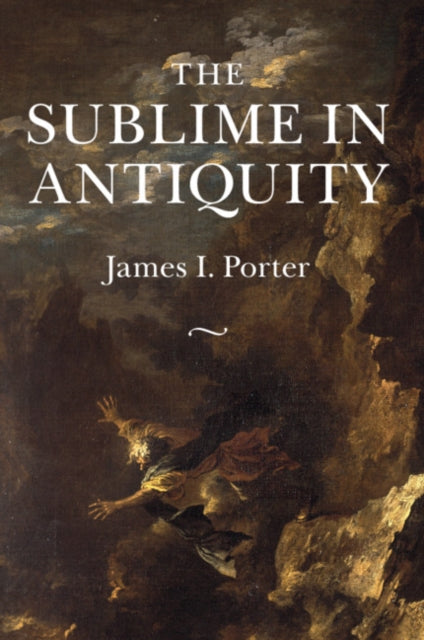
James I.Porter
Sublime in Antiquity
Sublime in Antiquity
💎 Earn 179 Points (£1.79) on this item.
We can order this item for you. Delivery usually takes about 4 to 6 weeks.
This item is not held in our immediate stock. We will order it for you after checkout.
Estimated delivery: About 4 to 6 weeks
YOU SAVE £2.13
- Condition: Brand new
- UK Delivery times: Usually arrives within 2 - 3 working days
- UK Shipping: Fee starts at £3.89. Subject to product weight & dimension
Bulk ordering. Want 15 or more copies? Get a personalised quote and bigger discounts. Learn more about bulk orders.
Couldn't load pickup availability
- More about Sublime in Antiquity
The focus of current understandings of the sublime is limited to a single word and author, but this book offers an alternative account that encompasses a broader range of ideas, meanings, and experiences embedded in conceptual and experiential patterns. It explores the sublime in Greek and Roman poetry, philosophy, the sciences, rhetoric, and literary criticism, placing Longinus within a larger context of reflection on the sublime in antiquity.
Format: Paperback / softback
Length: 712 pages
Publication date: 10 December 2020
Publisher: Cambridge University Press
Current interpretations of the sublime are centered around a single word, "sublimity," and a single author, Longinus. However, the sublime is not merely a word; it encompasses a concept and an experience, or rather a diverse array of ideas, meanings, and experiences intricately woven into conceptual and experiential patterns. Once we direct our attention to these patterns, a wholly different perspective on the sublime in antiquity emerges, one that encompasses its wide range of expressions, historical emergence, cultural significance, and subsequent receptions. This book stands as the first to present an alternative account of the sublime in Greek and Roman poetry, philosophy, the sciences, as well as rhetoric and literary criticism. Instead of privileging Longinus, it situates him within a broader context of reflection on the sublime in antiquity.
The concept of the sublime has evolved over time, with different interpretations and applications in various fields. In its early stages, the sublime was primarily associated with awe and fear, as described by Longinus in his seminal work, "On the Sublime." Longinus defined the sublime as an elevated and majestic experience that evokes a sense of reverence and admiration towards something beyond human comprehension. He believed that the sublime was characterized by its vastness, grandeur, and power, which could inspire awe and terror in the viewer or listener.
However, as time passed, the notion of the sublime expanded to include more diverse aspects. In the 18th century, the French philosopher Jean-Jacques Rousseau introduced the idea of the "beautiful and the sublime," which distinguished between two distinct forms of aesthetic experience. The beautiful, according to Rousseau, was associated with pleasure and harmony, while the sublime was associated with awe and terror. Rousseau argued that the sublime was a natural phenomenon that could be found in nature, such as mountains, waterfalls, or storms, and that it was a source of inspiration and awe for humans.
In the 20th century, the concept of the sublime gained renewed interest among scholars and artists. The Russian philosopher Vladimir Jankélévitch introduced the idea of the "objective sublime," which focused on the physical properties of objects and their ability to evoke a sense of awe and wonder. Jankélévitch argued that the objective sublime was not limited to nature but could also be found in the works of art, architecture, and literature.
Today, the study of the sublime continues to be an active area of research and exploration. Scholars in various disciplines, such as philosophy, literature, art, and psychology, are engaged in exploring the complexities of the sublime experience. They are investigating how the sublime can affect our emotions, thoughts, and behaviors, and how it can be used as a tool for artistic expression and cultural critique.
One of the key challenges in studying the sublime is defining its boundaries and characteristics. The sublime is often described as a paradoxical concept, as it can evoke both pleasure and discomfort simultaneously. It can be found in both natural and human-made environments, and it can be experienced through a wide range of sensory modalities, such as sight, sound, touch, and taste.
Another challenge is understanding the historical and cultural contexts in which the sublime has been experienced and interpreted. The sublime has been shaped by a variety of factors, including religious beliefs, political ideologies, and cultural traditions. Different cultures have different ways of understanding and experiencing the sublime, and these differences can impact how the concept is understood and applied in different fields.
Despite these challenges, the study of the sublime remains an important and valuable field of inquiry. The sublime has the power to inspire and challenge us, to broaden our perspectives and to deepen our understanding of the world around us. By exploring the complexities of the sublime, we can gain a deeper appreciation for the beauty and complexity of the natural and human-made world.
In conclusion, the sublime is a complex and multifaceted concept that has been studied and interpreted by scholars and artists for centuries. While current understandings of the sublime are centered around a single word and a single author, the sublime encompasses a wide range of ideas, meanings, and experiences that are embedded in conceptual and experiential patterns. This book offers an alternative account of the sublime in Greek and Roman poetry, philosophy, the sciences, as well as rhetoric and literary criticism. By situating Longinus within a broader context of reflection on the sublime in antiquity, it provides new readings of Longinus without privileging him. The study of the sublime continues to be an important and valuable field of inquiry, as it has the power to inspire and challenge us, to broaden our perspectives and to deepen our understanding of the world around us.
Weight: 1016g
Dimension: 228 x 151 x 41 (mm)
ISBN-13: 9781108994125
UK and International shipping information
UK and International shipping information
We deliver throughout the United Kingdom and to 128 countries and territories worldwide, including the United States, Australia, Canada, Germany, Spain and France.