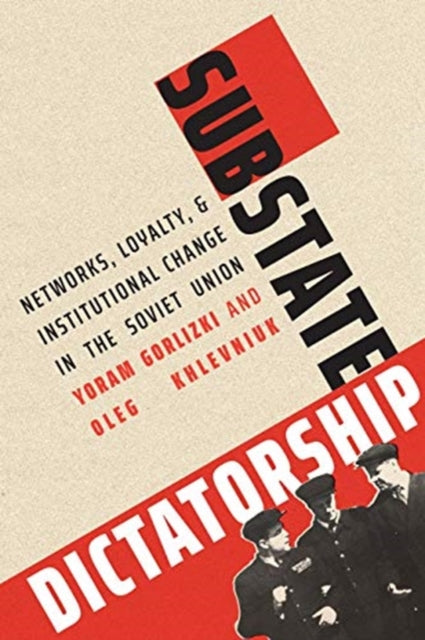
Yoram Gorlizki,Oleg Khlevniuk
Substate Dictatorship: Networks, Loyalty, and Institutional Change in the Soviet Union
Substate Dictatorship: Networks, Loyalty, and Institutional Change in the Soviet Union
YOU SAVE £0.88
- Condition: Brand new
- UK Delivery times: Usually arrives within 2 - 3 working days
- UK Shipping: Fee starts at £2.39. Subject to product weight & dimension
Bulk ordering. Want 15 or more copies? Get a personalised quote and bigger discounts. Learn more about bulk orders.
Couldn't load pickup availability
- More about Substate Dictatorship: Networks, Loyalty, and Institutional Change in the Soviet Union
Gorlizki and Khlevniuk's study is a must for scholars of Stalinism and Soviet politics, providing valuable insights into how authoritarian regimes operate at the local level. They show how Soviet regional leaders used political exclusion and control of information to build local networks and rule, and how understanding these networks is key to understanding how the dictatorship as a whole operated.
Format: Hardback
Length: 464 pages
Publication date: 04 September 2020
Publisher: Yale University Press
Introduction:
In the study of authoritarian regimes, understanding the local level of governance is crucial. Local leaders play a vital role in implementing policies and maintaining control within a dictatorship, often operating without direct access to the central authorities. This research aims to explore the strategies employed by local leaders in large dictatorships and the resources they draw upon to govern.
Theory of Dictatorship:
Recent advancements in the theory of dictatorship have provided valuable insights into the dynamics of authoritarian regimes. Scholars have recognized that dictatorships are not monolithic entities but rather complex systems characterized by power struggles, conflicts, and adaptations. One key aspect of these regimes is the use of local leaders as intermediaries between the central authorities and the population.
Local Leaders in Large Dictatorships:
Yoram Gorlizki and Oleg Khlevniuk examine the role of local leaders in one of the most important authoritarian regimes of the twentieth century: the Soviet Union. The authors argue that Soviet regional leaders, lacking direct access to the means of repression, resorted to alternative strategies to build the local networks they needed to rule. These strategies included political exclusion, control of information, and the manipulation of institutions.
Political Exclusion:
One of the primary strategies employed by local leaders was political exclusion. They sought to marginalize and exclude opposition groups and individuals from the political process. This was done by creating barriers to entry into political parties, suppressing dissent, and manipulating electoral processes. By excluding opposition, local leaders were able to maintain their grip on power and prevent any challenges to their authority.
Control of Information:
In addition to political exclusion, local leaders also relied on control of information to maintain their power. They tightly regulated the media, censored information, and manipulated public opinion. This control of information allowed local leaders to shape the narrative and present a favorable image of their regime to the population. It also helped to prevent the spread of dissent and opposition movements.
Manipulation of Institutions:
Local leaders also manipulated institutions to further their own interests. They appointed loyalists to key positions in government, including the police and security services. They also used these institutions to suppress dissent and maintain control over the population. For example, they may have used the police to crack down on protests or suppress opposition groups.
Conclusion:
In conclusion, the study of local leaders in large dictatorships provides valuable insights into the strategies employed by these regimes to maintain power. By examining the resources they draw upon, such as political exclusion, control of information, and manipulation of institutions, we can better understand how the dictatorship as a whole operated. This research contributes to our understanding of authoritarian regimes and their impact on society.
Weight: 832g
Dimension: 165 x 244 x 38 (mm)
ISBN-13: 9780300230819
This item can be found in:
UK and International shipping information
UK and International shipping information
UK Delivery and returns information:
- Delivery within 2 - 3 days when ordering in the UK.
- Shipping fee for UK customers from £2.39. Fully tracked shipping service available.
- Returns policy: Return within 30 days of receipt for full refund.
International deliveries:
Shulph Ink now ships to Australia, Belgium, Canada, France, Germany, Ireland, Italy, India, Luxembourg Saudi Arabia, Singapore, Spain, Netherlands, New Zealand, United Arab Emirates, United States of America.
- Delivery times: within 5 - 10 days for international orders.
- Shipping fee: charges vary for overseas orders. Only tracked services are available for most international orders. Some countries have untracked shipping options.
- Customs charges: If ordering to addresses outside the United Kingdom, you may or may not incur additional customs and duties fees during local delivery.