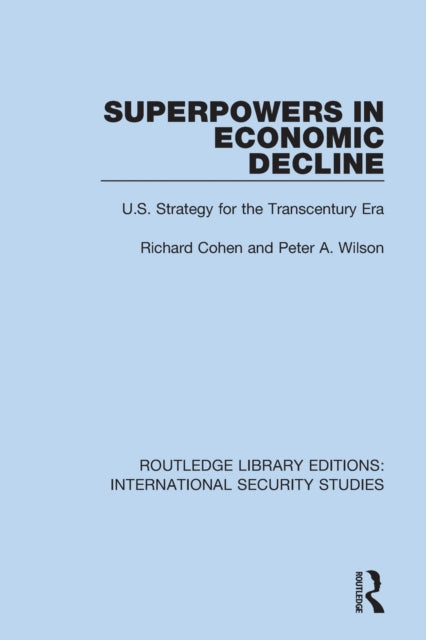
Richard Cohen,Peter A. Wilson
Superpowers in Economic Decline: U.S. Strategy for the Transcentury Era
Superpowers in Economic Decline: U.S. Strategy for the Transcentury Era
💎 Earn 160 Points (£1.60) on this item.
We can order this item for you. Delivery usually takes about 4 to 6 weeks.
This item is not held in our immediate stock. We will order it for you after checkout.
Estimated delivery: About 4 to 6 weeks
YOU SAVE £1.91
- Condition: Brand new
- UK Delivery times: Usually arrives within 2 - 3 working days
- UK Shipping: Fee starts at £2.39. Subject to product weight & dimension
Bulk ordering. Want 15 or more copies? Get a personalised quote and bigger discounts. Learn more about bulk orders.
Couldn't load pickup availability
- More about Superpowers in Economic Decline: U.S. Strategy for the Transcentury Era
This book evaluates the future policy adjustments the US will need to make to navigate a national security environment shaped by economic performance. It discusses the threat, the Soviet Union's response, and the resources available to the US.
Format: Paperback / softback
Length: 288 pages
Publication date: 15 October 2022
Publisher: Taylor & Francis Ltd
This book, first published in 1990, evaluates the future policy adjustments the United States will need to make to successfully navigate a national security environment that has been radically altered from the past and is more than ever determined by the economic performance of both superpowers. The book's structure revolves around two critical issues that will shape the future national security environment the United States faces. These issues include the stakes of the threat, the Soviet Union's response to the challenge of economic and related social/political decline, and its implications for the Soviet national defense effort. Additionally, the book examines the resources available to the United States to confront the threat, the status of the US economic performance, and the magnitude of resource stress it is likely to face in the future, as well as its potential impact on the US national defense effort.
The book begins by examining the changing nature of the threat to the United States. It highlights the emergence of new threats, such as terrorism and cyber warfare, as well as the continued importance of traditional threats, such as nuclear proliferation and regional conflicts. The author argues that the United States must adapt its policies and strategies to address these new and evolving threats effectively.
Next, the book explores the Soviet Union's response to the challenge of economic and related social/political decline. It discusses the Soviet Union's efforts to modernize its economy, reduce military spending, and improve its social welfare programs. The author analyzes the implications of these efforts for the Soviet national defense effort, including the potential for increased vulnerability and reduced capabilities.
The book also examines the resources available to the United States to meet the threat. It discusses the US military's capabilities and resources, as well as the economic and technological resources available to the United States. The author analyzes the strengths and weaknesses of these resources and assesses their ability to meet the challenges posed by the threat.
Furthermore, the book examines the status of the US economic performance and the magnitude of resource stress it is likely to face in the future. It discusses the impact of globalization, technological advancements, and demographic changes on the US economy and assesses the potential for economic downturn. The author argues that the US economy is likely to face significant challenges in the future, including income inequality, debt, and resource depletion, which could have implications for the US national defense effort.
Finally, the book discusses the potential impact of resource stress on the US national defense effort. It analyzes the potential for resource conflicts, economic instability, and political instability to undermine the US's ability to defend itself and its interests. The author argues that the United States must prioritize its resources and develop strategies to mitigate the potential negative impacts of resource stress on the US national defense effort.
In conclusion, this book provides a comprehensive analysis of the future policy adjustments the United States will need to make to successfully navigate a national security environment that has been radically altered from the past and is more than ever determined by the economic performance of both superpowers. The book highlights the importance of adapting policies and strategies to address new and evolving threats, as well as the need to prioritize resources and develop strategies to mitigate the potential negative impacts of resource stress on the US national defense effort. The book is a valuable resource for policymakers, scholars, and anyone interested in understanding the complex relationship between national security and economic performance.
Weight: 539g
Dimension: 234 x 156 (mm)
ISBN-13: 9780367711665
This item can be found in:
UK and International shipping information
UK and International shipping information
UK Delivery and returns information:
- Delivery within 2 - 3 days when ordering in the UK.
- Shipping fee for UK customers from £2.39. Fully tracked shipping service available.
- Returns policy: Return within 30 days of receipt for full refund.
International deliveries:
Shulph Ink now ships to Australia, Belgium, Canada, France, Germany, Ireland, Italy, India, Luxembourg Saudi Arabia, Singapore, Spain, Netherlands, New Zealand, United Arab Emirates, United States of America.
- Delivery times: within 5 - 10 days for international orders.
- Shipping fee: charges vary for overseas orders. Only tracked services are available for most international orders. Some countries have untracked shipping options.
- Customs charges: If ordering to addresses outside the United Kingdom, you may or may not incur additional customs and duties fees during local delivery.