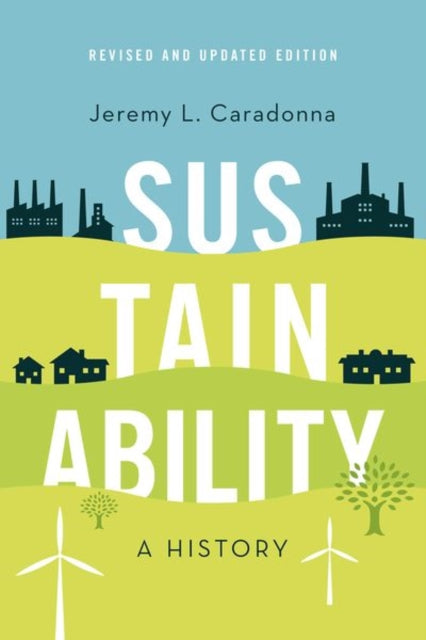
Jeremy L.Caradonna
Sustainability: A History, Revised and Updated Edition
Sustainability: A History, Revised and Updated Edition
💎 Earn 212 Points (£2.12) on this item.
- Condition: Brand new
- UK Delivery times: Usually arrives within 2 - 3 working days
- UK Shipping: Fee starts at £2.39. Subject to product weight & dimension
Bulk ordering. Want 15 or more copies? Get a personalised quote and bigger discounts. Learn more about bulk orders.
Couldn't load pickup availability
- More about Sustainability: A History, Revised and Updated Edition
A fully updated introduction to the sustainability movement from the 1600s to today, by one of the world's leading experts on the subject. The book traces the origins of sustainability across many fields throughout Europe and North America, and reveals how it progressed from a marginal concept to an ideal that shapes everything from individual lifestyles, government and corporate strategies, and even national and international policy.
Format: Hardback
Length: 352 pages
Publication date: 07 July 2022
Publisher: Oxford University Press Inc
Sustainability has become a widely recognized concept across various domains, from grocery shopping to global policy discussions. It encompasses a range of ideas and practices aimed at promoting long-term stability and well-being for both local and global communities. This movement has its roots in historical contexts, dating back several centuries. In his comprehensive book, "Sustainability: A Historical Introduction," Jeremy L. Caradonna delves into the origins and evolution of sustainability, tracing its development across Europe and North America.
Caradonna begins by exploring the concept's roots in the 1660s, examining the early thoughts and ideas that shaped sustainable yield forestry. He then takes us through the challenges of the Industrial Revolution, the emergence of the environmental movement, and the subsequent efforts to promote a balanced approach to development in the latter half of the 20th century. Through this historical lens, Caradonna demonstrates that sustainability is more than the sum of its parts; it blends social justice, ecological economics, and environmental conservation into a dynamic philosophy.
One of the key insights of the book is that sustainability has evolved from a relatively niche concern to a mainstream movement that has gained significant momentum century. This transformation has been driven by a growing awareness of the interconnectedness of human activities and the planet's ecosystems, as well as the urgent need to address climate change and other environmental challenges. Sustainability has also been influenced by various social movements.
One of the key challenges facing sustainability is the need to balance economic growth, social development, and environmental conservation. This requires a shift towards more sustainable and circular economic models, as well as policies and practices that promote social equity and inclusion while protecting and preserving natural resources. Another challenge is the need to address the global distribution of resources and wealth, which has led to significant disparities and inequalities.
Despite these challenges, there are numerous examples of sustainability initiatives and practices that are making a positive impact on the planet. These include renewable energy technologies, sustainable agriculture practices, urban planning, and the promotion of sustainable lifestyles. By adopting sustainable practices and promoting sustainable development, we can create a more resilient and sustainable future for ourselves and future generations.
In conclusion, "Sustainability: A Historical Introduction" provides a comprehensive and insightful exploration of the sustainability movement, from its historical roots.
Sustainability has become a widely recognized concept across various domains, from grocery shopping to global policy discussions. It encompasses a range of ideas and practices aimed at promoting long-term stability and well-being for both local and global communities. This movement has its roots.
Sustainability has become a widely recognized concept across various domains, from grocery shopping to global policy discussions. It encompasses a range the range of ideas and practices aimed at promoting long-term stability and well-being for both local and global communities. This movement has its roots in historical contexts, dating back several centuries. In his comprehensive book, "Sustainability: A Historical Introduction," Jeremy L. Caradonna delves into the origins and evolution of sustainability, tracing its development across Europe and North America.
Caradonna begins by exploring the concept's roots in the 1660s, examining the early thoughts and ideas that shaped sustainable yield forestry. He then takes us through the challenges of the Industrial Revolution, the emergence of the environmental movement, and the subsequent efforts to promote a balanced approach to development in the latter half of the 20th century. Through this historical lens, Caradonna demonstrates that sustainability is more than the sum of its parts; it blends social justice, ecological economics, and environmental conservation into a dynamic philosophy.
One of the key insights of the book is that sustainability has evolved from a relatively niche concern to a mainstream movement that has gained significant momentum century. This transformation has been driven by a growing awareness of the interconnected the interconnectedness of human activities and the planet's ecosystems, as well as the urgent need to address climate change and other environmental challenges. Sustainability has also been influenced by various social factors.
One of the key challenges facing sustainability is the need to balance economic growth.
Sustainability has become a widely recognized concept across various domains, from grocery shopping to global policy discussions. It encompasses a range of ideas and practices aimed at promoting long-term stability and well-being for both local and global communities. This movement has its roots in historical contexts.
Sustainability has become a widely recognized concept across various domains, from grocery shopping to global policy discussions. It encompasses a range of ideas and practices aimed at promoting long-term stability and well-being for both local and global communities. This movement has its roots.
Sustainability has become a widely recognized concept across various domains, from grocery shopping to global policy discussions. It encompasses a range of ideas and practices aimed at promoting long-term stability and well-being for both local and global communities. This movement has its roots in historical contexts, dating back several centuries. In his comprehensive book, "Sustainability: A Historical Introduction," Jeremy L. Caradonna delves into the origins.
Caradonna begins by exploring the concept's roots in the 1660s, examining the early thoughts and ideas that shaped sustainable yield forestry. He then takes us through the challenges of the Industrial Revolution, the emergence of the environmental movement, and the subsequent efforts to promote a balanced approach to development in the latter half of the 20th century. Through this historical lens, Caradonna demonstrates that sustainability is more than the sum of its parts; it blends social justice, ecological economics, and environmental conservation into a dynamic philosophy.
One of the key insights of the book, the book is that sustainability has evolved from a relatively niche concern to a mainstream movement that has gained significant century. This transformation has been driven by a growing awareness of the interconnectedness of human activities and the planet's ecosystems, as well as the urgent need to address climate change and other environmental challenges. Sustainability has also been influenced by various social.
One of the key challenges facing sustainability is the need to balance economic growth, social development, and environmental conservation. This requires a shift towards more sustainable and circular economic models, as well as policies and practices that promote social equity and inclusion while protecting and preserving natural resources. Another challenge is the need to address the global distribution of resources and wealth, which has led to significant disparities and inequalities.
Despite these challenges, there are numerous examples of sustainability initiatives and practices that are making a positive impact on the planet. These include renewable energy technologies, sustainable agriculture practices, urban planning, and the promotion of sustainable lifestyles. By adopting sustainable practices and promoting sustainable development, we can create a more resilient and sustainable future for ourselves and future generations.
In conclusion, "Sustainability: A Historical Introduction" provides a comprehensive and insightful exploration of the sustainability movement, from its historical.
ISBN-13: 9780197625026
UK and International shipping information
UK and International shipping information
UK Delivery and returns information:
- Delivery within 2 - 3 days when ordering in the UK.
- Shipping fee for UK customers from £2.39. Fully tracked shipping service available.
- Returns policy: Return within 30 days of receipt for full refund.
International deliveries:
Shulph Ink now ships to Australia, Belgium, Canada, France, Germany, Ireland, Italy, India, Luxembourg Saudi Arabia, Singapore, Spain, Netherlands, New Zealand, United Arab Emirates, United States of America.
- Delivery times: within 5 - 10 days for international orders.
- Shipping fee: charges vary for overseas orders. Only tracked services are available for most international orders. Some countries have untracked shipping options.
- Customs charges: If ordering to addresses outside the United Kingdom, you may or may not incur additional customs and duties fees during local delivery.