Uri Alon
Systems Medicine: Physiological Circuits and the Dynamics of Disease
Systems Medicine: Physiological Circuits and the Dynamics of Disease
💎 Earn 811 Points (£8.11) on this item.
We can order this item for you. Delivery usually takes about 4 to 6 weeks.
This item is not held in our immediate stock. We will order it for you after checkout.
Estimated delivery: About 4 to 6 weeks
YOU SAVE £9.63
- Condition: Brand new
- UK Delivery times: Usually arrives within 2 - 3 working days
- UK Shipping: Fee starts at £2.39. Subject to product weight & dimension
Bulk ordering. Want 15 or more copies? Get a personalised quote and bigger discounts. Learn more about bulk orders.
Couldn't load pickup availability
- More about Systems Medicine: Physiological Circuits and the Dynamics of Disease
The book "Why We Get Certain Diseases and Other Diseases Do Not" explains the underlying reasons for why certain diseases exist and others do not, using systems biology and mathematical models. It explores hormone circuits, immune circuits, and aging and age-related diseases, and provides a periodic table of diseases. The author writes in a accessible style that is suitable for a broad range of readers, including undergraduates, graduates, and researchers.
Format: Hardback
Length: 256 pages
Publication date: 05 December 2023
Publisher: Taylor & Francis Ltd
Why do we get certain diseases, whereas other diseases do not exist?
In this book, Alon, one of the founders of systems biology, builds a foundation for systems medicine. Starting from basic laws, the book derives why physiological circuits are built the way they are. The circuits have fragilities that explain specific diseases and offer new strategies to treat them.
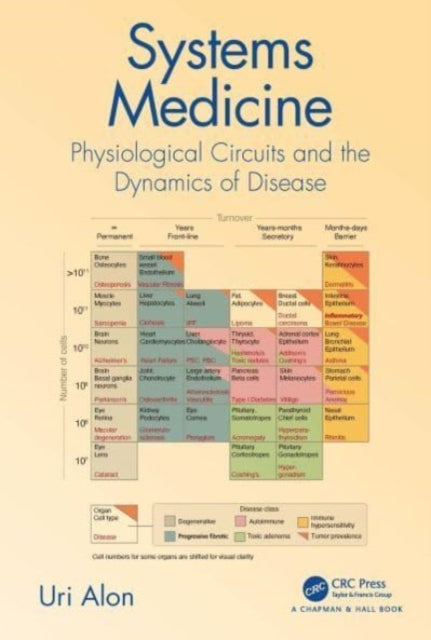
By the end, the reader will be able to use simple and powerful mathematical models to describe physiological circuits. The book explores, in three parts, hormone circuits, immune circuits, and aging and age-related disease. It culminates in a periodic table of diseases.
Alon writes in a style accessible to a broad range of readers - undergraduates, graduates, or researchers from computational or biological backgrounds. The level of math is friendly, and the math can even be bypassed altogether. For instructors and readers who want to go deeper, the book includes dozens of exercises that have been rigorously tested in the classroom.
Hormone circuits:
The book begins with a discussion of hormone circuits, which are essential for regulating many physiological processes. Alon explains how hormones are produced by glands and how they are transported throughout the body via blood vessels. He also discusses how hormones interact with receptors on target cells to elicit specific responses.
Alon then discusses the role of hormone circuits in regulating metabolism, reproduction, and the immune system. He explains how hormones such as insulin, glucagon, and thyroid hormones regulate blood sugar levels, energy expenditure, and metabolism. He also discusses how hormones such as estrogen and progesterone regulate reproduction and how the immune system is regulated by hormones such as cytokines and interleukins.
Alon also discusses the fragilities of hormone circuits, which can lead to diseases such as diabetes, obesity, and infertility. He explains how hormone imbalances can lead to insulin resistance, which can lead to diabetes, and how obesity can lead to insulin resistance and other metabolic disorders. He also discusses how infertility can be caused by hormone imbalances, such as hypothyroidism.
Alon then discusses how hormone circuits can be manipulated to treat diseases. He explains how hormone replacement therapy can be used to treat hypothyroidism and how insulin therapy can be used to treat diabetes. He also discusses how dietary changes can be used to regulate hormone levels and how exercise can be used to improve insulin sensitivity.
Immune circuits:
The book then discusses immune circuits, which are essential for protecting the body from pathogens. Alon explains how immune cells are produced and how they interact with each other to mount an immune response. He also discusses how immune circuits can be manipulated to treat diseases such as cancer and autoimmune diseases.
Alon explains how immune cells are produced by stem cells in the bone marrow and how they differentiate into different types of immune cells. He also discusses how immune cells interact with each other to mount an immune response, such as by producing antibodies and cytokines.
Alon then discusses the role of immune circuits in regulating inflammation and immunity. He explains how immune cells can cause inflammation, which can lead to diseases such as arthritis and asthma, and how immune cells can suppress inflammation, which can lead to autoimmune diseases. He also discusses how immune circuits can be manipulated to treat diseases such as cancer and autoimmune diseases.
Alon also discusses the fragilities of immune circuits, which can lead to diseases such as allergies and autoimmune diseases. He explains how immune cells can become overactive and cause inflammation, which can lead to allergies, and how autoimmune diseases can be caused by immune cells attacking the body's own tissues.
Alon then discusses how immune circuits can be manipulated to treat diseases. He explains how immune checkpoint inhibitors can be used to treat cancer and how immunosuppressive drugs can be used to treat autoimmune diseases. He also discusses how dietary changes can be used to regulate immune function and how exercise can be used to improve immune health.
Aging and age-related disease:
The book then discusses aging and age-related disease, which are major health concerns for many people. Alon explains how aging is caused by the accumulation of damage to cells and tissues over time and how this damage can lead to diseases such as cancer, Alzheimer's disease, and Parkinson's disease.
Alon explains how aging is caused by the accumulation of damage to cells and tissues over time. He explains how free radicals, which are produced by the body's metabolism, can damage cells and tissues and how this damage can lead to the development of cancer, Alzheimer's disease, and Parkinson's disease. He also explains how oxidative stress, which is caused by the accumulation of free radicals, can damage cells and tissues and how this damage can lead to the development of cancer, Alzheimer's disease, and Parkinson's disease.
Alon then discusses how aging and age-related disease can be treated. He explains how antioxidants, which can neutralize free radicals, can be used to protect cells and tissues from damage and how anti-inflammatory drugs can be used to reduce inflammation and reduce the risk of disease. He also explains how lifestyle changes, such as a healthy diet and regular exercise, can be used to reduce the risk of disease and improve overall health.
Alon also discusses the fragilities of aging and age-related disease, which can lead to diseases such as cancer, Alzheimer's disease, and Parkinson's disease. He explains how genetic factors can increase the risk of disease and how environmental factors, such as exposure to toxins, can increase the risk of disease. He also discusses how lifestyle factors, such as smoking and excessive alcohol consumption, can increase the risk of disease.
Alon then discusses how aging and age-related disease can be prevented. He explains how genetic factors can be manipulated to reduce the risk of disease and how environmental factors can be avoided to reduce the risk of disease. He also explains how lifestyle factors, such as a healthy diet and regular exercise, can be used to reduce the risk of disease and improve overall health.
Conclusion:
In conclusion, this book provides a comprehensive and accessible introduction to systems medicine, which is a new approach to understanding and treating diseases. By understanding the fragilities of physiological circuits, which can lead to specific diseases, the book offers new strategies to treat these diseases. The book is accessible to a broad range of readers, including undergraduates, graduates, and researchers from computational or biological backgrounds, and includes dozens of exercises that have been rigorously tested in the classroom.
By understanding the fragilities of physiological circuits, which can lead to specific diseases, the book offers new strategies to treat these diseases. The book is accessible to a broad range of readers, including undergraduates, graduates, and researchers from computational or biological backgrounds, and includes dozens of exercises that have been rigorously tested in the classroom.
Dimension: 254 x 178 (mm)
ISBN-13: 9781032412283
UK and International shipping information
UK and International shipping information
UK Delivery and returns information:
- Delivery within 2 - 3 days when ordering in the UK.
- Shipping fee for UK customers from £2.39. Fully tracked shipping service available.
- Returns policy: Return within 30 days of receipt for full refund.
International deliveries:
Shulph Ink now ships to Australia, Belgium, Canada, France, Germany, Ireland, Italy, India, Luxembourg Saudi Arabia, Singapore, Spain, Netherlands, New Zealand, United Arab Emirates, United States of America.
- Delivery times: within 5 - 10 days for international orders.
- Shipping fee: charges vary for overseas orders. Only tracked services are available for most international orders. Some countries have untracked shipping options.
- Customs charges: If ordering to addresses outside the United Kingdom, you may or may not incur additional customs and duties fees during local delivery.