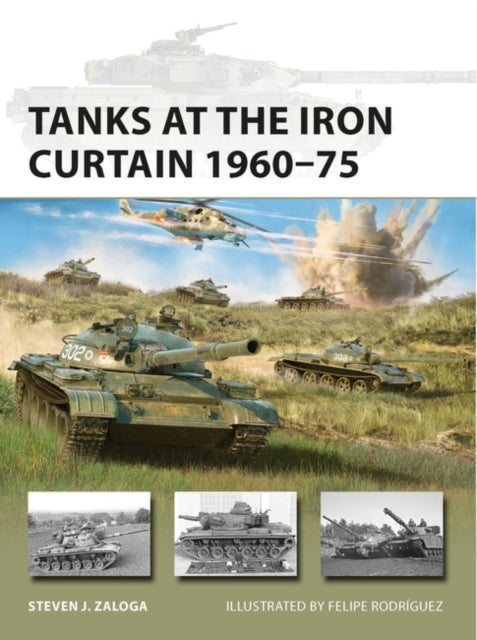
Steven J. Zaloga
Tanks at the Iron Curtain 1960-75
Tanks at the Iron Curtain 1960-75
💎 Earn 45 Points (£0.45) on this item.
YOU SAVE £3.80
- Condition: Brand new
- UK Delivery times: Usually arrives within 2 - 3 working days
- UK Shipping: Fee starts at £3.89. Subject to product weight & dimension
Bulk ordering. Want 15 or more copies? Get a personalised quote and bigger discounts. Learn more about bulk orders.
Couldn't load pickup availability
- More about Tanks at the Iron Curtain 1960-75
A new analysis of the technology and tanks that faced off against each other on opposite sides of the Iron Curtain during the Cold War, focusing on the generational shift in tank design and warfare with CBR protection and APFSDS ammunition. Soviet heavy tanks and tank destroyer/assault guns became obsolete, while NATO forces employed the Chieftain, AMX-30, Leopard I, and M60.
Format: Paperback / softback
Length: 48 pages
Publication date: 21 July 2022
Publisher: Bloomsbury Publishing PLC
A comprehensive examination of the technology and tanks that clashed on opposing sides of the Iron Curtain during the height of the Cold War is presented in this new analysis. Beginning in the 1960s, there was a significant shift in tank design and warfare with the introduction of CBR (chemical, biological, radiological) protection and a shift away from HEAT ammunition to APFSDS. This shift was in response to the growing threat posed by guided anti-tank missiles, which necessitated the development of composite armor. Soviet heavy tanks and tank destroyer/assault guns became obsolete, giving way to the technological prowess of the T-62 and T-64, while NATO forces employed the Chieftain, AMX-30, Leopard I, and M60, as well as the initial attempt at a common US-German tank, the MBT-70.
This companion volume to NVG 301, Tanks at the Iron Curtain 1946 – 60, focuses on key battle tanks and their technology to provide a comprehensive overview of how tanks developed during modern times. Detailed illustrations and contemporary photographs are used to showcase the evolution of these vehicles and their impact on warfare.
The introduction of CBR protection in the 1960s marked a significant milestone in tank design. Prior to this, tanks were primarily equipped with HEAT ammunition, which relied on the heat generated by the projectile to penetrate enemy armor. However, the development of chemical, biological, and radiological (CBR) weapons posed a significant threat to tank crews, as they could be deployed without warning and could cause incapacitation or even death.
To address this threat, tank designers began incorporating CBR protection into their designs. This included the use of NBC (nuclear, biological, and chemical) filters, which filtered out harmful gases and particles, and the installation of sealed compartments to protect crew members from chemical and biological agents.
Another significant change in tank design was the shift away from HEAT ammunition to APFSDS (Armor-Piercing, Fin-Stabilized, Discarding Sabot) ammunition. APFSDS ammunition was designed to penetrate the thick armor of modern tanks, such as the T-62 and T-64, which were equipped with composite armor. The use of APFSDS ammunition allowed NATO forces to effectively engage Soviet heavy tanks, which had previously been considered invincible.
Composite armor was another important development in tank design during the Cold War. Composite armor was made up of a combination of steel and ceramic materials, which were more resistant to penetration than traditional steel armor. This allowed tanks to withstand the impact of high-velocity projectiles, such as anti-tank missiles, without being damaged.
The introduction of composite armor also had a significant impact on the design of tank destroyer/assault guns. These weapons were designed to engage and destroy enemy tanks, and they were typically equipped with powerful guns that could penetrate the thick armor of modern tanks. However, the use of composite armor made it more difficult for tank destroyer/assault guns to penetrate enemy tanks, and they were often equipped with specialized ammunition, such as HEAT or APFSDS, to overcome this challenge.
One of the most significant developments in tank design during the Cold War was the introduction of guided anti-tank missiles. These missiles were designed to be launched from long distances and guided by radar or other sensors to their target. They posed a significant threat to tank crews, as they could be launched without warning and could penetrate the thick armor of modern tanks.
To address this threat, tank designers began incorporating countermeasures into their designs. These included the use of active protection systems, which used sensors to detect and neutralize incoming missiles, and the installation of reactive armor, which was designed to absorb the impact of incoming missiles.
In conclusion, the Cold War was a period of significant technological development in tank design and warfare. The introduction of CBR protection, the shift away from HEAT ammunition to APFSDS, and the development of composite armor were all important developments that allowed tanks to withstand the growing threat posed by guided anti-tank missiles. The introduction of guided anti-tank missiles also led to the development of countermeasures, such as active protection systems and reactive armor, which allowed tank crews to effectively engage enemy tanks.
Weight: 168g
Dimension: 185 x 247 x 6 (mm)
ISBN-13: 9781472848161
UK and International shipping information
UK and International shipping information
We deliver throughout the United Kingdom and to 128 countries and territories worldwide, including the United States, Australia, Canada, Germany, Spain and France.