The AEJMC Media Ethics Division
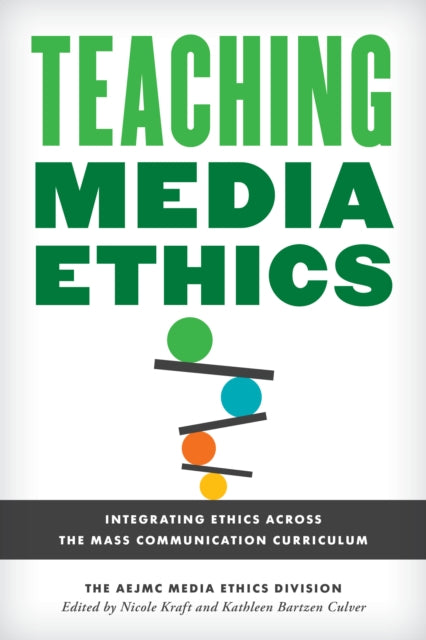
Teaching Media Ethics: Integrating Ethics Across the Mass Communication Curriculum
Teaching Media Ethics: Integrating Ethics Across the Mass Communication Curriculum
💎 Earn 331 Points (£3.31) on this item.
We can order this item for you. Delivery usually takes about 4 to 6 weeks.
This item is not held in our immediate stock. We will order it for you after checkout.
Estimated delivery: About 4 to 6 weeks
YOU SAVE £8.62
- Condition: Brand new
- UK Delivery times: Usually arrives within 2 - 3 working days
- UK Shipping: Fee starts at £2.39. Subject to product weight & dimension
Bulk ordering. Want 15 or more copies? Get a personalised quote and bigger discounts. Learn more about bulk orders.
Couldn't load pickup availability
- More about Teaching Media Ethics: Integrating Ethics Across the Mass Communication Curriculum
Teaching Media Ethics provides journalism and mass communication instructors with ideas and tools to effectively incorporate media ethics into courses across the curriculum, covering ethics-intensive courses, incorporating ethics into other classes, and addressing key specializations and critical issues. It emphasizes practical advice and suggestions for activities and resources and is the only book of its kind in the realm of media ethics.
Format: Hardback
Length: 208 pages
Publication date: 15 December 2023
Publisher: Rowman & Littlefield
Teaching Media Ethics provides journalism and mass communication instructors with the necessary ideas and tools to effectively integrate media ethics into their courses across the curriculum. It covers ethics-intensive courses from undergraduate to graduate levels, as well as how to incorporate ethics into other classes related to reporting and strategic communication. The volume includes nine chapters focused on key specializations, such as sports and social media, and critical issues, such as reporting on mental health. It offers thought-provoking chapters on diversifying the ethics curriculum, inclusive teaching practices, and challenges to traditional notions of media ethics.
One of the unique features of Teaching Media Ethics is that it is the only book of its kind in the realm of media ethics. Its primary goal is not to teach students directly, but rather to "teach teachers" how to address ethics in their own classrooms and engage students effectively. The authors, leading ethicists and award-winning teachers, approached their chapters with an emphasis on making it as easy as possible to deliver teaching in ethics.
Teaching Media Ethics has something for instructors at all stages of their careers and should be particularly useful to graduate students and faculty who are developing their approaches to journalism and mass communication classes. The chapters are organized in a clear and concise manner, making it easy to follow and understand. The authors provide practical advice and suggestions for activities and resources that can help instructors incorporate ethics into their courses.
One of the key themes of Teaching Media Ethics is the importance of diversity in the ethics curriculum. The authors argue that the ethics curriculum should be inclusive of all students, regardless of their background, ethnicity, or gender. They provide examples of how to incorporate diversity into the curriculum, such as using case studies that reflect different perspectives and experiences.
Inclusive teaching practices are also emphasized in Teaching Media Ethics. The authors argue that instructors should create a safe and supportive learning environment for all students, regardless of their background or beliefs. They provide examples of how to create inclusive classrooms, such as using active learning techniques and providing feedback that is constructive and supportive.
Challenges to traditional notions of media ethics are also discussed in Teaching Media Ethics. The authors argue that traditional notions of media ethics are often based on outdated and simplistic assumptions about the media. They provide examples of how to challenge these assumptions and develop a more nuanced and complex understanding of media ethics.
One of the challenges to traditional notions of media ethics is the impact of social media on journalism and mass communication. The authors argue that social media has created new challenges for journalists and media professionals, such as the need to be constantly connected and the risk of spreading misinformation. They provide examples of how to address these challenges and develop ethical practices for social media use.
Another challenge to traditional notions of media ethics is the impact of globalization on journalism and mass communication. The authors argue that globalization has created new opportunities for journalists and media professionals, but it has also created new challenges, such as the need to navigate complex cultural and political landscapes. They provide examples of how to address these challenges and develop ethical practices for global journalism.
In addition to the chapters on ethics-intensive courses and critical issues, Teaching Media Ethics also includes chapters on teaching methods and strategies. The authors provide examples of how to use different teaching methods, such as case studies, simulations, and group discussions, to engage students in ethical discussions. They also provide examples of how to use technology to enhance teaching in ethics, such as online courses and virtual classrooms.
One of the strengths of Teaching Media Ethics is its practical approach to teaching ethics. The authors provide examples of how to apply ethical principles to real-world situations, such as reporting on a controversial issue or dealing with a conflict of interest. They also provide examples of how to address ethical issues that may arise in the classroom, such as plagiarism or cheating.
Another strength of Teaching Media Ethics is its emphasis on the importance of ethical decision-making. The authors argue that ethical decision-making is a critical skill for journalists and media professionals, and they provide examples of how to develop ethical decision-making skills. They also provide examples of how to address ethical dilemmas that may arise in the classroom, such as when a student violates a school policy or when a teacher is faced with a conflict of interest.
In conclusion, Teaching Media Ethics provides journalism and mass communication instructors with the necessary ideas and tools to effectively integrate media ethics into their courses across the curriculum. It covers ethics-intensive courses from undergraduate to graduate levels, as well as how to incorporate ethics into other classes related to reporting and strategic communication. The volume includes nine chapters focused on key specializations, such as sports and social media, and critical issues, such as reporting on mental health. It offers thought-provoking chapters on diversifying the ethics curriculum, inclusive teaching practices, and challenges to traditional notions of media ethics. Whether you are a graduate student or a faculty member, Teaching Media Ethics is a valuable resource that can help you develop your approach to journalism and mass communication classes.
Dimension: 229 x 152 (mm)
ISBN-13: 9781538183069
This item can be found in:
UK and International shipping information
UK and International shipping information
UK Delivery and returns information:
- Delivery within 2 - 3 days when ordering in the UK.
- Shipping fee for UK customers from £2.39. Fully tracked shipping service available.
- Returns policy: Return within 30 days of receipt for full refund.
International deliveries:
Shulph Ink now ships to Australia, Belgium, Canada, France, Germany, Ireland, Italy, India, Luxembourg Saudi Arabia, Singapore, Spain, Netherlands, New Zealand, United Arab Emirates, United States of America.
- Delivery times: within 5 - 10 days for international orders.
- Shipping fee: charges vary for overseas orders. Only tracked services are available for most international orders. Some countries have untracked shipping options.
- Customs charges: If ordering to addresses outside the United Kingdom, you may or may not incur additional customs and duties fees during local delivery.