Shulph Ink
Technology and Tools in Engineering Education: Research and Innovations
Technology and Tools in Engineering Education: Research and Innovations
💎 Earn 689 Points (£6.89) on this item.
We can order this item for you. Delivery usually takes about 4 to 6 weeks.
This item is not held in our immediate stock. We will order it for you after checkout.
Estimated delivery: About 4 to 6 weeks
YOU SAVE £8.18
- Condition: Brand new
- UK Delivery times: Usually arrives within 2 - 3 working days
- UK Shipping: Fee starts at £2.39. Subject to product weight & dimension
Bulk ordering. Want 15 or more copies? Get a personalised quote and bigger discounts. Learn more about bulk orders.
Couldn't load pickup availability
- More about Technology and Tools in Engineering Education: Research and Innovations
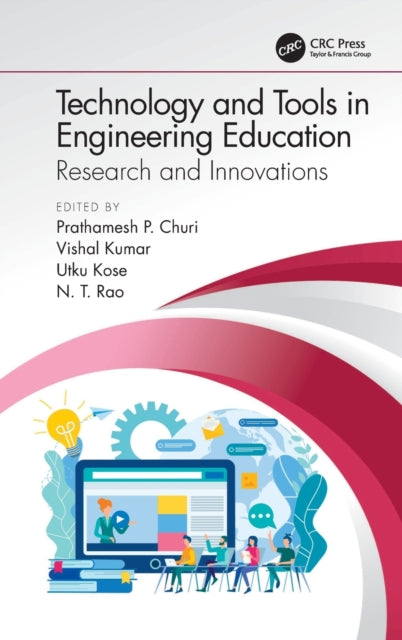
This book provides a comprehensive overview of engineering education, covering various aspects such as pedagogy, case studies, classroom practices, accreditation, and innovative strategies. It also explores cost-effective technologies and open-source tools for low-income educational institutions.
\n Format: Hardback
\n Length: 216 pages
\n Publication date: 28 October 2021
\n Publisher: Taylor & Francis Ltd
\n
Rewritten text:
Engineering education plays a crucial role in shaping the future of society by providing students with the skills and knowledge necessary to address complex technical challenges. In this comprehensive essay, we will explore the various aspects of engineering education, including its pedagogy, case studies, classroom practices, innovative strategies, accreditation bodies, cost-effective technologies, and open-source tools.
Pedagogy:
Engineering education employs a diverse range of pedagogical approaches to ensure students acquire the necessary skills and knowledge. These approaches include lectures, laboratory experiments, project-based learning, and collaborative learning. Lectures provide students with a theoretical foundation, while laboratory experiments allow them to apply theoretical concepts in practical settings. Project-based learning encourages students to work on real-world problems, develop critical thinking skills, and apply their knowledge to solve complex issues. Collaborative learning promotes teamwork, communication, and problem-solving abilities among students.
Case Studies and Classroom Practices:
Engineering institutions use case studies and classroom practices to enhance students' understanding of engineering principles and applications. Case studies provide students with real-world scenarios and problems that they must solve using engineering principles and techniques. Classroom practices involve hands-on activities, group projects, and simulations that allow students to apply their knowledge and skills in a practical setting. These practices help students develop problem-solving abilities, critical thinking skills, and teamwork skills.
Innovative Strategies:
Engineering education has embraced innovative strategies to adapt to the changing needs of society and the industry. One of these strategies is the use of technology, including virtual reality, augmented reality, and online learning platforms. Virtual reality allows students to experience realistic engineering scenarios and simulations, while augmented reality provides hands-on learning experiences in real-world environments. Online learning platforms provide students with access to educational resources and courses from anywhere in the world, enabling them to learn at their own pace and convenience.
Accreditation Bodies:
Engineering education is regulated and accredited by various national and international accreditation bodies. These bodies ensure that engineering programs meet certain quality standards and provide students with a rigorous education. Accreditation bodies include the Accreditation Board for Engineering and Technology (ABET), the Council for Higher Education Accreditation (CHEA), and the Institute of Electrical and Electronics Engineers (IEEE).
Cost-Effective Technologies:
Engineering education can be costly, particularly for low-income educational institutions. However, there are several cost-effective technologies and open-source tools that can be used to enhance engineering education. These technologies include low-cost computers, open-source software, and online educational resources. Low-cost computers allow students to access powerful computing resources, while open-source software provides students with access to high-quality software tools and resources. Online educational resources, such as open courseware and educational videos, provide students with access to high-quality educational materials at no cost.
Open-Source Tools:
Open-source tools are software tools that are freely available for anyone to use, modify, and distribute. Open-source tools have been used in engineering education to enhance teaching and learning. These tools include software for simulation, modeling, and visualization, as well as programming languages such as Python, C++, and Java. Open-source tools allow students to develop their skills and knowledge in a cost-effective manner, and they also promote collaboration and innovation among students.
Conclusion:
Engineering education plays a crucial role in shaping the future of society by providing students with the skills and knowledge necessary to address complex technical challenges. In this comprehensive essay, we have explored the various aspects of engineering education, including its pedagogy, case studies, classroom practices, innovative strategies, accreditation bodies, cost-effective technologies, and open-source tools. By embracing innovative strategies, such as technology, case studies, and classroom practices, engineering education can provide students with a rigorous and relevant education that prepares them for the challenges of the 21st century.
\n Weight: 492g\n
Dimension: 160 x 242 x 21 (mm)\n
ISBN-13: 9780367607746\n \n
This item can be found in:
UK and International shipping information
UK and International shipping information
UK Delivery and returns information:
- Delivery within 2 - 3 days when ordering in the UK.
- Shipping fee for UK customers from £2.39. Fully tracked shipping service available.
- Returns policy: Return within 30 days of receipt for full refund.
International deliveries:
Shulph Ink now ships to Australia, Belgium, Canada, France, Germany, Ireland, Italy, India, Luxembourg Saudi Arabia, Singapore, Spain, Netherlands, New Zealand, United Arab Emirates, United States of America.
- Delivery times: within 5 - 10 days for international orders.
- Shipping fee: charges vary for overseas orders. Only tracked services are available for most international orders. Some countries have untracked shipping options.
- Customs charges: If ordering to addresses outside the United Kingdom, you may or may not incur additional customs and duties fees during local delivery.