Carl Benedikt Frey
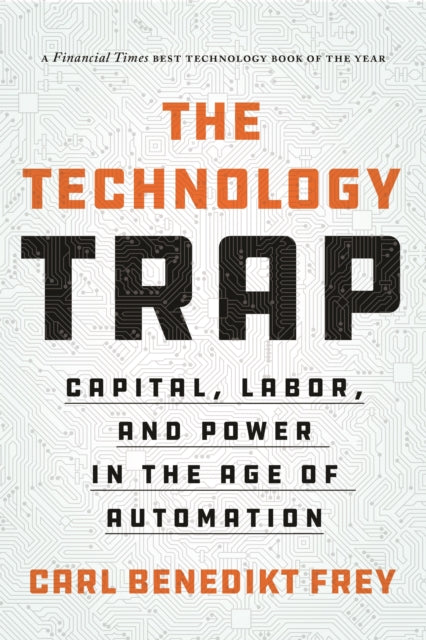
Technology Trap: Capital, Labor, and Power in the Age of Automation
Technology Trap: Capital, Labor, and Power in the Age of Automation
💎 Earn 60 Points (£0.60) on this item.
YOU SAVE £2.97
- Condition: Brand new
- UK Delivery times: Usually arrives within 2 - 3 working days
- UK Shipping: Fee starts at £2.39. Subject to product weight & dimension
Bulk ordering. Want 15 or more copies? Get a personalised quote and bigger discounts. Learn more about bulk orders.
Couldn't load pickup availability
- More about Technology Trap: Capital, Labor, and Power in the Age of Automation
The Technology Trap explores the history of technological revolutions and how they have shifted economic and political power, with the Industrial Revolution creating wealth and prosperity but also devastating for many. Carl Benedikt Frey argues that artificial intelligence systems have the potential to bring about extraordinary benefits, but only if the short term is managed properly. The Luddite uprisings of the nineteenth century and the increasing fragmentation of society today are examples of how frustration with machines can lead to negative attitudes towards technology.
Format: Paperback / softback
Length: 488 pages
Publication date: 22 September 2020
Publisher: Princeton University Press
The history of technological revolutions can help us better understand economic and political polarization in the age of automation. From the Industrial Revolution to the age of artificial intelligence, The Technology Trap takes a sweeping look at the history of technological progress and how it has radically shifted the distribution of economic and political power among society's members. As Carl Benedikt Frey shows, the Industrial Revolution created unprecedented wealth and prosperity over the long run, but the immediate consequences of mechanization were devastating for large swaths of the population. Middle-income jobs withered, wages stagnated, the labor share of income fell, profits surged, and economic inequality skyrocketed. These trends, Frey documents, broadly mirror those in our current age of automation, which began with the Computer Revolution. Just as the Industrial Revolution eventually brought about extraordinary benefits for society, artificial intelligence systems have the potential to do the same. But Frey argues that this depends on how the short term is managed. In the nineteenth century, workers violently expressed their concerns over machines taking their jobs. The Luddite uprisings joined a long wave of machinery riots that swept across Europe and China. Today's despairing middle class has not resorted to physical force, but their frustration has led to rising populism and the increasing fragmentation of society. As middle-class jobs continue to come under pressure, there's no assurance that positive attitudes to technology will persist. The Industrial Revolution was a period of rapid technological change that transformed society in many ways. It led to the creation of new industries, the growth of cities, and the development of new technologies that have changed the way we live and work. However, the Industrial Revolution also had negative consequences, such as pollution, worker exploitation, and social inequality. The Luddite uprisings were a response to the mechanization of the textile industry in the 19th century, which led to the loss of many jobs and the displacement of workers. Today, we are facing a new wave of technological change that is transforming our society in many ways. Artificial intelligence, robotics, and automation are changing the way we work and live, and they are creating new opportunities and challenges. However, they also have the potential to exacerbate economic and political polarization. The Technology Trap explores the history of technological revolutions and how they have shaped our societies differently. It argues that the short-term management of technological change is critical to ensuring that the benefits of automation are shared by all members of society. It also explores the role of government in regulating the use of technology and ensuring that it is used in a way that benefits society as a whole. The book is well-written and accessible, and it provides a valuable insight into the current debate about the impact of technology on our society. However, it does not offer any concrete solutions to the problems that it identifies. Instead, it suggests that we need to be more aware of the potential risks and benefits of technology and to work towards a more equitable and sustainable future. In conclusion, the history of technological revolutions can help us better understand economic and political polarization in the age of automation. The Technology Trap provides a valuable insight into the history of technological progress and how it has shaped our societies differently. It argues that the short-term management of technological change is critical to ensuring that the benefits of automation are shared by all members of society. However, it does not offer any concrete solutions to the problems that it identifies. Instead, it suggests that we need to be more aware of the potential risks and benefits of technology and to work towards a more equitable and sustainable future.
Weight: 456g
Dimension: 135 x 204 x 54 (mm)
ISBN-13: 9780691210797
This item can be found in:
UK and International shipping information
UK and International shipping information
UK Delivery and returns information:
- Delivery within 2 - 3 days when ordering in the UK.
- Shipping fee for UK customers from £2.39. Fully tracked shipping service available.
- Returns policy: Return within 30 days of receipt for full refund.
International deliveries:
Shulph Ink now ships to Australia, Belgium, Canada, France, Germany, Ireland, Italy, India, Luxembourg Saudi Arabia, Singapore, Spain, Netherlands, New Zealand, United Arab Emirates, United States of America.
- Delivery times: within 5 - 10 days for international orders.
- Shipping fee: charges vary for overseas orders. Only tracked services are available for most international orders. Some countries have untracked shipping options.
- Customs charges: If ordering to addresses outside the United Kingdom, you may or may not incur additional customs and duties fees during local delivery.