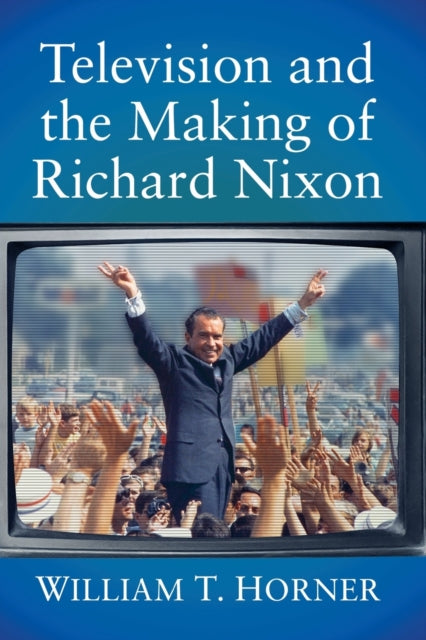
William T. Horner
Television and the Making of Richard Nixon
Television and the Making of Richard Nixon
We can order this item for you. Delivery usually takes about 4 to 6 weeks.
This item is not held in our immediate stock. We will order it for you after checkout.
Estimated delivery: About 4 to 6 weeks
YOU SAVE £3.51
- Condition: Brand new
- UK Delivery times: Usually arrives within 2 - 3 working days
- UK Shipping: Fee starts at £3.89. Subject to product weight & dimension
Bulk ordering. Want 15 or more copies? Get a personalised quote and bigger discounts. Learn more about bulk orders.
Couldn't load pickup availability
- More about Television and the Making of Richard Nixon
Richard Nixon's use of visual media in politics, including his Checkers speech and appearances on entertainment television, broke new ground and set a blueprint for using television to achieve political goals.
Format: Paperback / softback
Length: 277 pages
Publication date: 14 July 2022
Publisher: McFarland & Co Inc
While Richard Nixon's accomplishments and shortcomings are well-documented, one often overlooked aspect of his career is his profound influence on the media conduct of politicians of his generation. Nixon pioneered the use of visual media in politics, beginning in the 1940s during his Congressional service. His historic Checkers speech was the first of its kind: a politician using television to save his political career. His appearances on entertainment television, which are now a normal feature of most national political campaigns, broke new ground as well. This book delves into the blueprint Nixon set for using television to achieve political goals. Presidents have often employed new and innovative media as strategic tools for communication and public relations. The author argues that Nixon pioneered television media, using it consistently to connect with the American public.
Nixon's use of television was not without its challenges. Critics argued that his reliance on television was a sign of weakness, as it allowed him to avoid direct confrontations with his opponents and control the narrative of his campaign. However, Nixon's use of television was also a powerful tool for connecting with the American public and conveying his message. He was able to use television to present himself as a relatable and down-to-earth person, and to communicate his policies in a way that was accessible to a wide range of viewers.
One of the most significant aspects of Nixon's use of television was his ability to use it as a platform for political debate. He was the first president to use television to debate his opponents directly, and his appearances on television were often highly watched and influential. Nixon's use of television helped to shape the way that political debates are conducted today, and his ability to use it effectively was a key factor in his election victory in 1968.
In addition to his use of television for political purposes, Nixon also used it to communicate with the American public on a personal level. He was the first president to host a weekly television show, "The Nixon White House Hour," which allowed him to connect with the American people on a more personal and informal level. This show was a popular success and helped to humanize Nixon and his administration.
Nixon's use of television was also a significant factor in his ability to navigate the complex political landscape of the 1960s. He was able to use television to appeal to a wide range of voters, including those who were skeptical of his policies and those who were supportive of his agenda. His use of television helped to create a sense of unity and purpose among his supporters, and it helped to undermine the opposition's efforts to divide and conquer.
Overall, Richard Nixon's use of television was a groundbreaking and influential aspect of his career. He pioneered the use of visual media in politics, using it consistently to connect with the American public and achieve his political goals. While his use of television was not without its challenges, it was also a powerful tool for connecting with the American people and shaping the political landscape of the 1960s. Nixon's legacy as a politician and a leader is still felt today, and his use of television is a significant part of that legacy.
Weight: 157g
Dimension: 229 x 152 (mm)
ISBN-13: 9781476686639
UK and International shipping information
UK and International shipping information
We deliver throughout the United Kingdom and to 128 countries and territories worldwide, including the United States, Australia, Canada, Germany, Spain and France.