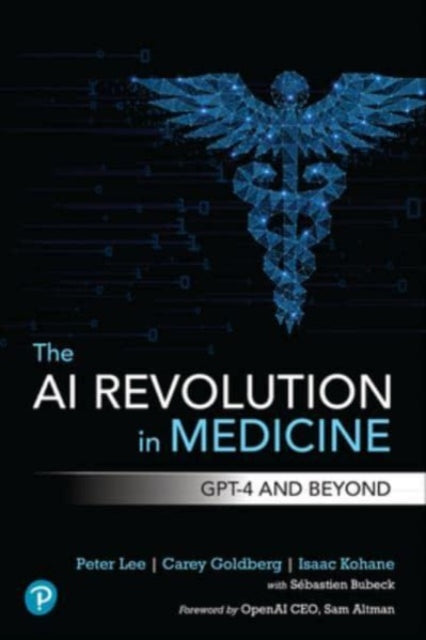
Peter Lee,Carey Goldberg,Isaac Kohane
The AI Revolution in Medicine: GPT-4 and Beyond
The AI Revolution in Medicine: GPT-4 and Beyond
💎 Earn 94 Points (£0.94) on this item.
YOU SAVE £4.00
- Condition: Brand new
- UK Delivery times: Usually arrives within 2 - 3 working days
- UK Shipping: Fee starts at £2.39. Subject to product weight & dimension
Bulk ordering. Want 15 or more copies? Get a personalised quote and bigger discounts. Learn more about bulk orders.
Couldn't load pickup availability
- More about The AI Revolution in Medicine: GPT-4 and Beyond
AI is about to transform medicine, and it is essential to understand its potential benefits and risks. This book provides an early exploration of the opportunities and responsibilities of AI in medicine, with real GPT-4 dialogues annotated with valuable context, candid commentary, risk insights, and takeaways. It also empowers patients, improves access and equity, fills gaps in care, supports behavior change, cuts waste, uncovers fraud, streamlines reimbursement, and lowers costs.
Format: Paperback / softback
Length: 304 pages
Publication date: 22 May 2023
Publisher: Pearson Education (US)
The development of artificial intelligence (AI) is poised to revolutionize the field of medicine in unprecedented ways. With its advanced capabilities, AI has the potential to transform the way healthcare is delivered, improving patient outcomes and enhancing the efficiency of medical practices. However, it is important to approach the integration of AI with medicine cautiously and responsibly, ensuring that its benefits outweigh the risks.
One of the most significant ways in which AI is set to impact medicine is through its ability to analyze vast amounts of data and make accurate diagnoses. AI algorithms can process large volumes of medical records, imaging scans, and other clinical data, identifying patterns and abnormalities that may be missed by human doctors. This can lead to earlier detection of diseases, more personalized treatment plans, and improved patient care.
AI is also well-suited for assisting doctors in patient care. For example, AI-powered chatbots can provide patients with 24/7 access to medical advice and support, answering common questions and helping them manage their health conditions. AI-powered virtual assistants can also help doctors manage their schedules, track patient progress, and communicate with other healthcare professionals.
Another area where AI is making significant strides is in drug discovery and development. AI algorithms can analyze vast amounts of data, including genetic information, chemical compounds, and clinical trial data, to identify new drug candidates and optimize existing treatments. This can lead to faster and more efficient drug development processes, reducing the time and cost of bringing new treatments to market.
However, it is important to note that the integration of AI with medicine also presents several challenges. One of the biggest concerns is the potential for bias in AI algorithms. If the data used to train AI algorithms is biased, the algorithms may perpetuate and amplify these biases, leading to inaccurate diagnoses and treatment plans.
Another challenge is the ethical implications of using AI in medicine. There are concerns about the privacy and security of patient data, as well as the potential for AI to be used for surveillance or discrimination. There are also concerns about the role of humans in the healthcare system, as AI may replace some human tasks and potentially lead to job loss.
To address these challenges, it is important to ensure that the development and deployment of AI in medicine is guided by ethical principles and regulations. This includes ensuring that patient data is protected and secure, that AI algorithms are transparent and accountable, and that there is ongoing human oversight and regulation of AI use in medicine.
In conclusion, the development of AI is as fundamental as the creation of the personal computer, and it has the potential to transform the field of medicine in unprecedented ways. While there are risks associated with the integration of AI with medicine, these can be mitigated by careful management and responsible use of the technology. By leveraging the capabilities of AI, healthcare providers can improve patient care, accelerate drug discovery, and enhance the efficiency of medical practices. However, it is important to approach the integration of AI with medicine cautiously and responsibly, ensuring that its benefits outweigh the risks.
Weight: 446g
Dimension: 152 x 230 x 17 (mm)
ISBN-13: 9780138200138
UK and International shipping information
UK and International shipping information
UK Delivery and returns information:
- Delivery within 2 - 3 days when ordering in the UK.
- Shipping fee for UK customers from £2.39. Fully tracked shipping service available.
- Returns policy: Return within 30 days of receipt for full refund.
International deliveries:
Shulph Ink now ships to Australia, Belgium, Canada, France, Germany, Ireland, Italy, India, Luxembourg Saudi Arabia, Singapore, Spain, Netherlands, New Zealand, United Arab Emirates, United States of America.
- Delivery times: within 5 - 10 days for international orders.
- Shipping fee: charges vary for overseas orders. Only tracked services are available for most international orders. Some countries have untracked shipping options.
- Customs charges: If ordering to addresses outside the United Kingdom, you may or may not incur additional customs and duties fees during local delivery.