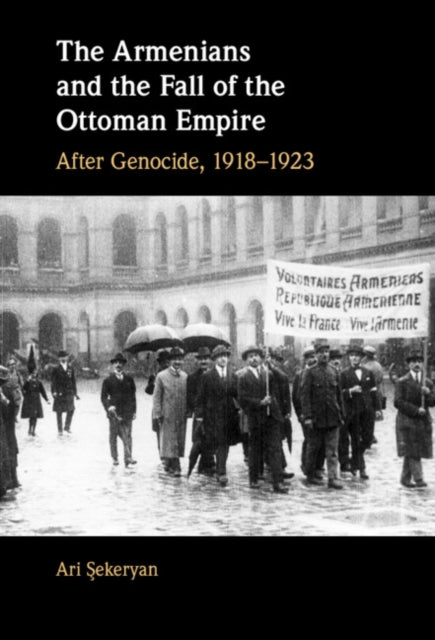
AriSekeryan
The Armenians and the Fall of the Ottoman Empire: After Genocide, 1918-1923
The Armenians and the Fall of the Ottoman Empire: After Genocide, 1918-1923
💎 Earn 387 Points (£3.87) on this item.
We can order this item for you. Delivery usually takes about 4 to 6 weeks.
This item is not held in our immediate stock. We will order it for you after checkout.
Estimated delivery: About 4 to 6 weeks
YOU SAVE £4.59
- Condition: Brand new
- UK Delivery times: Usually arrives within 2 - 3 working days
- UK Shipping: Fee starts at £2.39. Subject to product weight & dimension
Bulk ordering. Want 15 or more copies? Get a personalised quote and bigger discounts. Learn more about bulk orders.
Couldn't load pickup availability
- More about The Armenians and the Fall of the Ottoman Empire: After Genocide, 1918-1923
The Armistice of Mudros was signed on 1918-10-30, marking the beginning of the end of the Ottoman Empire. This day brought new opportunities for all Ottomans, Muslim and non-Muslim alike, but also caused great suffering and chaos. Ari Şekeryan's book examines the Armenian community's shifting political position and strategies to survive the post-war period, providing a new case study for understanding the political reactions of ethnic groups to the fall of empires and nation-states.
Format: Hardback
Length: 200 pages
Publication date: 19 January 2023
Publisher: Cambridge University Press
The Armistice of Mudros was signed on October 30, 1918, and on November 13, 1918, a mighty fleet of battleships from Britain, France, Italy, and Greece sailed to Istanbul and dropped anchor without encountering resistance. This day marked the beginning of the end of the Ottoman Empire, a dissolution that would bring great suffering and chaos, but also new opportunities for all Ottomans, Muslims, and non-Muslims alike. Drawing upon a previously untouched collection of Armenian and Ottoman Turkish primary sources, Ari Şekeryan considers these understudied post-war years. Examining the Armenian community as they emerged from the aftermath of war and genocide, Şekeryan outlines their shifting political position and the strategies they used to survive this turbulent period. By focusing on the Ottoman Armistice (1918–1923), Şekeryan illuminates an oft-neglected period in history and develops a new case study for understanding the political reactions of ethnic groups to the fall of empires and nation-states.
The Armistice of Mudros, signed on October 30, 1918, marked a significant turning point in the Ottoman Empire's decline. This agreement, which ended the bloody World War I, brought an end to the Ottoman Empire's rule over much of the Middle East and Southeast Europe. However, the aftermath of the Armistice was marked by immense suffering and chaos for the Armenian community, as well as other ethnic groups within the empire.
The Armenian community, which had been living in the Ottoman Empire for centuries, faced widespread persecution and genocide during the war. Millions of Armenians were massacred by the Ottoman Turks, with the most infamous example being the Armenian Genocide of 1915-1916. The genocide resulted in the deaths of over 1.5 million Armenians, and it is widely regarded as one of the most heinous crimes against humanity in history.
Despite the horrors of the genocide, the Armenian community continued to survive and thrive in the aftermath of the Armistice. Many Armenians fled to neighboring countries, such as Russia, France, and the United States, seeking safety and a new life. However, many Armenians remained in the Ottoman Empire, hoping to rebuild their lives and communities.
The Armistice of Mudros brought about significant changes in the political landscape of the Ottoman Empire. The empire was divided into several territories, with the Armenian community receiving its own autonomous region known as the Armenian National Republic. The Republic was led by the Armenian Revolutionary Federation (ARF), a political party that had been advocating for Armenian rights and self-determination for decades.
However, the Armenian National Republic was short-lived, as it was soon annexed by the Soviet Union in 1920. The Soviet Union, which had been a major ally of the Ottoman Empire during the war, saw the Armenian National Republic as a potential threat to its own interests in the region. The Soviet Union's annexation of the Republic marked the end of any hope for Armenian self-determination and led to the further persecution and marginalization of the Armenian community within the Soviet Union.
The Armistice of Mudros also had significant implications for the broader Middle East and Southeast Europe. The collapse of the Ottoman Empire led to the emergence of new nation-states, such as Turkey, Syria, and Iraq. These new states were often dominated by ethnic groups that had been marginalized or oppressed under the Ottoman Empire, such as the Kurds, Greeks, and Armenians.
The emergence of new nation-states also brought about new political and social tensions, as these groups sought to assert their identity and claim their rightful place in the new political order. The tensions between these groups often led to violence and conflict, as each group sought to dominate and control the territory and resources of their respective nation-states.
In conclusion, the Armistice of Mudros marked the beginning of the end of the Ottoman Empire, a dissolution that would bring great suffering and chaos, but also new opportunities for all Ottomans, Muslims, and non-Muslims alike. The Armenian community, which had been living in the Ottoman Empire for centuries, faced widespread persecution and genocide during the war, and the aftermath of the Armistice was marked by immense suffering and chaos. The Armistice of Mudros also had significant implications for the broader Middle East and Southeast Europe, as it led to the emergence of new nation-states and the assertion of the identity and rights of marginalized and oppressed ethnic groups.
Weight: 524g
ISBN-13: 9781108844017
UK and International shipping information
UK and International shipping information
UK Delivery and returns information:
- Delivery within 2 - 3 days when ordering in the UK.
- Shipping fee for UK customers from £2.39. Fully tracked shipping service available.
- Returns policy: Return within 30 days of receipt for full refund.
International deliveries:
Shulph Ink now ships to Australia, Belgium, Canada, France, Germany, Ireland, Italy, India, Luxembourg Saudi Arabia, Singapore, Spain, Netherlands, New Zealand, United Arab Emirates, United States of America.
- Delivery times: within 5 - 10 days for international orders.
- Shipping fee: charges vary for overseas orders. Only tracked services are available for most international orders. Some countries have untracked shipping options.
- Customs charges: If ordering to addresses outside the United Kingdom, you may or may not incur additional customs and duties fees during local delivery.