Paul L Dawson
The Battle Against the Luddites: Unrest in the Industrial Revolution During the Napoleonic Wars
The Battle Against the Luddites: Unrest in the Industrial Revolution During the Napoleonic Wars
💎 Earn 88 Points (£0.88) on this item.
YOU SAVE £7.30
- Condition: Brand new
- UK Delivery times: Usually arrives within 2 - 3 working days
- UK Shipping: Fee starts at £2.39. Subject to product weight & dimension
Bulk ordering. Want 15 or more copies? Get a personalised quote and bigger discounts. Learn more about bulk orders.
Couldn't load pickup availability
- More about The Battle Against the Luddites: Unrest in the Industrial Revolution During the Napoleonic Wars
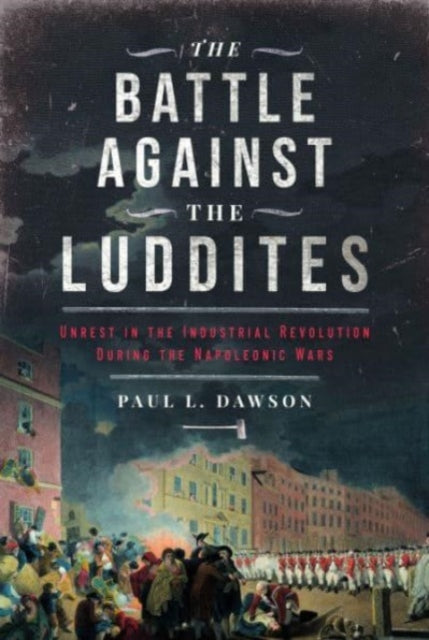
The Napoleonic Wars saw the rise of Luddism, a movement that saw workers destroy machinery as a threat to their livelihood. This led to industrial unrest and the largest economic depression of the era, with famine, pestilence and rising employment fuelling the fires of Luddism. Paul L. Dawson explores the origins of Luddism and their allies in the middle classes, and how the changes in Britain between 1790 and 1815 created a unique set of social grievances.
Format: Hardback
Length: 248 pages
Publication date: 04 July 2023
Publisher: Pen & Sword Books Ltd
As the columns of French infantry marched up the slopes of the Mont St Jean at Waterloo, the British heavy cavalry, the Royal Scots Greys to the fore, crashed into the packed ranks of the enemy. This was not the first time the Greys had drawn their swords during the Napoleonic Wars – but it was their first against Napoleon's troops. Three years earlier, they had attacked workers in Halifax protesting at the introduction of machinery in the wool trade. Taking their name from Ned Ludd, who had smashed up knitting frames in Nottingham, the Luddites saw the emergence of mechanisation as a threat to their livelihood, with men replacing machines. In response, they took matters into their own hands by wrecking the new equipment. Industrial unrest had gathered pace throughout the 18th century and exploded in an unprecedented wave of violence in 1799. Outbreaks of machine-breaking developed rapidly into strikes in a battle of capital against labour. A court battle ensued, culminating in new legislation in 1806 that backed the capitalists. This act, coupled with the impact of the Continental system introduced by Napoleon, which closed European and American ports to British merchants, heralded the largest economic depression of the era. Famine, pestilence, and rising employment all fuelled the fires of Luddism. Months of violence swept across the West Midlands, Lancashire, and Yorkshire, which saw one factory boss murdered; other factory owners began shooting protesting workers. The disturbances resulted in the mobilising of thousands of regular soldiers – at one time, there were as many British soldiers fighting the Luddites as there were fighting Napoleon on the Iberian Peninsula. As well as exploring these events, Paul L. Dawson also uncovers the origins of Luddism and their allies in the Industrial Revolution.
As the columns of French infantry marched up the slopes of the Mont St Jean at Waterloo, the British heavy cavalry, the Royal Scots Greys to the fore, crashed into the packed ranks of the enemy. This was not the first time the Greys had drawn their swords during the Napoleonic Wars – but it was their first against Napoleon's troops. Three years earlier, they had attacked workers in Halifax protesting at the introduction of machinery in the wool trade. Taking their name from Ned Ludd, who had smashed up knitting frames in Nottingham, the Luddites saw the emergence of mechanisation as a threat to their livelihood, with men replacing machines. In response, they took matters into their own hands by wrecking the new equipment. Industrial unrest had gathered pace throughout the 18th century and exploded in an unprecedented wave of violence in 1799. Outbreaks of machine-breaking developed rapidly into strikes in a battle of capital against labour. A court battle ensued, culminating in new legislation in 1806 that backed the capitalists. This act, coupled with the impact of the Continental system introduced by Napoleon, which closed European and American ports to British merchants, heralded the largest economic depression of the era. Famine, pestilence, and rising employment all fuelled the fires of Luddism. Months of violence swept across the West Midlands, Lancashire, and Yorkshire, which saw one factory boss murdered; other factory owners began shooting protesting workers. The disturbances resulted in the mobilising of thousands of regular soldiers – at one time, there were as many British soldiers fighting the Luddites as there were fighting Napoleon on the Iberian Peninsula. As well as exploring these events, Paul L. Dawson also uncovers the origins of Luddism and their allies in the Industrial Revolution.
Weight: 542g
Dimension: 241 x 164 x 26 (mm)
ISBN-13: 9781399052405
UK and International shipping information
UK and International shipping information
UK Delivery and returns information:
- Delivery within 2 - 3 days when ordering in the UK.
- Shipping fee for UK customers from £2.39. Fully tracked shipping service available.
- Returns policy: Return within 30 days of receipt for full refund.
International deliveries:
Shulph Ink now ships to Australia, Belgium, Canada, France, Germany, Ireland, Italy, India, Luxembourg Saudi Arabia, Singapore, Spain, Netherlands, New Zealand, United Arab Emirates, United States of America.
- Delivery times: within 5 - 10 days for international orders.
- Shipping fee: charges vary for overseas orders. Only tracked services are available for most international orders. Some countries have untracked shipping options.
- Customs charges: If ordering to addresses outside the United Kingdom, you may or may not incur additional customs and duties fees during local delivery.