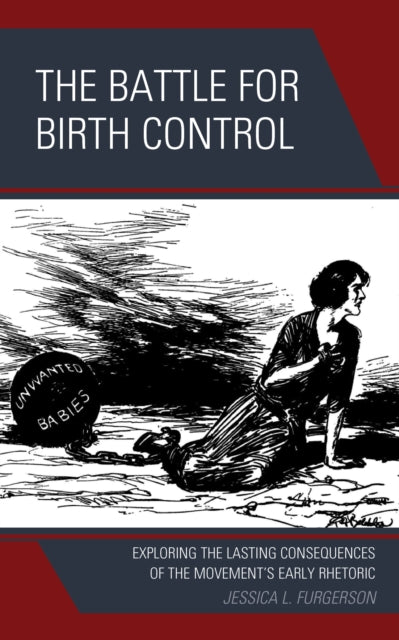
Jessica L. Furgerson
The Battle for Birth Control: Exploring the Lasting Consequences of the Movement's Early Rhetoric
The Battle for Birth Control: Exploring the Lasting Consequences of the Movement's Early Rhetoric
💎 Earn 531 Points (£5.31) on this item.
We can order this item for you. Delivery usually takes about 4 to 6 weeks.
This item is not held in our immediate stock. We will order it for you after checkout.
Estimated delivery: About 4 to 6 weeks
- Condition: Brand new
- UK Delivery times: Usually arrives within 2 - 3 working days
- UK Shipping: Fee starts at £3.89. Subject to product weight & dimension
Bulk ordering. Want 15 or more copies? Get a personalised quote and bigger discounts. Learn more about bulk orders.
Couldn't load pickup availability
- More about The Battle for Birth Control: Exploring the Lasting Consequences of the Movement's Early Rhetoric
The Battle for Birth Control explores the rhetorical history of the American birth control movement, from a fringe radical movement to a mainstream cause endorsed by professionals and politicians. It argues that the movement's accommodationist strategy led to increased contraceptive access but at the cost of endorsing the neoliberal regime of reproductive control, which threatens reproductive autonomy in the 21st century.
Format: Hardback
Length: 358 pages
Publication date: 15 April 2022
Publisher: Lexington Books
The Battle for Birth Control explores the intricate and multifaceted rhetorical legacy of the American birth control movement during its formative years. Spanning just four decades, advocates, led by the strategic guidance of Margaret Sanger, successfully transformed the fight for contraception from a marginalized and radical movement to a widely recognized and mainstream cause embraced by influential professionals and politicians alike. Initially driven by ideological convictions, birth controllers strategically adjusted their approach, employing deferential rhetoric and calculated posturing to gain widespread acceptance. This accommodative strategy resulted in significant victories for the movement, but it came at a significant cost.
Informed by a profound commitment to reproductive justice, The Battle for Birth Control uncovers the duplicity of the movement's early rhetoric. It argues that their accommodationist strategy, driven by a willingness to endorse the neoliberal regime of reproductive control, ultimately led to increased contraceptive access. This endorsement, despite its apparent benefits, has inadvertently contributed to the current threats to reproductive autonomy in the 21st century.
The book delves into the historical context, including the social, political, and cultural factors that shaped the birth control movement. It examines the early advocates' radical ideas and their gradual shift towards more moderate and mainstream positions. The authors highlight the strategic collaborations and alliances formed with influential individuals and organizations, such as physicians, scientists, and politicians, to gain support and legitimacy.
Through a critical analysis of primary sources, speeches, and writings, The Battle for Birth Control sheds light on the rhetorical strategies employed by birth controllers. It explores how they nuanced their messages, appealed to different audiences, and employed persuasive techniques to gain public support. The book also examines the challenges and setbacks faced by the movement, including legal battles, religious opposition, and societal stigma.
The Battle for Birth Control raises important questions about the intersection of reproductive rights, gender equality, and social justice. It challenges the notion that birth control is solely a personal choice and emphasizes the broader societal implications of access to contraception. The book argues that the movement's accommodationist strategy, while successful in gaining acceptance, inadvertently perpetuated the power structures and policies that have marginalized reproductive autonomy.
In conclusion, The Battle for Birth Control is a comprehensive and insightful exploration of the rhetorical history of the American birth control movement. It provides a valuable perspective on the strategies employed by advocates, the challenges faced by the movement, and the lasting impact of their efforts on reproductive rights and autonomy. By examining the duplicity of the movement's early rhetoric, the book underscores the importance of a more radical and intersectional approach to the fight for reproductive justice in the 21st century.
Weight: 703g
Dimension: 227 x 161 x 32 (mm)
ISBN-13: 9781793643247
UK and International shipping information
UK and International shipping information
We deliver throughout the United Kingdom and to 128 countries and territories worldwide, including the United States, Australia, Canada, Germany, Spain and France.