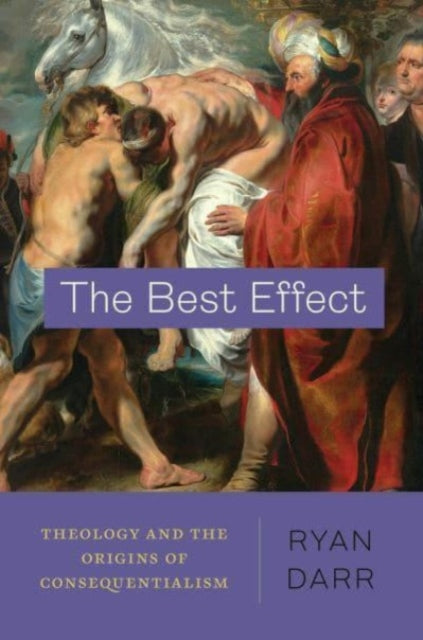
Ryan Darr
The Best Effect: Theology and the Origins of Consequentialism
The Best Effect: Theology and the Origins of Consequentialism
💎 Earn 99 Points (£0.99) on this item.
YOU SAVE £8.18
- Condition: Brand new
- UK Delivery times: Usually arrives within 2 - 3 working days
- UK Shipping: Fee starts at £2.39. Subject to product weight & dimension
Bulk ordering. Want 15 or more copies? Get a personalised quote and bigger discounts. Learn more about bulk orders.
Couldn't load pickup availability
- More about The Best Effect: Theology and the Origins of Consequentialism
Consequentialism, as a theological and cosmological vision, has influenced ethics and public policy for centuries, but Ryan Darr argues it is not as secular as it is often assumed to be. He proposes a more expansive vision for teleological ethics.
Format: Paperback / softback
Length: 320 pages
Publication date: 06 December 2023
Publisher: The University of Chicago Press
Consequentialism, the belief that we can assess an action solely based on its consequences, has exerted a profound influence on ethics and public policy in the Anglophone world for over two centuries. In his book, The Best Effect, Ryan Darr challenges the common perception that consequentialism is secular and rational, presenting it as a theological and cosmological vision that emerged in the seventeenth century. Darr traces the intellectual evolution of consequentialism and its eventual secularization across several centuries.
The Best Effect unveils how contemporary consequentialism retains remnants of its historical roots and offers an alternative vision for teleological ethics. By delving into the origins and development of consequentialism, Darr provides a comprehensive account of this ethical framework. He highlights its theological origins, emphasizing the role of religious beliefs and concepts in shaping its early development. Darr also explores how consequentialism evolved in response to secular challenges and how it was gradually secularized through philosophical debates and intellectual advancements.
Through his analysis, Darr challenges the notion that consequentialism is purely secular and rational. He argues that it has been influenced by religious and philosophical traditions, including the belief in divine providence and the search for ultimate meaning. Darr further suggests that consequentialism can be enriched by incorporating these theological dimensions, providing a more comprehensive and nuanced understanding of ethical decision-making.
In addition to challenging the secular nature of consequentialism, Darr proposes a more expansive vision for teleological ethics. He advocates for a teleological approach that considers not only the immediate consequences of an action but also its long-term effects and the broader goals and values that guide our actions. Darr suggests that a teleological ethics can provide a more holistic framework for evaluating ethical dilemmas and promoting social welfare.
The book concludes by highlighting the ongoing relevance of consequentialism in contemporary society. Darr argues that despite its secularization, consequentialism continues to shape our ethical decisions and public policies. He suggests that a deeper understanding of consequentialism's historical roots can help us refine and improve this ethical framework, ensuring that it remains relevant and effective in addressing the complex ethical challenges of our time.
In conclusion, The Best Effect offers a thought-provoking exploration of consequentialism's historical roots and its potential for renewal. By challenging the secular nature of consequentialism and proposing a more expansive vision for teleological ethics, Darr provides a valuable contribution to the ongoing debate about ethical decision-making. This book is a must-read for anyone interested in ethics, public policy, and the history of philosophical thought.
Weight: 512g
Dimension: 151 x 228 x 23 (mm)
ISBN-13: 9780226829999
UK and International shipping information
UK and International shipping information
UK Delivery and returns information:
- Delivery within 2 - 3 days when ordering in the UK.
- Shipping fee for UK customers from £2.39. Fully tracked shipping service available.
- Returns policy: Return within 30 days of receipt for full refund.
International deliveries:
Shulph Ink now ships to Australia, Belgium, Canada, France, Germany, Ireland, Italy, India, Luxembourg Saudi Arabia, Singapore, Spain, Netherlands, New Zealand, United Arab Emirates, United States of America.
- Delivery times: within 5 - 10 days for international orders.
- Shipping fee: charges vary for overseas orders. Only tracked services are available for most international orders. Some countries have untracked shipping options.
- Customs charges: If ordering to addresses outside the United Kingdom, you may or may not incur additional customs and duties fees during local delivery.