Justin McCarthy
The British and the Turks: A History of Animosity, 1893-1923
The British and the Turks: A History of Animosity, 1893-1923
💎 Earn 402 Points (£4.02) on this item.
We can order this item for you. Delivery usually takes about 4 to 6 weeks.
This item is not held in our immediate stock. We will order it for you after checkout.
Estimated delivery: About 4 to 6 weeks
YOU SAVE £24.46
- Condition: Brand new
- UK Delivery times: Usually arrives within 2 - 3 working days
- UK Shipping: Fee starts at £2.39. Subject to product weight & dimension
Bulk ordering. Want 15 or more copies? Get a personalised quote and bigger discounts. Learn more about bulk orders.
Couldn't load pickup availability
- More about The British and the Turks: A History of Animosity, 1893-1923
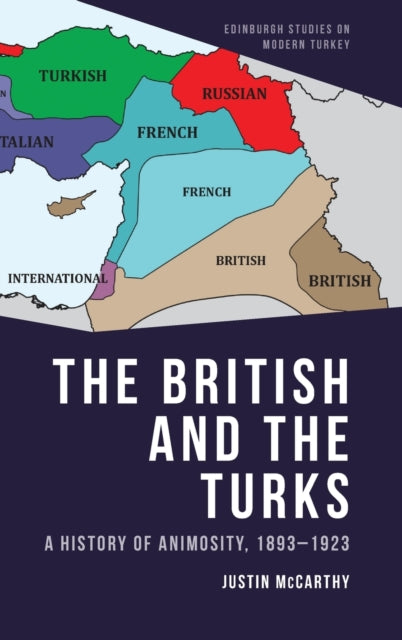
During World War I, the British government pushed for the partition and eventual destruction of the Ottoman Empire, citing concerns over its stability and influence in the region. This policy was influenced by a variety of factors, including British imperialism, strategic interests, and religious and ethnic tensions.
Format: Hardback
Length: 672 pages
Publication date: 30 June 2022
Publisher: Edinburgh University Press
The British Empire exerted significant pressure on the Ottoman Empire to partition and ultimately destroy it. This pressure was primarily driven by a combination of political, economic, and strategic interests.
The British Empire exerted a profound and relentless pressure on the Ottoman Empire, driven by a complex interplay of political, economic, and strategic motives. This relentless pressure sought to dismantle the Ottoman Empire and carve out a new territorial empire for Britain.
The political dimension of British pressure on the Ottoman Empire was rooted in the desire to expand British influence in the Middle East and North Africa. The Empire saw the Ottomans as a hindrance to its expansionist ambitions and sought to undermine their power and influence in the region. The British government employed a range of tactics, including diplomatic negotiations, military interventions, and economic sanctions, to exert pressure on the Ottomans and force them to comply with their demands.
One of the key strategies employed by the British was the partition of the Ottoman Empire. The Empire had ruled over a vast territory spanning multiple continents, including Europe, Asia, and Africa. The British sought to divide this territory into smaller, more manageable colonies that would be easier to control and exploit. The partition of the Empire was finalized in 1918 with the Treaty of Sevres, which divided the Empire into several provinces, including Iraq, Syria, and Lebanon.
The economic dimension of British pressure on the Ottoman Empire was also significant. The Empire was a major economic power in the region, with a robust economy that included agriculture, industry, and trade. The British sought to undermine the Ottoman economy by imposing tariffs, embargoes, and other economic measures that would hinder their ability to trade and prosper. The British also sought to gain control of key economic resources, such as oil and natural gas, which were abundant in the Ottoman Empire.
The strategic dimension of British pressure on the Ottoman Empire was driven by the desire to establish a strong military presence in the Middle East and North Africa. The Empire saw the Ottomans as a potential threat to its security and sought to weaken their military capabilities and influence in the region. The British government invested heavily in the military infrastructure of its colonies in the region, including the construction of ports, railways, and airfields. The British also sought to recruit and train Ottoman soldiers and officers, who were often viewed as loyal to the British Empire.
The British pressure on the Ottoman Empire was not without its consequences. The Empire was weakened and fragmented, and its people suffered greatly as a result of the partition and the subsequent conflicts that followed. The Empire's loss of territory and resources also had a significant impact on the global economy, as the Empire was a major player in global trade and commerce.
In conclusion, the British Empire exerted significant pressure on the Ottoman Empire to partition and ultimately destroy it. This pressure was driven by a combination of political, economic, and strategic interests. The partition of the Empire was finalized in 1918 with the Treaty of Sevres, which divided the Empire into several provinces, including Iraq, Syria, and Lebanon. The economic dimension of British pressure on the Empire was also significant, with the British seeking to undermine the Ottoman economy and gain control of key economic resources. The strategic dimension of British pressure on the Empire was driven by the desire to establish a strong military presence in the Middle East and North Africa. The consequences of British pressure on the Ottoman Empire were profound, with the Empire weakened and fragmented, and its people suffering greatly as a result of the partition and the subsequent conflicts that followed.
Dimension: 234 x 156 (mm)
ISBN-13: 9781399500043
UK and International shipping information
UK and International shipping information
UK Delivery and returns information:
- Delivery within 2 - 3 days when ordering in the UK.
- Shipping fee for UK customers from £2.39. Fully tracked shipping service available.
- Returns policy: Return within 30 days of receipt for full refund.
International deliveries:
Shulph Ink now ships to Australia, Belgium, Canada, France, Germany, Ireland, Italy, India, Luxembourg Saudi Arabia, Singapore, Spain, Netherlands, New Zealand, United Arab Emirates, United States of America.
- Delivery times: within 5 - 10 days for international orders.
- Shipping fee: charges vary for overseas orders. Only tracked services are available for most international orders. Some countries have untracked shipping options.
- Customs charges: If ordering to addresses outside the United Kingdom, you may or may not incur additional customs and duties fees during local delivery.