Shulph Ink
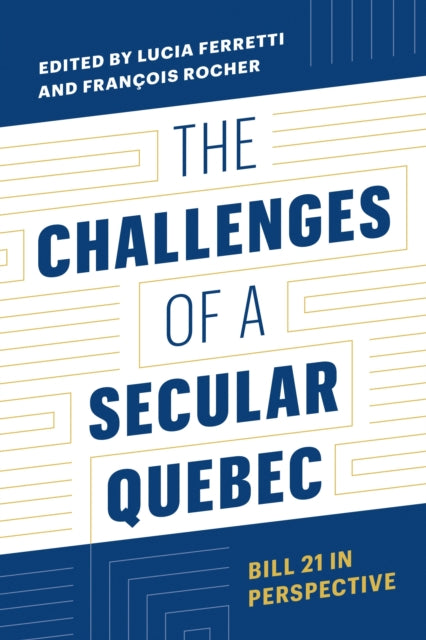
The Challenges of a Secular Quebec: Bill 21 in Perspective
The Challenges of a Secular Quebec: Bill 21 in Perspective
💎 Earn 140 Points (£1.40) on this item.
YOU SAVE £5.92
- Condition: Brand new
- UK Delivery times: Usually arrives within 2 - 3 working days
- UK Shipping: Fee starts at £2.39. Subject to product weight & dimension
Bulk ordering. Want 15 or more copies? Get a personalised quote and bigger discounts. Learn more about bulk orders.
Couldn't load pickup availability
- More about The Challenges of a Secular Quebec: Bill 21 in Perspective
The Quebec National Assembly passed Bill 21 in 2019, prohibiting certain state employees in positions of authority from wearing religious symbols while providing public services. The move was criticized for running counter to Canadian multiculturalism and human rights, but it garnered public support. The book explores why many Quebecers consider the law legitimate and analyzes it from different angles. It calls for a legal interpretation that is sensitive to the province's unique history in North America.
Format: Paperback / softback
Length: 328 pages
Publication date: 01 August 2024
Publisher: University of British Columbia Press
The Challenges of a Secular Quebec
In 2019, the Quebec National Assembly passed Bill 21, a controversial law that prohibits certain state employees in positions of authority from wearing religious symbols when providing public services. The law has been denounced by many political commentators as running counter to Canadian multiculturalism and human rights. However, the law garnered public support, and it remains in effect today. In this article, we will explore why the government adopted this form of state secularism and why it garnered public support. We will also analyze the law from different angles to provide a nuanced, respectful discussion of its intentions and principles.
The Challenges of a Secular Quebec
The Challenges of a Secular Quebec provides illuminating answers to these questions and explores why many Quebecers consider the law legitimate. Contributors analyze the statute from different angles to provide a nuanced, respectful discussion of its intentions and principles. Given the provinces singular history in North America, the merits of the initiative to separate church and state must be considered within the Quebec context. The Challenges of a Secular Quebec calls for a legal interpretation of Bill 21 that is sensitive to this difference.
The Challenges of a Secular Quebec
One of the main challenges of a secular Quebec is the tension between religious freedom and the principle of secularism. While religious freedom is a fundamental human right, it can be difficult to reconcile with the principle of secularism, which seeks to keep religion and government separate. In Quebec, the law has been interpreted to prohibit all religious symbols, including those that are worn for religious purposes, such as a hijab or a kippah. This has led to a sense of exclusion and marginalization among some religious communities, who feel that their religious identity is being threatened by the state. However, the law has also been defended as a necessary measure to promote equality and prevent discrimination. The government has argued that the law is not intended to target any particular religion or religious group, but rather to ensure that public services are provided in a neutral and impartial manner. This argument has been supported by the fact that the law applies to all state employees in positions of authority, regardless of their religious beliefs or affiliations.
The Challenges of a Secular Quebec
Another challenge of a secular Quebec is the impact on religious education. While religious education is a fundamental right in Quebec, the law has been interpreted to prohibit it in public schools. This has led to a debate about the role of religion in education and the extent to which it should be allowed in public schools. Some argue that religious education should be allowed in public schools, while others argue that it should be limited to private schools. The government has argued that the law is necessary to ensure that public schools are neutral and impartial and that they do not promote any particular religious beliefs or affiliations. This argument has been supported by the fact that the law applies to all state employees in positions of authority, regardless of their religious beliefs or affiliations.
The Challenges of a Secular Quebec
Despite these challenges, the law has garnered public support. Many Quebecers believe that the law is necessary to promote equality and prevent discrimination. They argue that the law is not intended to target any particular religion or religious group, but rather to ensure that public services are provided in a neutral and impartial manner. However, there have been some criticisms of the law, including the fact that it has been interpreted to prohibit all religious symbols, even those that are worn for religious purposes. This has led to a sense of exclusion and marginalization among some religious communities, who feel that their religious identity is being threatened by the state. In response to these criticisms, the government has made some changes to the law, including allowing religious symbols to be worn in certain circumstances, such as during religious ceremonies or when providing religious education. However, these changes have not been enough to satisfy some critics, who argue that the law is still too restrictive and that it should be repealed.
Conclusion
In conclusion, the Challenges of a Secular Quebec provides illuminating answers to the questions of why the government adopted this form of state secularism and why it garnered public support. While there are some challenges associated with a secular Quebec, the law has been defended as a necessary measure to promote equality and prevent discrimination. However, it is important to consider the impact of the law on religious education and to ensure that it is implemented in a way that is respectful of religious freedom and the principle of secularism. By working together, we can create a more inclusive and diverse society that respects the rights of all individuals, regardless of their religious beliefs or affiliations.
Dimension: 229 x 152 (mm)
ISBN-13: 9780774868433
UK and International shipping information
UK and International shipping information
UK Delivery and returns information:
- Delivery within 2 - 3 days when ordering in the UK.
- Shipping fee for UK customers from £2.39. Fully tracked shipping service available.
- Returns policy: Return within 30 days of receipt for full refund.
International deliveries:
Shulph Ink now ships to Australia, Belgium, Canada, France, Germany, Ireland, Italy, India, Luxembourg Saudi Arabia, Singapore, Spain, Netherlands, New Zealand, United Arab Emirates, United States of America.
- Delivery times: within 5 - 10 days for international orders.
- Shipping fee: charges vary for overseas orders. Only tracked services are available for most international orders. Some countries have untracked shipping options.
- Customs charges: If ordering to addresses outside the United Kingdom, you may or may not incur additional customs and duties fees during local delivery.