MaeNgai
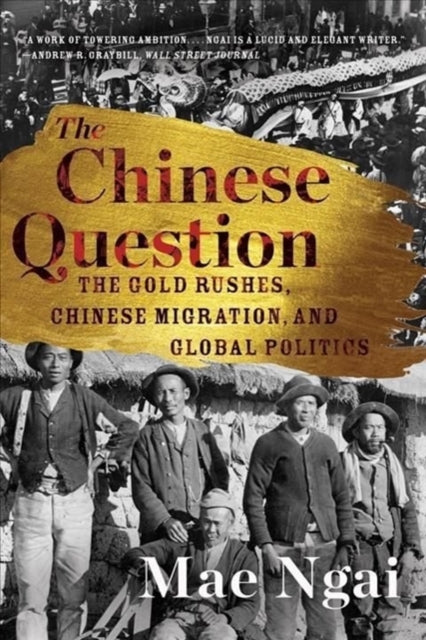
The Chinese Question: The Gold Rushes, Chinese Migration, and Global Politics
The Chinese Question: The Gold Rushes, Chinese Migration, and Global Politics
💎 Earn 70 Points (£0.70) on this item.
YOU SAVE £2.96
- Condition: Brand new
- UK Delivery times: Usually arrives within 2 - 3 working days
- UK Shipping: Fee starts at £2.39. Subject to product weight & dimension
Bulk ordering. Want 15 or more copies? Get a personalised quote and bigger discounts. Learn more about bulk orders.
Couldn't load pickup availability
- More about The Chinese Question: The Gold Rushes, Chinese Migration, and Global Politics
Between 1848 and 1899, a significant amount of gold was extracted from the earth, leading to a global battle over Chinese immigration. Mae Ngai's book explores how race and money brought Chinese to the West and reshaped the nineteenth-century world, arguing that Chinese exclusion was integral to the emerging global economy.
Format: Paperback / softback
Length: 480 pages
Publication date: 06 January 2023
Publisher: WW Norton & Co
Between 1848 and 1899, a remarkable phenomenon occurred: more gold was extracted from the Earth than had been mined in the previous 3,000 years. This extraordinary surge in gold mining sparked a global battle over a pressing question: would the United States and the British Empire outlaw Chinese immigration? This captivating history of the Chinese diaspora and global capitalism explores how a fervent mix of race and money brought Chinese to the West, profoundly shaping the 19th century world. From Europe's conquest of China to the establishment of the international gold standard and the emergence of racist, anti-Chinese stereotypes that persist to this day, this book sheds light on the intricate connections between these historical events. Drawing on a decade of extensive research conducted across five continents, renowned historian Mae Ngai makes a compelling argument that Chinese exclusion was not merely incidental to the emerging global economy but rather an essential component of it.
The Chinese diaspora, comprising millions of individuals who had migrated from China to various parts of the world, played a pivotal role in this historical narrative. The gold rush in California, Australia, and South Africa attracted a vast number of Chinese workers, who were often subjected to discrimination and exploitation. The tensions between Chinese and white settlers on the goldfields led to a heated debate about the "Chinese Question," which ultimately spilled over into the broader international arena.
The United States and the British Empire were among the nations grappling with the issue of Chinese immigration. Some policymakers argued for restricting Chinese immigration, viewing it as a threat to the economic and social stability of their respective countries. Others, however, advocated for a more inclusive approach, recognizing the contributions that Chinese immigrants could make to the global economy.
The Chinese Exclusion Act of 1882, passed by the United States Congress, was a significant milestone in the history of Chinese immigration. This legislation prohibited the entry of Chinese laborers into the United States and effectively barred Chinese immigrants from entering the country for a period of 20 years. The act was widely criticized by human rights activists and scholars, who argued that it violated the principles of freedom of movement and equality.
Despite the Chinese Exclusion Act, Chinese immigrants continued to find ways to enter the United States. Some resorted to illegal means, such as crossing the border undetected or entering through ports of entry that were not heavily patrolled. Others sought legal means of entry, such as applying for visas or green cards through family members or sponsors.
The Chinese Exclusion Act had far-reaching consequences for both China and the United States. In China, the act exacerbated the already existing tensions between the Chinese government and the Western powers. The Chinese government viewed the act as a symbol of Western imperialism and a violation of its sovereignty. It led to increased persecution of Chinese immigrants and further marginalization of Chinese communities in China.
In the United States, the Chinese Exclusion Act had a significant impact on the labor market. It created a shortage of low-skilled labor, which led to increased wages for workers in other industries. It also led to the development of a new class of Chinese immigrants known as "******" workers, who were recruited from China to work in agriculture, mining, and other low-wage industries.
The Chinese Exclusion Act was not the only factor contributing to the global battle over Chinese immigration. Other factors, such as the rise of nationalism in China, the expansion of European colonialism, and the development of the international gold standard, also played a role.
The rise of nationalism in China, particularly during the late 19th and early 20th centuries, led to a sense of pride and identity among Chinese citizens. This nationalism was often expressed through opposition to Western imperialism and the desire for self-determination. The expansion of European colonialism, particularly in Asia and Africa, also contributed to the global battle over Chinese immigration. As European powers sought to expand their economic and political influence, they encountered resistance from local populations, including Chinese immigrants.
The development of the international gold standard also played a role in the global battle over Chinese immigration. The international gold standard was a system of currency exchange that was established in the late 19th century. It was based on the principle century, it was based on the fixed exchange rate of gold to other currencies, such as silver and paper money. The international gold standard facilitated the flow of capital and trade across borders, but it also created a demand for gold, which led to the exploitation of gold mines in China and other parts of the world.
The international gold standard also created a demand for cheap labor, which led to the recruitment of Chinese immigrants to work in mines and other industries. Chinese immigrants were often subjected to poor working conditions, long hours, and low wages. They were also often subjected to discrimination and exploitation, such as being forced to work in hazardous environments or being paid less than their white counterparts.
The global battle over Chinese immigration was not just a matter of race and economics. It was also a matter of cultural and social change. The arrival of Chinese immigrants to the West brought with it a new wave of cultural exchange and integration. Chinese immigrants brought with them their language, customs, and traditions, which were often met with resistance and hostility by the dominant Western culture.
However, over time, Chinese immigrants began to integrate into Western society. They established schools, churches, and community organizations, which helped to promote cultural exchange and understanding. They also contributed to the development of a new hybrid culture, which blends elements of Chinese and Western culture.
Despite the challenges and struggles faced by Chinese immigrants, they have also made significant contributions to the development of global capitalism. Chinese immigrants have played a key role in the growth of industries such as agriculture, mining, and manufacturing. They have also contributed to the development of infrastructure, such as roads, bridges, and railroads, in China and other parts of the world.
In conclusion, the history of the Chinese diaspora and global capitalism is a complex and multifaceted narrative that spans several centuries. It explores how a feverish alchemy of race and money brought Chinese to the West, reshaped the 19th-century world, and continues to impact our lives today. The global battle over Chinese immigration was not just a matter of race and economics but also of cultural and social change. It highlights the importance of understanding the historical context in which these events occurred and the impact they have had on our world. By examining the history of the Chinese diaspora and global capitalism, we can gain a deeper appreciation of the complex and interconnected nature of our global society and the challenges we face in the 21st century.
Weight: 355g
Dimension: 211 x 140 x 30 (mm)
ISBN-13: 9781324036104
UK and International shipping information
UK and International shipping information
UK Delivery and returns information:
- Delivery within 2 - 3 days when ordering in the UK.
- Shipping fee for UK customers from £2.39. Fully tracked shipping service available.
- Returns policy: Return within 30 days of receipt for full refund.
International deliveries:
Shulph Ink now ships to Australia, Belgium, Canada, France, Germany, Ireland, Italy, India, Luxembourg Saudi Arabia, Singapore, Spain, Netherlands, New Zealand, United Arab Emirates, United States of America.
- Delivery times: within 5 - 10 days for international orders.
- Shipping fee: charges vary for overseas orders. Only tracked services are available for most international orders. Some countries have untracked shipping options.
- Customs charges: If ordering to addresses outside the United Kingdom, you may or may not incur additional customs and duties fees during local delivery.