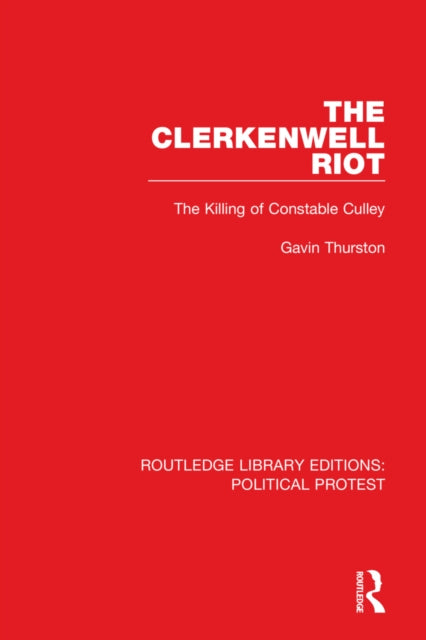
Gavin Thurston
The Clerkenwell Riot: The Killing of Constable Culley
The Clerkenwell Riot: The Killing of Constable Culley
💎 Earn 552 Points (£5.52) on this item.
We can order this item for you. Delivery usually takes about 4 to 6 weeks.
This item is not held in our immediate stock. We will order it for you after checkout.
Estimated delivery: About 4 to 6 weeks
- Condition: Brand new
- UK Delivery times: Usually arrives within 2 - 3 working days
- UK Shipping: Fee starts at £2.39. Subject to product weight & dimension
Bulk ordering. Want 15 or more copies? Get a personalised quote and bigger discounts. Learn more about bulk orders.
Couldn't load pickup availability
- More about The Clerkenwell Riot: The Killing of Constable Culley
This book, first published in 1967, examines the implications of a now-forgotten minor riot that occurred in 1833, a turbulent year with the working classes striving for recognition in a changing social order. A policeman was stabbed to death during a political meeting in London, leading to a bad-tempered inquest and a verdict of justified killing. The crime and verdict are set against the political protests of the time.
Format: Hardback
Length: 188 pages
Publication date: 06 September 2021
Publisher: Taylor & Francis Ltd
This captivating book, originally published in 1967, delves into the profound implications of a now-forgotten minor riot that took place in 1833, a year marked by intense social upheaval and the relentless pursuit of recognition by the working classes. A political gathering in London had been deemed illegal by the authorities, and when the police attempted to disperse the crowd, they encountered fierce resistance. In the ensuing chaos, a policeman was tragically stabbed to death. A contentious inquest ensued, during which the jury rendered a verdict of justified killing, which was met with acclaim from a section of the public who viewed the jurors as heroes. This insightful analysis contextualizes the crime and verdict within the broader political protests of the time, shedding light on the complex dynamics and tensions of the era.
Introduction:
The year 1833 was a pivotal period in British history, marked by widespread social unrest and the growing demands of the working classes for recognition and equality. In the midst of this tumultuous backdrop, a minor riot occurred in London, which shed light on the complex interplay between politics, law enforcement, and public opinion. This book aims to examine the implications of this riot and its significance in shaping the political landscape of the time.
The Riot:
On the evening of July 14, 1833, a political meeting was held in London, which had been declared illegal by the authorities. The gathering was attended by a large crowd of working-class individuals who were frustrated by their lack of representation and social exclusion. The police were dispatched to disperse the crowd, but they encountered resistance from the protesters.
The Killing:
As the tensions escalated, a policeman named James Gordon was stabbed to death by a protester. The incident caused widespread outrage and led to a series of protests and demonstrations throughout the city. The public viewed the killing as a symbol of the oppressive conditions faced by the working classes and demanded justice for the officer.
The Inquest:
A coroner's inquest was held to investigate the killing, and a jury was convened to determine the cause of death and the appropriate punishment for the perpetrator. The inquest was highly contentious, with the jury returning a verdict of justified killing. They argued that the police had acted in self-defense and that the protester had posed a threat to their safety.
The Public Reaction:
The public reaction to the verdict was mixed. While some hailed the jurors as heroes for their bravery and commitment to justice, others criticized them for their lack of empathy and understanding of the working-class perspective. The riot and the subsequent inquest became a focal point for political activists and reformers, who used them to highlight the need for social and political change.
The Political Context:
The riot and the inquest took place at a time when the working classes were increasingly asserting their rights and seeking to challenge the dominant social order. The Industrial Revolution had brought about significant economic and social changes, but many workers remained marginalized and exploited. The political protests of the time were characterized by a sense of urgency and a desire for greater equality and representation.
Conclusion:
The riot and the inquest of 1833 were significant events in British history, which had a lasting impact on the political landscape of the time. They highlighted the tensions between the working classes and the authorities, and they served as a reminder of the need for social and political reform. This book provides a valuable insight into the complexities of the era and its significance in shaping the history of Britain.
Weight: 513g
Dimension: 234 x 156 (mm)
ISBN-13: 9781032030777
This item can be found in:
UK and International shipping information
UK and International shipping information
UK Delivery and returns information:
- Delivery within 2 - 3 days when ordering in the UK.
- Shipping fee for UK customers from £2.39. Fully tracked shipping service available.
- Returns policy: Return within 30 days of receipt for full refund.
International deliveries:
Shulph Ink now ships to Australia, Belgium, Canada, France, Germany, Ireland, Italy, India, Luxembourg Saudi Arabia, Singapore, Spain, Netherlands, New Zealand, United Arab Emirates, United States of America.
- Delivery times: within 5 - 10 days for international orders.
- Shipping fee: charges vary for overseas orders. Only tracked services are available for most international orders. Some countries have untracked shipping options.
- Customs charges: If ordering to addresses outside the United Kingdom, you may or may not incur additional customs and duties fees during local delivery.