Devin J. Vartija
The Color of Equality: Race and Common Humanity in Enlightenment Thought
The Color of Equality: Race and Common Humanity in Enlightenment Thought
💎 Earn 230 Points (£2.30) on this item.
We can order this item for you. Delivery usually takes about 4 to 6 weeks.
This item is not held in our immediate stock. We will order it for you after checkout.
Estimated delivery: About 4 to 6 weeks
YOU SAVE £5.98
- Condition: Brand new
- UK Delivery times: Usually arrives within 2 - 3 working days
- UK Shipping: Fee starts at £2.39. Subject to product weight & dimension
Bulk ordering. Want 15 or more copies? Get a personalised quote and bigger discounts. Learn more about bulk orders.
Couldn't load pickup availability
- More about The Color of Equality: Race and Common Humanity in Enlightenment Thought
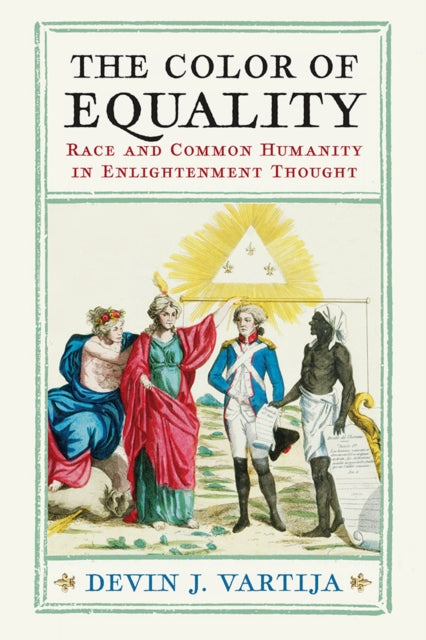
The Enlightenment is often praised as the wellspring of modern egalitarianism or condemned as the cradle of scientific racism. The Color of Equality investigates how eighteenth-century thinkers made sense of these tensions, using three major Enlightenment encyclopedias from England, France, and Switzerland. It demonstrates that Enlightenment ideas of race and equality can best be explained by their attempt to provide a naturalistic account of humanity, including both physical and moral attributes.
Format: Hardback
Length: 312 pages
Publication date: 06 August 2021
Publisher: University of Pennsylvania Press
The Enlightenment, a period of profound intellectual and social transformation, has been both celebrated as the birthplace of modern egalitarianism and criticized as the cradle of scientific racism. This paradoxical nature of the Enlightenment has led to a longstanding debate among scholars about how to make sense of this complex and multifaceted era. In his groundbreaking book, "The Color of Equality," Vartija explores this paradoxical relationship in depth, examining how Enlightenment thinkers grappled with the competing ideas of equality and race.
The Enlightenment was characterized by a profound belief in the power of reason and human progress, and this belief extended to the realm of race. Enlightenment thinkers believed that human beings were not divided by innate biological differences but rather by social and cultural factors. They argued that race was a social construct created by human societies and that individuals could be categorized based on their physical characteristics rather than their genetic makeup.
Despite these progressive ideals, Enlightenment thinkers also perpetuated hierarchical notions of race. They used physical features such as skin color, facial features, and hair texture to categorize humanity into novel racial groups, often with Eurocentric aesthetic and moral judgments. These classifications were imbued with a sense of superiority and inferiority, with certain races being deemed more intelligent, beautiful, or moral than others.
At the same time, Enlightenment thinkers politicized equality by putting it to new uses. They used the concept of equality to denounce slavery and inhumane treatment, grounded in the nascent philosophy of human rights. Enlightenment thinkers such as John Locke and Jean-Jacques Rousseau argued that all individuals, regardless of race, had inherent rights to life, liberty, and the pursuit of happiness.
The tension between Enlightenment ideas of race and equality can best be explained by these thinkers' attempt to provide a naturalistic account of humanity, including both our physical and moral attributes. Enlightenment racial classification fits into the novel inclusion of humanity in histories of nature, while the search for the origins of morality in social experience alone lent equality a normative authority it had not previously possessed.
However, the Enlightenment's legacy of race and equality is complex and multifaceted. While Enlightenment thinkers laid the groundwork for modern egalitarianism and human rights, they also perpetuated harmful stereotypes and biases that continue to impact our society today. The legacy of scientific racism, for example, has led to a persistent and pernicious belief that certain races are inherently superior to others, which has been used to justify discrimination, oppression, and violence.
In conclusion, the Enlightenment's paradoxical relationship with race and equality is a testament to the complex and multifaceted nature of human thought and society. While Enlightenment thinkers made significant contributions to the development of modern egalitarianism and human rights, they also perpetuated harmful stereotypes and biases that continue to impact our society today. Understanding this paradox is essential for navigating the challenges of diversity and inequality in our modern world.
Weight: 648g
Dimension: 163 x 236 x 27 (mm)
ISBN-13: 9780812253191
This item can be found in:
UK and International shipping information
UK and International shipping information
UK Delivery and returns information:
- Delivery within 2 - 3 days when ordering in the UK.
- Shipping fee for UK customers from £2.39. Fully tracked shipping service available.
- Returns policy: Return within 30 days of receipt for full refund.
International deliveries:
Shulph Ink now ships to Australia, Belgium, Canada, France, Germany, Ireland, Italy, India, Luxembourg Saudi Arabia, Singapore, Spain, Netherlands, New Zealand, United Arab Emirates, United States of America.
- Delivery times: within 5 - 10 days for international orders.
- Shipping fee: charges vary for overseas orders. Only tracked services are available for most international orders. Some countries have untracked shipping options.
- Customs charges: If ordering to addresses outside the United Kingdom, you may or may not incur additional customs and duties fees during local delivery.