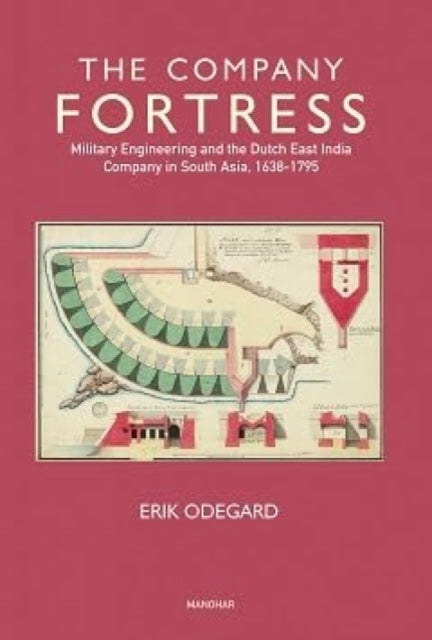
Erik Odegard
The Company Fortress: Military Engineering and the Dutch East India Company in South Asia, 1638-1795
The Company Fortress: Military Engineering and the Dutch East India Company in South Asia, 1638-1795
💎 Earn 385 Points (£3.85) on this item.
- Condition: Brand new
- UK Delivery times: Usually arrives within 2 - 3 working days
- UK Shipping: Fee starts at £2.39. Subject to product weight & dimension
Bulk ordering. Want 15 or more copies? Get a personalised quote and bigger discounts. Learn more about bulk orders.
Couldn't load pickup availability
- More about The Company Fortress: Military Engineering and the Dutch East India Company in South Asia, 1638-1795
The Dutch East India Company (VOC) built and maintained fortifications in present-day India and Sri Lanka, which were important in enabling early modern European expansion. The Company Fortress explores the system of fortifications and their designers, revealing that many were amateurs and contained serious flaws.
Format: Hardback
Length: 306 pages
Publication date: 28 August 2023
Publisher: Manohar Publishers and Distributors
The remains of the Dutch East India Company (VOC) forts can be found scattered across littoral Asia and Africa, but their specific characteristics in enabling early modern European expansion have been the subject of much debate. The Company Fortress addresses this question by examining the fortifications built and maintained by the VOC in present-day India and Sri Lanka. The remaining fortifications in places like Kannur, Sadras, Jaffna, and Galle provide a glimpse into the size and complexity of these works, while cities like Kochi, Nagapattinam, and Colombo were also fortified by the Dutch company. The book delves into the stories of these fortifications and their designers, revealing that many of those responsible for building these forts were amateurs and their creations contained serious flaws, much to the bewilderment of later engineers tasked with improving them.
The VOC was a powerful trading company that controlled a vast territory in Asia and Africa during the 17th and 18th centuries. Its fortifications were designed to protect its trade routes, settlements, and resources from external threats. The fortifications were typically built using a combination of brick, stone, and timber, and were designed to withstand a variety of attacks, including siege warfare, naval bombardment, and land assault.
One of the key characteristics of VOC fortifications was their bastion-trace design. This design involved the construction of a series of bastions, or fortified towers, around the perimeter of the fort. These bastions were connected by a series of trenches and walls, which provided a strong defensive barrier. The bastions were typically designed to be high and thick, with a wide opening at the top to allow for the passage of troops and supplies.
Another characteristic of VOC fortifications was their use of artillery. The company had a large arsenal of cannons and other artillery pieces, which were used to bombard enemy fortifications and ships. The cannons were typically mounted on the bastions and were capable of firing a wide range of projectiles, including cannonballs, grapeshot, and chain shot.
The VOC fortifications were also designed to be self-sufficient. They had a well-developed water supply, a food supply, and a medical facility. This allowed the fortifications to withstand long sieges and to maintain their troops in good health.
However, the VOC fortifications were not without their flaws. One of the most significant flaws was their lack of mobility. The fortifications were designed to be stationary, and this made them vulnerable to attack from mobile forces. This was particularly true in the case of naval bombardment, where enemy ships could easily bypass the fortifications and attack the settlements and resources behind them.
Another flaw of VOC fortifications was their lack of flexibility. The fortifications were designed to be used in a specific way, and this made it difficult for the company to adapt to changing circumstances. For example, the company's fortifications in India were designed to protect against the threat of the Mughal Empire, but the empire eventually collapsed, and the fortifications became obsolete.
Despite these flaws, the VOC fortifications were still a significant force in early modern European expansion. They helped to protect the company's trade routes and settlements from external threats, and they played a key role in the establishment of the Dutch East India Company's empire in Asia and Africa.
In recent years, the remains of VOC fortifications have been the subject of much attention. Many of the fortifications have been restored and preserved, and they have become popular tourist attractions. The Company Fortress has played a key role in this effort, by providing a detailed account of the fortifications and their designers.
The book also highlights the importance of the VOC fortifications in shaping the history of Asia and Africa. The fortifications helped to establish the Dutch East India Company's empire in the region, and they played a key role in the development of trade and commerce in the region. They also helped to shape the political and social landscape of the region, by creating a sense of power and authority for the Dutch company.
However, the VOC fortifications also had a negative impact on the local population. The fortifications were often built on land that was previously used by local communities, and this led to the displacement of many people. The fortifications also required a large amount of resources, which were often taken from the local population, leading to economic hardship and poverty.
In conclusion, the remains of the Dutch East India Company (VOC) forts are scattered throughout littoral Asia and Africa, and their specific characteristics in enabling early modern European expansion have been the subject of much debate. The Company Fortress addresses this question by examining the fortifications built and maintained by the VOC in present-day India and Sri Lanka. The fortifications were designed to protect the company's trade routes, settlements, and resources from external threats, and they played a key role in the establishment of the Dutch East India Company's empire in Asia and Africa. However, the fortifications also had a negative impact on the local population, and it is important to recognize the impact of these fortifications on the history of the region.
Dimension: 250 x 170 (mm)
ISBN-13: 9788119139231
This item can be found in:
UK and International shipping information
UK and International shipping information
UK Delivery and returns information:
- Delivery within 2 - 3 days when ordering in the UK.
- Shipping fee for UK customers from £2.39. Fully tracked shipping service available.
- Returns policy: Return within 30 days of receipt for full refund.
International deliveries:
Shulph Ink now ships to Australia, Belgium, Canada, France, Germany, Ireland, Italy, India, Luxembourg Saudi Arabia, Singapore, Spain, Netherlands, New Zealand, United Arab Emirates, United States of America.
- Delivery times: within 5 - 10 days for international orders.
- Shipping fee: charges vary for overseas orders. Only tracked services are available for most international orders. Some countries have untracked shipping options.
- Customs charges: If ordering to addresses outside the United Kingdom, you may or may not incur additional customs and duties fees during local delivery.