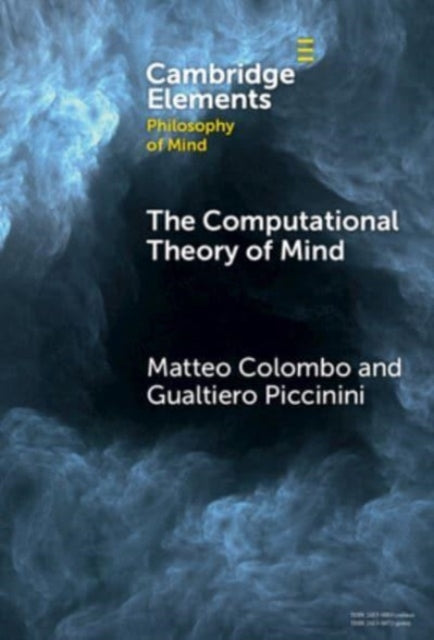
MatteoColombo,GualtieroPiccinini
The Computational Theory of Mind
The Computational Theory of Mind
💎 Earn 275 Points (£2.75) on this item.
We can order this item for you. Delivery usually takes about 4 to 6 weeks.
This item is not held in our immediate stock. We will order it for you after checkout.
Estimated delivery: About 4 to 6 weeks
- Condition: Brand new
- UK Delivery times: Usually arrives within 2 - 3 working days
- UK Shipping: Fee starts at £2.39. Subject to product weight & dimension
Bulk ordering. Want 15 or more copies? Get a personalised quote and bigger discounts. Learn more about bulk orders.
Couldn't load pickup availability
- More about The Computational Theory of Mind
The Computational Theory of Mind suggests that the mind is a computing system that can be explained through analogies with contemporary computing technology and computational models. It has been successful in solving the mind-body problem, explaining mental phenomena, and simulating the brain's workings. However, it still needs to be made compatible with tractability of cognition, situatedness and dynamical aspects of the mind, the way the brain works, intentionality, and consciousness.
Format: Hardback
Length: 75 pages
Publication date: 07 December 2023
Publisher: Cambridge University Press
The Computational Theory of Mind (CTM) posits that the mind functions as a complex computing system. This theory has its roots in the belief that thought can be likened to computational processes. In its contemporary form, CTM draws upon analogies with modern computing technology and employs computational models to explain mental phenomena. There exist various versions of CTM, some of which are more plausible than others.
The primary support for CTM comes from its ability to address the mind-body problem, its capacity to explain mental processes, and the remarkable success of computational modelling and artificial intelligence. However, for CTM to be considered a comprehensive theory, it must align with the tractability of cognition, the situated and dynamic nature of the mind, the functioning of the brain, intentionality, and consciousness.
The mind-body problem, a central concern of CTM, involves understanding how the mind and the physical body interact and influence each other. Traditional theories of mind have struggled to provide a satisfactory explanation for this complex relationship. CTM, on the other hand, proposes that the mind is a computational system that processes information and generates mental states through the manipulation of symbols, such as thoughts and perceptions. This computational perspective allows CTM to address the mind-body problem by proposing that the physical body is merely a computational device that implements the mind's computational processes.
By explaining mental phenomena through computational models, CTM offers a more mechanistic and empirically grounded approach to understanding the mind. These models can simulate the processes of perception, attention, memory, and decision-making, providing insights into how the mind works and how it interacts with the environment. For example, cognitive psychology has employed computational models to study visual perception, showing how the brain processes visual information and how it contributes to our understanding of the world.
Another strength of CTM is its ability to explain mental phenomena that traditional theories of mind have struggled to comprehend. For instance, CTM can account for the emergence of consciousness, the subjective experience of the world, and the ability to think about the future and the past. These phenomena are often considered to be non-computable, as they involve subjective experiences and the manipulation of non-physical entities. However, CTM proposes that consciousness is a computational state that arises from the processing of information by the mind.
Furthermore, CTM has been successful in developing computational models that can replicate human-level performance in various cognitive tasks. This success has led to the development of artificial intelligence (AI) systems that can perform tasks that were once considered the exclusive domain of human intelligence. For example, AI systems can recognize images, understand natural language, and solve complex problems.
However, CTM also faces several challenges and criticisms. One of the main concerns is the issue of consciousness. While CTM can explain the emergence of consciousness as a computational state, it does not provide a clear explanation for the subjective experience of consciousness. Some philosophers argue that consciousness cannot be reduced to a computational process, as it involves a level of subjective experience that cannot be captured by computational models.
Another challenge is the issue of free will. CTM posits that the mind is a computational system that follows deterministic laws of nature. This means that our thoughts and actions are determined by the underlying computational processes and that we have no control over our decisions. However, many people believe in the existence of free will, which suggests that we have the ability to make choices that are not determined by our underlying computational processes.
In conclusion, the Computational Theory of Mind (CTM) offers a powerful and comprehensive framework for understanding the mind as a computing system. By drawing upon analogies with contemporary computing technology and employing computational models, CTM provides a mechanistic and empirically grounded approach to understanding mental phenomena. CTM has been successful in explaining mental phenomena that traditional theories of mind have struggled to comprehend, such as consciousness and free will. However, CTM also faces several challenges and criticisms, such as the issue of consciousness and the issue of free will. As research in this field continues, CTM may evolve and refine its understanding of the mind and its relationship to the physical world.
ISBN-13: 9781009454070
This item can be found in:
UK and International shipping information
UK and International shipping information
UK Delivery and returns information:
- Delivery within 2 - 3 days when ordering in the UK.
- Shipping fee for UK customers from £2.39. Fully tracked shipping service available.
- Returns policy: Return within 30 days of receipt for full refund.
International deliveries:
Shulph Ink now ships to Australia, Belgium, Canada, France, Germany, Ireland, Italy, India, Luxembourg Saudi Arabia, Singapore, Spain, Netherlands, New Zealand, United Arab Emirates, United States of America.
- Delivery times: within 5 - 10 days for international orders.
- Shipping fee: charges vary for overseas orders. Only tracked services are available for most international orders. Some countries have untracked shipping options.
- Customs charges: If ordering to addresses outside the United Kingdom, you may or may not incur additional customs and duties fees during local delivery.