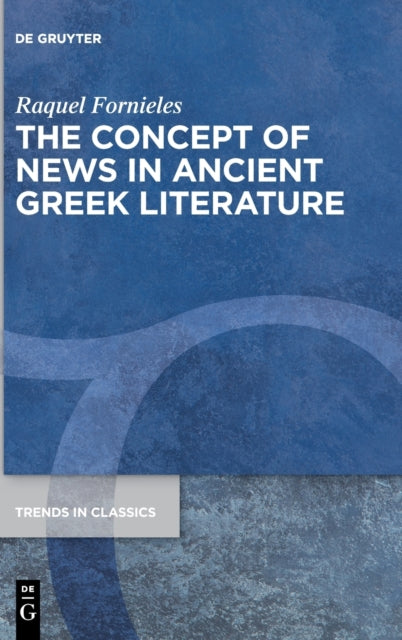
Raquel Fornieles
The Concept of News in Ancient Greek Literature
The Concept of News in Ancient Greek Literature
💎 Earn 444 Points (£4.44) on this item.
YOU SAVE £11.55
- Condition: Brand new
- UK Delivery times: Usually arrives within 2 - 3 working days
- UK Shipping: Fee starts at £2.39. Subject to product weight & dimension
Bulk ordering. Want 15 or more copies? Get a personalised quote and bigger discounts. Learn more about bulk orders.
Couldn't load pickup availability
- More about The Concept of News in Ancient Greek Literature
The concept of news is a social and cultural institution that has been passed down to us by the Greeks, modified by social, political, and economic conditions. A lexical study of ἄγγελος and its derivatives in a representative corpus of the period reveals the presence of false news in ancient Greek literature, especially in tragedy and historiography. This study provides new contributions to Classics and journalism.
Format: Hardback
Length: 292 pages
Publication date: 05 December 2022
Publisher: De Gruyter
The concept of news that we encounter today is not a novel creation, but rather a deeply ingrained social and cultural institution that has been passed down to us through the legacy of the Greeks. While this concept may have undergone certain modifications due to the unique social, political, and economic conditions of our modern society, its core essence remains largely unchanged. To gain a deeper understanding of what constituted news in Ancient Greece, a comprehensive lexical study has been conducted, encompassing all derivatives of the term ἄγγελος attested in a representative corpus of the period spanning from the second millennium BC to the end of the fourth BC. This research not only contributes to the field of Classics, where studies on the transmission of news in Antiquity are relatively scarce, but also has significant implications for journalism.
One of the most intriguing findings of this study is the presence of false news, akin to the contemporary phenomenon of fake news, in ancient Greek literature, particularly in tragedy and historiography. The authors of these works employed various derivatives of ἄγγελος to fabricate or embellish events, creating a narrative that was often misleading or inaccurate. This discovery sheds light on the historical context in which news was disseminated and the challenges faced by writers in maintaining the integrity of their work.
Furthermore, this research offers valuable insights into the cultural and societal values of Ancient Greece. By examining the use of news and its derivatives in ancient Greek literature, we can gain a better understanding of the importance of information, the role of the media in shaping public opinion, and the ethical considerations involved in reporting the news. This knowledge can help us to appreciate the rich heritage of ancient Greek culture and to navigate the complex world of modern journalism with a greater awareness of its historical roots.
In conclusion, the concept of news as we know it today is not a modern invention, but rather a legacy that has been passed down to us by the Greeks. Through a comprehensive lexical study of ἄγγελος and its derivatives, we have gained a deeper understanding of the historical context in which news was disseminated and the challenges faced by writers in maintaining the integrity of their work. This research not only contributes to our knowledge of Classics and journalism but also sheds light on the cultural and societal values of Ancient Greece, helping us to appreciate the rich heritage of this ancient civilization and to navigate the complex world of modern journalism with a greater awareness of its historical roots.
Weight: 618g
Dimension: 164 x 241 x 25 (mm)
ISBN-13: 9783111021669
UK and International shipping information
UK and International shipping information
UK Delivery and returns information:
- Delivery within 2 - 3 days when ordering in the UK.
- Shipping fee for UK customers from £2.39. Fully tracked shipping service available.
- Returns policy: Return within 30 days of receipt for full refund.
International deliveries:
Shulph Ink now ships to Australia, Belgium, Canada, France, Germany, Ireland, Italy, India, Luxembourg Saudi Arabia, Singapore, Spain, Netherlands, New Zealand, United Arab Emirates, United States of America.
- Delivery times: within 5 - 10 days for international orders.
- Shipping fee: charges vary for overseas orders. Only tracked services are available for most international orders. Some countries have untracked shipping options.
- Customs charges: If ordering to addresses outside the United Kingdom, you may or may not incur additional customs and duties fees during local delivery.