William A.Phillips
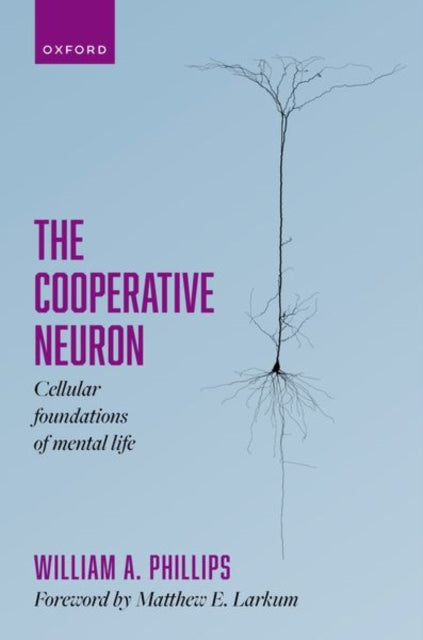
The Cooperative Neuron: Cellular Foundations of Mental Life
The Cooperative Neuron: Cellular Foundations of Mental Life
💎 Earn 297 Points (£2.97) on this item.
We can order this item for you. Delivery usually takes about 4 to 6 weeks.
This item is not held in our immediate stock. We will order it for you after checkout.
Estimated delivery: About 4 to 6 weeks
- Condition: Brand new
- UK Delivery times: Usually arrives within 2 - 3 working days
- UK Shipping: Fee starts at £2.39. Subject to product weight & dimension
Bulk ordering. Want 15 or more copies? Get a personalised quote and bigger discounts. Learn more about bulk orders.
Couldn't load pickup availability
- More about The Cooperative Neuron: Cellular Foundations of Mental Life
The Cooperative Neuron is a groundbreaking book that explores the new field of cellular psychology, which reveals that many neurons in the brain cooperate to seek agreement in deciding what is relevant in the current context. This cooperative context-sensitivity provides the cellular foundations for knowledge, doubt, imagination, self-development, and the search for purpose in life. It has far-reaching implications for psychology, neuroscience, psychiatry, neurology, and philosophy of mind.
Format: Hardback
Length: 384 pages
Publication date: 20 April 2023
Publisher: Oxford University Press
The Cooperative Neuron is at the forefront of a transformative shift in the fields of brain and mind sciences. It delves into the emerging realm of cellular psychology, a discipline rooted in the recent revelation that numerous brain neurons collaborate to reach consensus on what is relevant in the present context. This cooperative context-sensitivity forms the bedrock of knowledge, skepticism, imagination, self-improvement, and the quest for meaning in life. This burgeoning field holds profound implications for psychology, neuroscience, psychiatry, neurology, and the philosophy of mind. Written in a clear and concise manner, the book bridges the gap between neuroscience and psychology, providing insights to both psychologists and neuroscientists, as well as philosophers, students of behavioral and brain sciences, and anyone captivated by the enduring enigma of how brains can manifest as minds.
The discovery of cooperative neurons in the brain has sparked a revolutionary shift in our understanding of how the mind works. These neurons collaborate to seek agreement and determine what is relevant in the current context, providing the cellular foundations for knowledge, doubt, imagination, self-development, and the search for purpose in life. This emerging field has far-reaching implications for psychology, neuroscience, psychiatry, neurology, and the philosophy of mind.
In this book, we explore the neuroscience behind cooperative neurons and their role in shaping our cognitive processes. We also delve into the psychology of cooperation and how it contributes to our understanding of human behavior and social interactions. By bridging the gap between neuroscience and psychology, we aim to provide a comprehensive and accessible guide to the enduring mystery of how brains can be minds.
The cooperative nature of neurons in the brain highlights the importance of collaboration and communication in mental processes. Neurons communicate with each other through electrical and chemical signals, allowing them to coordinate their activities and respond to external stimuli. This cooperation enables us to perform complex tasks, such as thinking, learning, and problem-solving, which would be impossible if each neuron worked in isolation.
Cellular psychology, as a field built upon the discovery of cooperative neurons, offers a new perspective on the nature of knowledge, doubt, imagination, and self-development. It suggests that these cognitive processes are not solely the result of individual neural activity but are also influenced by the interactions and collaborations between neurons. This understanding has implications for our understanding of mental disorders, such as schizophrenia, where abnormal neural activity and cooperation may contribute to the development of symptoms.
Furthermore, the cooperative nature of neurons suggests that the mind is not a separate entity from the brain but is rather an emergent property of the brain's complex network of connections. This perspective challenges the traditional view of the mind as an immaterial entity that exists independently of the physical world. Instead, it suggests that the mind is a product of the brain's physical processes and that understanding the brain is essential to understanding the mind.
The implications of cellular psychology for neuroscience and psychiatry are significant. By understanding the mechanisms underlying cooperative behavior, researchers can develop new treatments for mental disorders that target the brain's neural networks. For example, cognitive-behavioral therapy, which focuses on changing negative thought patterns and behaviors, can be enhanced by targeting cooperative neurons and their interactions.
In conclusion, the discovery of cooperative neurons in the brain has opened up a new field of research that has the potential to transform our understanding of the mind and mental processes. Cellular psychology offers a new perspective on knowledge, doubt, imagination, and self-development, and has implications for psychology, neuroscience, psychiatry, neurology, and the philosophy of mind. By bridging the gap between neuroscience and psychology, we can gain a deeper understanding of the enduring mystery of how brains can be minds.
Weight: 726g
Dimension: 165 x 242 x 24 (mm)
ISBN-13: 9780198876984
This item can be found in:
UK and International shipping information
UK and International shipping information
UK Delivery and returns information:
- Delivery within 2 - 3 days when ordering in the UK.
- Shipping fee for UK customers from £2.39. Fully tracked shipping service available.
- Returns policy: Return within 30 days of receipt for full refund.
International deliveries:
Shulph Ink now ships to Australia, Belgium, Canada, France, Germany, Ireland, Italy, India, Luxembourg Saudi Arabia, Singapore, Spain, Netherlands, New Zealand, United Arab Emirates, United States of America.
- Delivery times: within 5 - 10 days for international orders.
- Shipping fee: charges vary for overseas orders. Only tracked services are available for most international orders. Some countries have untracked shipping options.
- Customs charges: If ordering to addresses outside the United Kingdom, you may or may not incur additional customs and duties fees during local delivery.