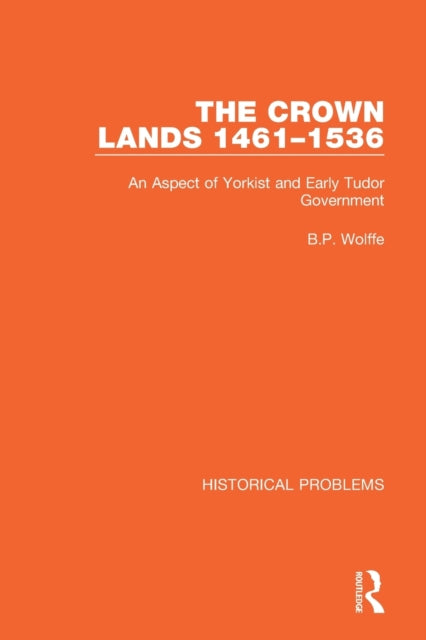
B.P. Wolffe
The Crown Lands 1461-1536: An Aspect of Yorkist and Early Tudor Government
The Crown Lands 1461-1536: An Aspect of Yorkist and Early Tudor Government
💎 Earn 160 Points (£1.60) on this item.
We can order this item for you. Delivery usually takes about 4 to 6 weeks.
This item is not held in our immediate stock. We will order it for you after checkout.
Estimated delivery: About 4 to 6 weeks
YOU SAVE £1.91
- Condition: Brand new
- UK Delivery times: Usually arrives within 2 - 3 working days
- UK Shipping: Fee starts at £2.39. Subject to product weight & dimension
Bulk ordering. Want 15 or more copies? Get a personalised quote and bigger discounts. Learn more about bulk orders.
Couldn't load pickup availability
- More about The Crown Lands 1461-1536: An Aspect of Yorkist and Early Tudor Government
This book examines the history of the Yorkist and early Tudor royal landed estate, providing insight into the changes in Tudor chamber finance and challenging fundamental assumptions in English constitutional history.
Format: Paperback / softback
Length: 212 pages
Publication date: 01 June 2023
Publisher: Taylor & Francis Ltd
Originally published in 1970, this comprehensive volume delves into the rich history of the Yorkist and early Tudor royal landed estate, shedding light on its significance in earlier medieval history and, particularly, in Lancastrian government. By examining the estate in the context of these historical periods, the book offers valuable insights into the nature and origins of the transformative changes that occurred in Tudor chamber finance during the late 15th and early 16th centuries. Notably, many of the documents featured in this publication had not been previously made available to the public. Furthermore, the book challenges fundamental assumptions prevalent in the broader field of English constitutional history, such as the notion that medieval kings of England received their revenues in two distinct categories: "ordinary" and "extraordinary." Additionally, it questions the expectation that these kings were expected to rely solely on their "ordinary revenues" for their livelihood.
The Yorkist and early Tudor royal landed estate played a pivotal role in shaping the political and economic landscape of England during the late medieval and early Tudor periods. This estate, which encompassed vast tracts of land across the country, was not only a source of wealth and power for the ruling elite but also a symbol of their status and authority.
The Yorkist dynasty, which ruled England from 1485 to 1547, was particularly associated with the development and expansion of the royal landed estate. The first Yorkist king, Edward IV, was a skilled administrator who oversaw the consolidation of the estate and the creation of new properties. He also invested heavily in the military, which helped to secure his reign and expand his territories.
During the reign of Edward IV, the Yorkist estate experienced significant growth and development. New properties were acquired, including the crown jewels, the Palace of Whitehall, and the Tower of London. The estate was also expanded through the acquisition of land in Scotland and Ireland, which helped to strengthen the Yorkist grip on the British Isles.
However, the Yorkist dynasty was not without its challenges. The reign of Edward IV was marked by political instability and conflict, which led to the Wars of the Roses between the Houses of Lancaster and York. The wars were fought over the throne and the control of the royal landed estate, and they lasted for over thirty years.
Despite the challenges, the Yorkist estate continued to play a significant role in English politics and society. The Wars of the Roses ultimately ended with the victory of the Lancastrian dynasty, led by Henry VII. However, Henry VII was not interested in the Yorkist estate and sold it off to various individuals and families.
The early Tudor period, which followed the reign of Henry VII, saw a further expansion and development of the royal landed estate. The Tudor dynasty, which ruled England from 1485 to 1603, was characterized by a more centralized government and a greater emphasis on the rule of law. The Tudors also invested heavily in the military, which helped to secure their reign and expand their territories.
During the reign of Henry VIII, the royal landed estate experienced significant growth and development. New properties were acquired, including the Palace of Westminster, the Tower of London, and the Palace of Whitehall. The estate was also expanded through the acquisition of land in France and Ireland, which helped to strengthen the Tudor grip on Europe.
However, the Tudor dynasty was not without its challenges. The reign of Henry VIII was marked by religious reform and the break from the Roman Catholic Church, which led to the English Reformation. The Reformation also led to the dissolution of the monasteries and the sale of their land, which significantly impacted the royal landed estate.
Despite the challenges, the royal landed estate continued to play a significant role in English politics and society. The Tudors also invested heavily in the arts and culture, which helped to promote the English Renaissance and the development of English literature and art.
In conclusion, the Yorkist and early Tudor royal landed estate played a pivotal role in shaping the political and economic landscape of England during the late medieval and early Tudor periods. The estate was not only a source of wealth and power for the ruling elite but also a symbol of their status and authority. The Yorkist dynasty, particularly Edward IV, oversaw significant growth and development of the estate, while the early Tudor period saw further expansion and development under the Tudors. Despite the challenges faced by the dynasties, the royal landed estate continued to play a significant role in English politics and society.
Weight: 400g
Dimension: 234 x 156 (mm)
ISBN-13: 9781032042039
UK and International shipping information
UK and International shipping information
UK Delivery and returns information:
- Delivery within 2 - 3 days when ordering in the UK.
- Shipping fee for UK customers from £2.39. Fully tracked shipping service available.
- Returns policy: Return within 30 days of receipt for full refund.
International deliveries:
Shulph Ink now ships to Australia, Belgium, Canada, France, Germany, Ireland, Italy, India, Luxembourg Saudi Arabia, Singapore, Spain, Netherlands, New Zealand, United Arab Emirates, United States of America.
- Delivery times: within 5 - 10 days for international orders.
- Shipping fee: charges vary for overseas orders. Only tracked services are available for most international orders. Some countries have untracked shipping options.
- Customs charges: If ordering to addresses outside the United Kingdom, you may or may not incur additional customs and duties fees during local delivery.