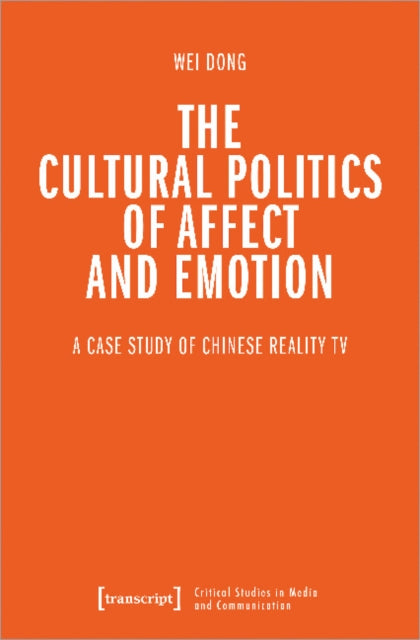
Wei Dong
The Cultural Politics of Affect and Emotion: A Case Study of Chinese Reality TV
The Cultural Politics of Affect and Emotion: A Case Study of Chinese Reality TV
💎 Earn 206 Points (£2.06) on this item.
YOU SAVE £8.70
- Condition: Brand new
- UK Delivery times: Usually arrives within 2 - 3 working days
- UK Shipping: Fee starts at £2.39. Subject to product weight & dimension
Bulk ordering. Want 15 or more copies? Get a personalised quote and bigger discounts. Learn more about bulk orders.
Couldn't load pickup availability
- More about The Cultural Politics of Affect and Emotion: A Case Study of Chinese Reality TV
Wei Dong investigates the entanglements between emotion, subjectivity, ideology, identity, and hegemonic power in Chinese reality TV, focusing on how emotions are appropriated and disciplined by regimes of power and identity and how affect (primarily kuqing) can challenge or exceed existing relations of power in the mediascape.
Format: Paperback / softback
Length: 234 pages
Publication date: 15 August 2022
Publisher: Transcript Verlag
Against the backdrop of China's media commercialization reform since the 1990s, and drawing on the case study of X-Change (2006-2019), Wei Dong delves into the intricate interplay between emotion, subjectivity, ideology, identity, and hegemonic power within the multimodal text of the program. The central focus lies in examining how emotions are appropriated and disciplined by regimes of power and identity, as well as the potential for affect, particularly kuqing (bitter emotions) conveyed through material and bodily expressions, to challenge or exceed existing power relations in the mediascape. Through his analysis, Wei Dong demonstrates how Chinese reality TV offers a historical and theoretical lens for understanding the affective dynamics of contemporary China in the ever-evolving process of fracture and integration.
The media commercialization reform in China since the 1990s has brought about significant changes in the country's media landscape. This reform has led to the increasing commercialization of media outlets, the expansion of media conglomerates, and the rise of new media technologies. These changes have had a profound impact on the way news and entertainment are produced, distributed, and consumed in China.
One of the most notable effects of the media commercialization reform has been the increasing commodification of news and entertainment. Media outlets have become more focused on generating revenue through advertising and subscription fees, rather than on providing quality journalism and entertainment. This has led to a decline in the quality of content, as media outlets prioritize profits over journalistic integrity.
Another effect of the media commercialization reform has been the expansion of media conglomerates. These conglomerates have become dominant in the Chinese media industry, controlling a large share of the market and influencing the content produced by media outlets. This has led to a concentration of power in the hands of a few companies, which has raised concerns about media independence and the ability of the media to hold powerful institutions accountable.
The rise of new media technologies has also had a significant impact on the Chinese media industry. Social media platforms, such as Weibo and WeChat, have become increasingly popular in China, allowing individuals to express their opinions and share news and entertainment content. These platforms have also provided new opportunities for media outlets to reach a wider audience and generate revenue through advertising and subscription fees.
However, the media commercialization reform has also brought about challenges and risks. One of the biggest challenges is the lack of regulation and oversight in the media industry. Media outlets are often free to produce and distribute content without being held accountable for their actions. This has led to the spread of misinformation, hate speech, and other harmful content, which can have negative consequences for society.
Another challenge is the concentration of power in the hands of a few companies. This concentration of power has led to concerns about media bias and the ability of the media to provide unbiased coverage of important issues. Media outlets may be influenced by the interests of their owners or advertisers, which can lead to the suppression of information or the promotion of certain ideologies.
Despite these challenges, the media commercialization reform has also brought about some positive changes in the Chinese media industry. The expansion of media outlets has led to greater diversity in the types of content available to the public, and the rise of new media technologies has provided new opportunities for individuals to express their opinions and engage with the media.
In conclusion, the media commercialization reform in China since the 1990s has had a profound impact on the country's media landscape. While the reform has brought about some positive changes, such as greater diversity in the types of content available and new opportunities for individuals to engage with the media, it has also brought about challenges and risks. It is important for the Chinese government to continue to regulate and oversee the media industry to ensure that the media can provide quality journalism and entertainment to the public, while also promoting media independence and the ability of the media to hold powerful institutions accountable.
Dimension: 23 x 15 (mm)
ISBN-13: 9783837662849
UK and International shipping information
UK and International shipping information
UK Delivery and returns information:
- Delivery within 2 - 3 days when ordering in the UK.
- Shipping fee for UK customers from £2.39. Fully tracked shipping service available.
- Returns policy: Return within 30 days of receipt for full refund.
International deliveries:
Shulph Ink now ships to Australia, Belgium, Canada, France, Germany, Ireland, Italy, India, Luxembourg Saudi Arabia, Singapore, Spain, Netherlands, New Zealand, United Arab Emirates, United States of America.
- Delivery times: within 5 - 10 days for international orders.
- Shipping fee: charges vary for overseas orders. Only tracked services are available for most international orders. Some countries have untracked shipping options.
- Customs charges: If ordering to addresses outside the United Kingdom, you may or may not incur additional customs and duties fees during local delivery.