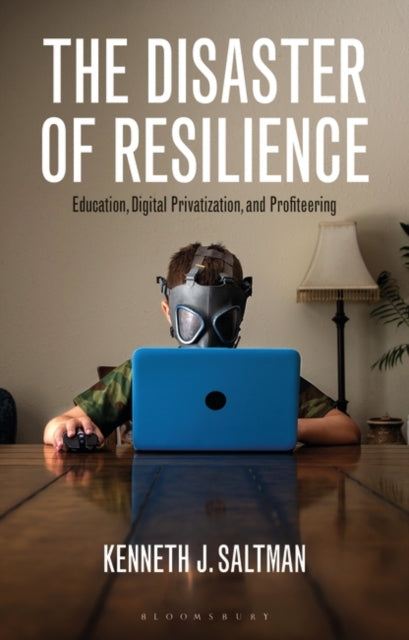
Kenneth J.Saltman
The Disaster of Resilience: Education, Digital Privatization, and Profiteering
The Disaster of Resilience: Education, Digital Privatization, and Profiteering
💎 Earn 79 Points (£0.79) on this item.
YOU SAVE £2.07
- Condition: Brand new
- UK Delivery times: Usually arrives within 2 - 3 working days
- UK Shipping: Fee starts at £2.39. Subject to product weight & dimension
Bulk ordering. Want 15 or more copies? Get a personalised quote and bigger discounts. Learn more about bulk orders.
Couldn't load pickup availability
- More about The Disaster of Resilience: Education, Digital Privatization, and Profiteering
The past decade has seen a vast expansion of resilience pedagogies, policies, and products in public education, but Saltman argues that resilience has provided the justification for new educational profiteering and that we must replace it with pedagogies and curriculum that allow students to see beyond their conditions and act collectively on social, economic, and racial injustices.
Format: Paperback / softback
Length: 168 pages
Publication date: 14 December 2023
Publisher: Bloomsbury Publishing PLC
The past decade has witnessed a remarkable expansion of resilience pedagogies, policies, and products in public education, ranging from the Every Student Succeeds Act to social and emotional learning to grit. Educational apps, avatars, and games, as well as behaviorist techniques, meditation programs, and biometric devices, all claim to impart resilience to students in adverse social conditions. At the same time, new cyber schools, education brokers, global democracy promotion companies, and dropout recovery firms promise schools resilience to disaster and disruption.
The Disaster of Resilience, a book by Daniel Saltman, delves into the intricate relationship between resilience discourse and the new digital directions of educational privatization. Saltman argues that resilience has served as a justification for new educational profiteering, perpetuating a climate that individualizes collective responsibilities, depoliticizes and dehistoricizes knowledge and curriculum, and falsely grounds its politics in a mix of pseudoscience and human capital theory. He contends that we must replace resilience discourse with pedagogies and curriculum that enable students not only to endure the intolerable conditions they encounter but also to see beyond those conditions and to act collectively to address the social, economic, and racial injustices that have contributed to their existence.
In this expansion of resilience initiatives, there is a growing concern about the potential risks and unintended consequences associated with these approaches. Some critics argue that resilience discourse can perpetuate harmful stereotypes and reinforce existing power structures, while others suggest that it may lead to the marginalization of students who do not possess the "right" resilience traits. Additionally, the emphasis on individual resilience can overshadow the need for systemic change and address the root causes of social and economic inequality.
To address these concerns, it is essential to develop a more nuanced and critical understanding of resilience. Resilience should not be seen as a fixed trait or a panacea for all social problems, but rather as a process that can be cultivated and supported through education and social interventions. This requires a shift from a narrow focus on individual resilience to a broader understanding of social and environmental factors that contribute to resilience and the collective efforts needed to address them.
Furthermore, it is important to recognize the role of education in promoting social and economic justice. Education should be a tool for empowering students to critically analyze the world around them, develop empathy and compassion, and engage in collective action to address social and economic inequalities. This requires a curriculum that is inclusive, culturally responsive, and socially relevant, and that provides students with the skills and knowledge they need to thrive in an increasingly complex and interconnected world.
In conclusion, the past decade has seen a significant expansion of resilience pedagogies, policies, and products in public education. While these initiatives have the potential to improve student well-being and promote social resilience, it is essential to approach them with a critical eye and to be aware of the potential risks and unintended consequences. By developing a more nuanced and critical understanding of resilience, and by promoting education that is inclusive, culturally responsive, and socially relevant, we can create a more equitable and just educational system that prepares students for the challenges they will face in the 21st century.
Weight: 220g
Dimension: 138 x 216 x 14 (mm)
ISBN-13: 9781350342408
UK and International shipping information
UK and International shipping information
UK Delivery and returns information:
- Delivery within 2 - 3 days when ordering in the UK.
- Shipping fee for UK customers from £2.39. Fully tracked shipping service available.
- Returns policy: Return within 30 days of receipt for full refund.
International deliveries:
Shulph Ink now ships to Australia, Belgium, Canada, France, Germany, Ireland, Italy, India, Luxembourg Saudi Arabia, Singapore, Spain, Netherlands, New Zealand, United Arab Emirates, United States of America.
- Delivery times: within 5 - 10 days for international orders.
- Shipping fee: charges vary for overseas orders. Only tracked services are available for most international orders. Some countries have untracked shipping options.
- Customs charges: If ordering to addresses outside the United Kingdom, you may or may not incur additional customs and duties fees during local delivery.