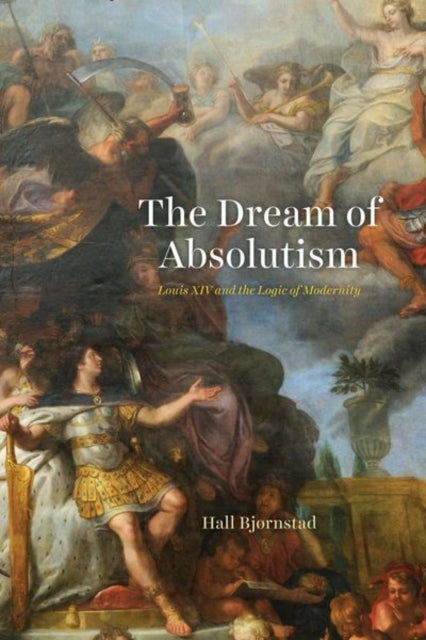
Hall Bj?rnstad
The Dream of Absolutism: Louis XIV and the Logic of Modernity
The Dream of Absolutism: Louis XIV and the Logic of Modernity
💎 Earn 395 Points (£3.95) on this item.
YOU SAVE £3.98
- Condition: Brand new
- UK Delivery times: Usually arrives within 2 - 3 working days
- UK Shipping: Fee starts at £2.39. Subject to product weight & dimension
Bulk ordering. Want 15 or more copies? Get a personalised quote and bigger discounts. Learn more about bulk orders.
Couldn't load pickup availability
- More about The Dream of Absolutism: Louis XIV and the Logic of Modernity
During the reign of Louis XIV, absolutism was a dream shared by the king, court, image-makers, and nation, manifested in extravagant displays at Versailles. Hall Bjornstad argues that this dream was not top-down propaganda but a collective vision that shaped politics and aesthetics and continues to influence our political imagination today.
Format: Hardback
Length: 248 pages
Publication date: 15 October 2021
Publisher: The University of Chicago Press
Absolutism was a political ideology that emerged in Europe during the 16th and 17th centuries, characterized by the belief in the absolute authority of a ruler or monarch. It was a reaction against the feudal system, which had limited the power of kings and nobles.
Absolutism worked by centralizing power in the hands of a single ruler, who had the authority to make laws, appoint officials, and control the military. This allowed for greater efficiency and stability in government, as well as the ability to implement policies quickly and effectively.
The ostentatious display surrounding Louis XIV at Versailles was a key aspect of absolutist culture. The palace was designed to showcase the power and wealth of the king, and it was filled with lavish decorations, sculptures, and artwork. The Hall of Mirrors, in particular, was a masterpiece of architectural design that reflected the king's glory and power.
The function of this display was to reinforce the idea of absolutism and to demonstrate the king's superiority to his subjects. It was also a way to intimidate rivals and foreign powers, who were impressed by the grandeur and opulence of the palace.
However, there were also criticisms of absolutism. One of the main concerns was the lack of political freedom and individual rights. Under absolutism, the king had absolute power over his subjects, and there was little room for dissent or opposition. This could lead to abuses of power and the repression of certain groups or individuals.
Another criticism was the economic impact of absolutism. The centralization of power in the hands of a single ruler could lead to inefficient government and the concentration of wealth in the hands of a few. This could lead to economic instability and social unrest, as people struggled to find their place in a society that was dominated by the king.
In recent years, scholars have approached absolutism as propaganda, focusing on the ways in which it was used to promote the king's power and authority. This approach has been criticized for oversimplifying the complex political and social dynamics of absolutist culture.
One of the key arguments made by Hall Bjornstad in his book "The Dream of Absolutism" is that the exuberance of Louis XIV's reign was not top-down propaganda in any modern sense. Rather, it was a dream dreamt collectively by the king, court, image-makers, and nation alike. Bjornstad explores this dream through a sustained close analysis of a corpus of absolutist artifacts, ranging from Charles Le Brun's famous paintings in the Hall of Mirrors at Versailles via the king's secret Memoires to two little-known particularly extravagant verbal and textual celebrations of the king.
Bjornstad concludes that the dream of absolutism lives at the intersection of politics and aesthetics. It is the carrier of a force that emerges as a glorious image; a participatory emotional reality that requires reality to conform to it. It is a dream, finally, that still shapes our collective political imaginary today.
In conclusion, absolutism was a political ideology that emerged in Europe during the 16th and 17th centuries, characterized by the belief in the absolute authority of a ruler or monarch. It worked by centralizing power in the hands of a single ruler, who had the authority. The ostentatious display surrounding Louis XIV at Versailles was a key aspect of absolutist culture, designed to reinforce the idea of absolutism and demonstrate the king's superiority to his subjects. While there were criticisms of absolutism, such as the lack of political freedom and individual rights, it was also a way to promote the king's power and authority. In recent years, scholars have approached absolutism as propaganda, focusing on the ways in which it was used to promote the king's power and authority. However, Hall Bjornstad argues that the exuberance of Louis XIV's reign was not top-down propaganda in any modern sense, but rather a dream dreamt collectively by the king, court, image-makers, and nation alike. The dream of absolutism lives at the intersection of politics and aesthetics, carrying a force that emerges as a glorious image and a participatory emotional reality that requires reality to conform to it. It is a dream that still shapes our collective political imaginary today.
Weight: 468g
Dimension: 344 x 288 x 19 (mm)
ISBN-13: 9780226803661
This item can be found in:
UK and International shipping information
UK and International shipping information
UK Delivery and returns information:
- Delivery within 2 - 3 days when ordering in the UK.
- Shipping fee for UK customers from £2.39. Fully tracked shipping service available.
- Returns policy: Return within 30 days of receipt for full refund.
International deliveries:
Shulph Ink now ships to Australia, Belgium, Canada, France, Germany, Ireland, Italy, India, Luxembourg Saudi Arabia, Singapore, Spain, Netherlands, New Zealand, United Arab Emirates, United States of America.
- Delivery times: within 5 - 10 days for international orders.
- Shipping fee: charges vary for overseas orders. Only tracked services are available for most international orders. Some countries have untracked shipping options.
- Customs charges: If ordering to addresses outside the United Kingdom, you may or may not incur additional customs and duties fees during local delivery.