Shulph Ink
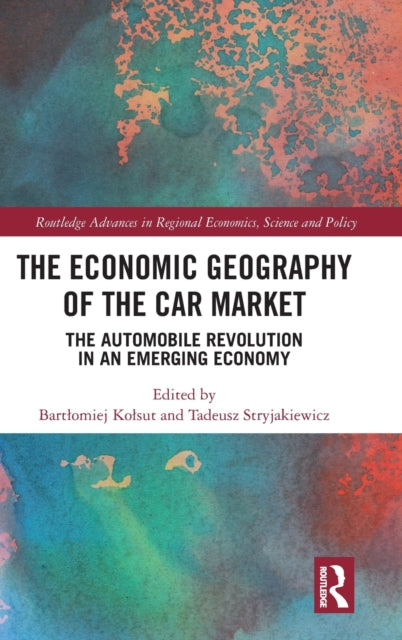
The Economic Geography of the Car Market: The Automobile Revolution in an Emerging Economy
The Economic Geography of the Car Market: The Automobile Revolution in an Emerging Economy
💎 Earn 811 Points (£8.11) on this item.
We can order this item for you. Delivery usually takes about 4 to 6 weeks.
This item is not held in our immediate stock. We will order it for you after checkout.
Estimated delivery: About 4 to 6 weeks
YOU SAVE £9.63
- Condition: Brand new
- UK Delivery times: Usually arrives within 2 - 3 working days
- UK Shipping: Fee starts at £2.39. Subject to product weight & dimension
Bulk ordering. Want 15 or more copies? Get a personalised quote and bigger discounts. Learn more about bulk orders.
Couldn't load pickup availability
- More about The Economic Geography of the Car Market: The Automobile Revolution in an Emerging Economy
This book analyzes long-term changes in the car market of an emerging economy, focusing on Poland's unique laboratory of automobile revolution during the late 20th and early 21st centuries. It discusses car ownership, markets for new cars, import of second-hand cars, car use, electromobility, and environmental impact, and how these aspects relate to sustainable development goals. The book combines quantitative and qualitative research, using big data and social surveys, and explores the geography of automobile revolution in the context of other social, economic, and spatial phenomena. It will be of interest to scholars, students, and practitioners in transport research, geography of transportation, spatial economy, urban and regional planning, and sustainability studies, as well as car hobbyists.
Format: Hardback
Length: 194 pages
Publication date: 26 September 2022
Publisher: Taylor & Francis Ltd
This comprehensive book delves into the profound long-term transformations of an emerging economy's car market, with a special emphasis on its spatial and temporal dimensions. Poland serves as a unique case study, showcasing a remarkable automobile revolution during the late 20th and early 21st centuries. The volume uncovers a multitude of critical aspects of the car market, including car ownership, new car markets, second-hand car imports, car usage patterns, electromobility, and environmental impact. These topics are at the forefront of global discussions in the pursuit of sustainable development goals. At the same time, the book highlights the distinct nature of the transformations experienced in Poland's car market. By examining these multifaceted aspects, the book contributes significantly to the international literature, expanding the discourse on the car market to encompass emerging economies, particularly those in Central and Eastern Europe.
The research employed a combination of quantitative and qualitative methodologies. The quantitative analysis relies on a vast big data set, encompassing approximately 40 million vehicles, providing valuable insights into market trends and patterns. On the other hand, the qualitative research involves in-depth social survey questionnaires, conducted with over 4,000 drivers, which shed light on drivers' preferences, decision-making processes, and the impact of cars on their quality of life.
The book's discussion of the geography of automobile revolution intertwines with various social, economic, and spatial phenomena and processes. It explores the interplay between urban sprawl, rural marginalization, consumer choices, quality of life improvements, and the development of individual entrepreneurship and environmental protection. Additionally, the analysis considers the influence of transport, tax, and customs policies on the car market.
The book pays particular attention to critical junctures that have shaped the dynamics of change in the car market. These pivotal moments include the collapse of the communist system, EU membership, the global financial crisis (2007-2009), and the initial phase of the COVID-19 pandemic (2020-2021). By examining these turning points, the book offers valuable insights into the short-term and long-term impacts of these events on the car market, as well as their broader societal implications.
In conclusion, this book provides a comprehensive and insightful examination of the long-term changes in the car market of an emerging economy, with a focus on Poland as a case study. By exploring a wide range of critical aspects, including car ownership, markets, imports, usage, electromobility, and environmental impact, the book contributes to the growing body of knowledge on the car market in emerging economies. The book's interdisciplinary approach, combining quantitative and qualitative research methodologies, enables a deeper understanding of the complex relationships and dynamics at play in the car market, ultimately shedding light on the pathways toward sustainable development and the unique characteristics of transformations in Poland.
Weight: 544g
Dimension: 234 x 156 (mm)
ISBN-13: 9781032314204
This item can be found in:
UK and International shipping information
UK and International shipping information
UK Delivery and returns information:
- Delivery within 2 - 3 days when ordering in the UK.
- Shipping fee for UK customers from £2.39. Fully tracked shipping service available.
- Returns policy: Return within 30 days of receipt for full refund.
International deliveries:
Shulph Ink now ships to Australia, Belgium, Canada, France, Germany, Ireland, Italy, India, Luxembourg Saudi Arabia, Singapore, Spain, Netherlands, New Zealand, United Arab Emirates, United States of America.
- Delivery times: within 5 - 10 days for international orders.
- Shipping fee: charges vary for overseas orders. Only tracked services are available for most international orders. Some countries have untracked shipping options.
- Customs charges: If ordering to addresses outside the United Kingdom, you may or may not incur additional customs and duties fees during local delivery.