InaMoeller
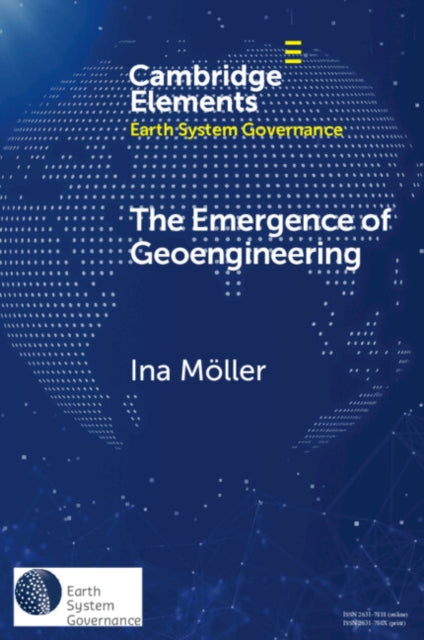
The Emergence of Geoengineering: How Knowledge Networks Form Governance Objects
The Emergence of Geoengineering: How Knowledge Networks Form Governance Objects
💎 Earn 84 Points (£0.84) on this item.
We can order this item for you. Delivery usually takes about 4 to 6 weeks.
This item is not held in our immediate stock. We will order it for you after checkout.
Estimated delivery: About 4 to 6 weeks
YOU SAVE £1.01
- Condition: Brand new
- UK Delivery times: Usually arrives within 2 - 3 working days
- UK Shipping: Fee starts at £2.39. Subject to product weight & dimension
Bulk ordering. Want 15 or more copies? Get a personalised quote and bigger discounts. Learn more about bulk orders.
Couldn't load pickup availability
- More about The Emergence of Geoengineering: How Knowledge Networks Form Governance Objects
Geoengineering has evolved from a controversial idea to a governance object that is likely to shape the future of climate politics. This Element provides an analysis of the recent history and evolution of geoengineering as a governance object, explaining how it evolved from a thought shared by a small network into a governance object that is in need of international governance.
Format: Paperback / softback
Length: 75 pages
Publication date: 09 February 2023
Publisher: Cambridge University Press
Geoengineering has been a controversial topic in climate change science and politics for many years. However, recent developments have made visions of massive carbon drawdown and sunlight reflection more reasonable additions to conventional mitigation and adaptation strategies. This Element provides an analysis of the recent history and evolution of geoengineering as a governance object. It explains how geoengineering evolved from a thought shared by a small network of scientists into a governance object that is likely to shape the future of climate politics. In the process, it generates a theory on the earliest phase of the policy cycle and sheds light on the question of why we govern the things we govern in the first place.
Geoengineering has been a controversial topic in climate change science and politics for many years. However, recent developments have made visions of massive carbon drawdown and sunlight reflection more reasonable additions to conventional mitigation and adaptation strategies. This Element provides an analysis of the recent history and evolution of geoengineering as a governance object. It explains how geoengineering evolved from a thought shared by a small network of scientists into a governance object that is likely to shape the future of climate politics. In the process, it generates a theory on the earliest phase of the policy cycle and sheds light on the question of why we govern the things we govern in the first place.
Geoengineering has been a controversial topic in climate change science and politics for many years. However, recent developments have made visions of massive carbon drawdown and sunlight reflection more reasonable additions to conventional mitigation and adaptation strategies. This Element provides an analysis of the recent history and evolution of geoengineering as a governance object. It explains how geoengineering evolved from a thought shared by a small network of scientists into a governance object that is likely to shape the future of climate politics. In the process, it generates a theory on the earliest phase of the policy cycle and sheds light on the question of why we govern the things we govern in the first place.
Geoengineering has been a controversial topic in climate change science and politics for many years. However, recent developments have made visions of massive carbon drawdown and sunlight reflection more reasonable additions to conventional mitigation and adaptation strategies. This Element provides an analysis of the recent history and evolution of geoengineering as a governance object. It explains how geoengineering evolved from a thought shared by a small network of scientists into a governance object that is likely to shape the future of climate politics. In the process, it generates a theory on the earliest phase of the policy cycle and sheds light on the question of why we govern the things we govern in the first place.
ISBN-13: 9781009048958
This item can be found in:
UK and International shipping information
UK and International shipping information
UK Delivery and returns information:
- Delivery within 2 - 3 days when ordering in the UK.
- Shipping fee for UK customers from £2.39. Fully tracked shipping service available.
- Returns policy: Return within 30 days of receipt for full refund.
International deliveries:
Shulph Ink now ships to Australia, Belgium, Canada, France, Germany, Ireland, Italy, India, Luxembourg Saudi Arabia, Singapore, Spain, Netherlands, New Zealand, United Arab Emirates, United States of America.
- Delivery times: within 5 - 10 days for international orders.
- Shipping fee: charges vary for overseas orders. Only tracked services are available for most international orders. Some countries have untracked shipping options.
- Customs charges: If ordering to addresses outside the United Kingdom, you may or may not incur additional customs and duties fees during local delivery.