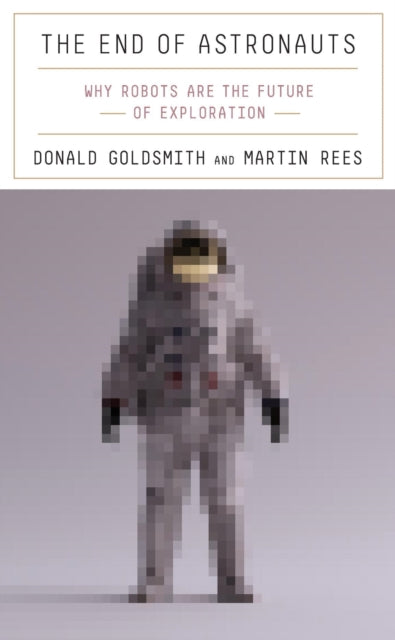
Donald Goldsmith,Martin Rees
The End of Astronauts: Why Robots Are the Future of Exploration
The End of Astronauts: Why Robots Are the Future of Exploration
💎 Earn 90 Points (£0.90) on this item.
YOU SAVE £4.80
- Condition: Brand new
- UK Delivery times: Usually arrives within 2 - 3 working days
- UK Shipping: Fee starts at £2.39. Subject to product weight & dimension
Bulk ordering. Want 15 or more copies? Get a personalised quote and bigger discounts. Learn more about bulk orders.
Couldn't load pickup availability
- More about The End of Astronauts: Why Robots Are the Future of Exploration
Donald Goldsmith and Martin Rees argue that space exploration should proceed beyond low-Earth orbit without humans, as it is more cost-effective and safer. They suggest that robots can investigate planetary surfaces efficiently and effectively, operating autonomously or under direction from Earth. Decades of research and experience support their arguments, and the book also examines how spacefaring AI might be regulated.
Format: Hardback
Length: 192 pages
Publication date: 01 April 2022
Publisher: Harvard University Press
A History Today Book of the Year
A renowned astronomer and esteemed science writer present a compelling case for space exploration without astronauts.
Human ventures into space evoke a sense of wonder. However, the exhilaration of space travel for astronauts comes at a substantial cost and carries inherent risks. As our robot explorers become increasingly capable, governments and corporations must ponder whether the desire to send astronauts to the Moon and Mars justifies the expense and danger. Donald Goldsmith and Martin Rees argue in their book, "The End of Astronauts," that beyond low-Earth orbit, space exploration should proceed without humans.
In "The End of Astronauts," Goldsmith and Rees delve into the merits and demerits of human exploration across the solar system. In space, humans necessitate air, food, water, and protection against potentially lethal radiation and high-energy particles, at a cost that exceeds ten times that of robotic exploration. On the other hand, automated explorers have proven their efficiency in exploring planetary surfaces, either autonomously or under the guidance of Earth. While Goldsmith and Rees acknowledge the limitations of artificial intelligence, they recognize that robots continue to improve, whereas human bodies do not. Today, a robot cannot match the expertise of a geologist, but by the time we land a geologist on Mars, this advantage will significantly diminish.
Decades of research, combined with interviews with scientific authorities and former astronauts, provide compelling arguments in favor of robots as the future of space exploration. "The End of Astronauts" also explores the regulation of spacefaring AI, as corporations race to privatize the stars. While we may ultimately conclude that humans belong in space despite the dangers and expenses, their journeys will likely take different forms.
Weight: 318g
Dimension: 145 x 224 x 22 (mm)
ISBN-13: 9780674257726
UK and International shipping information
UK and International shipping information
UK Delivery and returns information:
- Delivery within 2 - 3 days when ordering in the UK.
- Shipping fee for UK customers from £2.39. Fully tracked shipping service available.
- Returns policy: Return within 30 days of receipt for full refund.
International deliveries:
Shulph Ink now ships to Australia, Belgium, Canada, France, Germany, Ireland, Italy, India, Luxembourg Saudi Arabia, Singapore, Spain, Netherlands, New Zealand, United Arab Emirates, United States of America.
- Delivery times: within 5 - 10 days for international orders.
- Shipping fee: charges vary for overseas orders. Only tracked services are available for most international orders. Some countries have untracked shipping options.
- Customs charges: If ordering to addresses outside the United Kingdom, you may or may not incur additional customs and duties fees during local delivery.