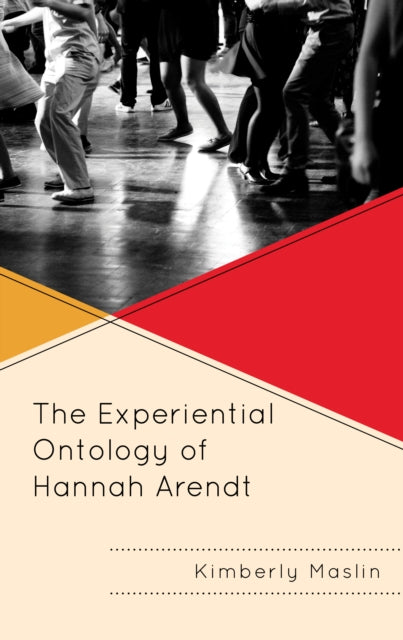
Kimberly Maslin
The Experiential Ontology of Hannah Arendt
The Experiential Ontology of Hannah Arendt
💎 Earn 191 Points (£1.91) on this item.
We can order this item for you. Delivery usually takes about 4 to 6 weeks.
This item is not held in our immediate stock. We will order it for you after checkout.
Estimated delivery: About 4 to 6 weeks
- Condition: Brand new
- UK Delivery times: Usually arrives within 2 - 3 working days
- UK Shipping: Fee starts at £2.39. Subject to product weight & dimension
Bulk ordering. Want 15 or more copies? Get a personalised quote and bigger discounts. Learn more about bulk orders.
Couldn't load pickup availability
- More about The Experiential Ontology of Hannah Arendt
Kim Maslin's book explores Hannah Arendt's political philosophy through a Heideggerian framework, arguing that she became one of Heidegger's most astute critics while also recognizing his profound insights and limitations. Arendt's project aimed to modify Heidegger's fundamental ontology for use in the public sphere, seeking to address its collective implications and create a more politically responsive and responsible approach.
Format: Paperback / softback
Length: 234 pages
Publication date: 15 May 2022
Publisher: Lexington Books
In her book "The Experiential Ontology of Hannah Arendt,"Kim Maslin delves into the political philosophy of Hannah Arendt by employing a Heideggerian framework. Maslin contends that Arendt transcended her initial role as a naïve and impressionable student and emerged as one of Heidegger's most astute critics. Arendt, who was well-versed in and deeply respectful of Heidegger's contributions to existential philosophy, regarded his work as both profoundly insightful and remarkably narrow-minded. Instead of merely offering a critique of her mentor's work, Arendt embarked on a lifelong endeavor to grapple with the collective ramifications of fundamental ontology. According to Maslin, Arendt's transition to political philosophy was not driven by her personal disappointment at Heidegger's personal betrayal but rather by her desire to rectify the collective shortcomings of fundamental ontology. Her project proposes a politically responsive and responsible modification of Heidegger's fundamental ontology, aimed at its application in the public sphere. Maslin demonstrates how Arendt endeavors to construct an experiential ontology that transforms Heidegger's ontology for use in the broader context of society.
Arendt's project aimed to address the limitations of Heidegger's allegedly descriptive and non-normative insight into the nature of being. She argued that this insight must be approached with a consciousness of the collective implications, as it could potentially be incomplete and even irresponsible. Arendt sought to develop an experiential ontology that would serve as a means to rectify the collective flaws of fundamental ontology and make it more applicable to the public realm.
One of the key aspects of Arendt's approach was her emphasis on the role of human experience in shaping our understanding of the world. She argued that our experiences, both individual and collective, are essential in shaping our understanding of the fundamental categories of being, such as existence, identity, and freedom. Arendt believed that by engaging with the experiential dimension of ontology, we can gain a more comprehensive and nuanced understanding of the world and our place in it.
To achieve this, Arendt drew on a range of philosophical sources, including Heidegger, Kant, and Nietzsche. She also incorporated insights from political theory, sociology, and history to develop her own unique perspective on the nature of politics and the role of the individual in society.
One of the most significant contributions of Arendt's experiential ontology is its emphasis on the political dimension of human existence. She argued that politics is not merely a matter of governing or ruling but is also a deeply human activity that involves the exercise of our freedom and our capacity for judgment. Arendt believed that politics is not just about achieving certain goals or pursuing certain interests but is also about the cultivation of our moral and ethical values.
Another important aspect of Arendt's approach is her recognition of the role of power in shaping our experiences and our understanding of the world. She argued that power is not just a physical force or a means of coercion but is also a social and cultural construct that shapes our relationships with one another and our sense of self. Arendt believed that by understanding the nature of power and its relationship to our experiences, we can gain a deeper understanding of the political dynamics that shape our societies and our lives.
In conclusion, Kim Maslin's book "The Experiential Ontology of Hannah Arendt" provides a valuable contribution to the study of Hannah Arendt's political philosophy. By employing a Heideggerian framework, Maslin demonstrates how Arendt transcended her initial role as a student and emerged as one of Heidegger's most astute critics. Through her project, Arendt sought to rectify the collective shortcomings of fundamental ontology and develop an experiential ontology that would be more applicable to the public sphere. Arendt's emphasis on the role of human experience, the political dimension of human existence, and the relationship between power and our experiences offers a rich and nuanced perspective on the nature of politics and the role of the individual in society.
Dimension: 229 x 152 (mm)
ISBN-13: 9781793612465
This item can be found in:
UK and International shipping information
UK and International shipping information
UK Delivery and returns information:
- Delivery within 2 - 3 days when ordering in the UK.
- Shipping fee for UK customers from £2.39. Fully tracked shipping service available.
- Returns policy: Return within 30 days of receipt for full refund.
International deliveries:
Shulph Ink now ships to Australia, Belgium, Canada, France, Germany, Ireland, Italy, India, Luxembourg Saudi Arabia, Singapore, Spain, Netherlands, New Zealand, United Arab Emirates, United States of America.
- Delivery times: within 5 - 10 days for international orders.
- Shipping fee: charges vary for overseas orders. Only tracked services are available for most international orders. Some countries have untracked shipping options.
- Customs charges: If ordering to addresses outside the United Kingdom, you may or may not incur additional customs and duties fees during local delivery.