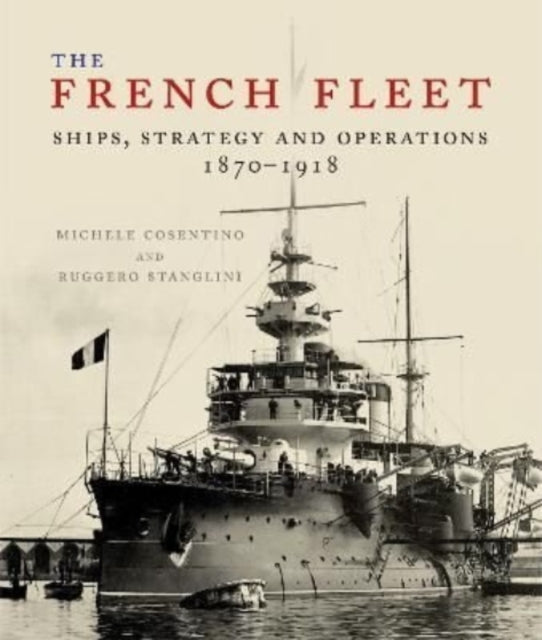
Ruggero Stanglini,Michele Cosentino
The French Fleet: Ships, Strategy and Operations 1870 - 1918
The French Fleet: Ships, Strategy and Operations 1870 - 1918
💎 Earn 153 Points (£1.53) on this item.
YOU SAVE £14.22
- Condition: Brand new
- UK Delivery times: Usually arrives within 2 - 3 working days
- UK Shipping: Fee starts at £3.89. Subject to product weight & dimension
Bulk ordering. Want 15 or more copies? Get a personalised quote and bigger discounts. Learn more about bulk orders.
Couldn't load pickup availability
- More about The French Fleet: Ships, Strategy and Operations 1870 - 1918
The French Navy began to reconstruct its fleet after the Franco-Prussian War, but the process was slow and erratic. The establishment of the Third Republic led to political and economic instability, which affected naval and shipbuilding policy. The rise of the Jeune cole strategic naval concept in the early 1880s changed shipbuilding priorities, and the French Navy implemented the dreadnought concept later than other European naval powers. The 1904 Entente Cordiale contributed to further radical changes to foreign, naval, and shipbuilding policies, and the French fleet was populated with limited dreadnoughts, obsolete armoured cruisers, torpedo boats, and submarines.
Format: Hardback
Length: 320 pages
Publication date: 30 August 2022
Publisher: Pen & Sword Books Ltd
After the Franco-Prussian War of 1870-1, the French Navy embarked on a reconstruction process to modernize its fleet, replacing outdated warships with steam-powered and iron-hulled men-of-war. However, this endeavor was slow and inconsistent, as initial priority was given to the Army. Furthermore, the establishment of the Third Republic brought about a prolonged period of political and economic instability, which significantly impacted naval and shipbuilding policies. French naval yards and private shipyards worked diligently to construct a fleet consisting of ironclads, cruisers, and minor vessels, ultimately elevating France to become the second European naval power, at least in terms of quantitative strength.
In the early 1880s, the emergence of the Jeune cole (Young School) strategic naval concept altered shipbuilding priorities. Emphasis shifted towards coastal torpedo boats and cruisers, while the construction of battleships was slowed down. As a result, the French Navy implemented the dreadnought concept later than other European naval powers, such as Great Britain and Germany.
The 1904 Entente Cordiale brought about further radical changes to French foreign, naval, and shipbuilding policies. At the outbreak of World War One, the French fleet consisted of limited dreadnoughts, many obsolete armoured cruisers, an impressive array of torpedo boats, and a fleet of submarines, although their efficiency was questionable.
This comprehensive book offers a detailed overview of the French Navy, spanning from the establishment of the Third Republic to the end of World War One. It delves into French foreign and naval policy, shipyards and industrial organization, technological innovations, operations, and shipbuilding programs. The first part of the volume provides a comprehensive examination of these topics, while the second and larger part focuses on the various categories of warships, including their qualitative and quantitative developments.
Dimension: 289 x 245 (mm)
ISBN-13: 9781526701312
UK and International shipping information
UK and International shipping information
We deliver throughout the United Kingdom and to 128 countries and territories worldwide, including the United States, Australia, Canada, Germany, Spain and France.