Sophie Wahnich
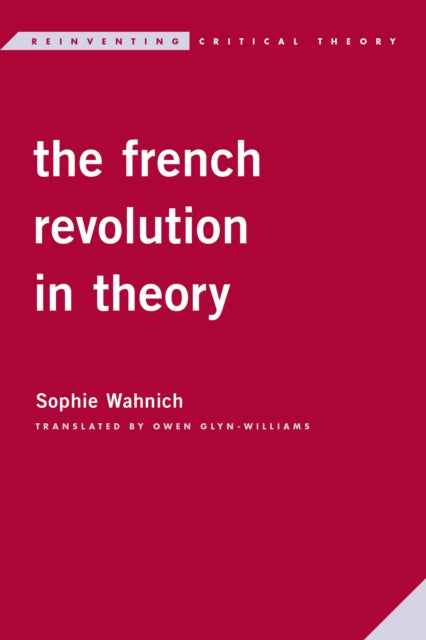
The French Revolution in Theory
The French Revolution in Theory
💎 Earn 531 Points (£5.31) on this item.
We can order this item for you. Delivery usually takes about 4 to 6 weeks.
This item is not held in our immediate stock. We will order it for you after checkout.
Estimated delivery: About 4 to 6 weeks
- Condition: Brand new
- UK Delivery times: Usually arrives within 2 - 3 working days
- UK Shipping: Fee starts at £3.89. Subject to product weight & dimension
Bulk ordering. Want 15 or more copies? Get a personalised quote and bigger discounts. Learn more about bulk orders.
Couldn't load pickup availability
- More about The French Revolution in Theory
The French Revolution has been portrayed as a matrix of totalitarianisms and an ethnocentric phenomenon, but philosophers have played a leading role in the portrayal of this major event in French political history. Recent explorations by Rancière, Derrida, Balibar, Lefort, Robin, and Loraux allow us to move away from a myth of identity and rediscover a real Revolution that offers Enlightenment and political utility and interrogates what democracy and emancipation mean for us today.
Format: Hardback
Length: 246 pages
Publication date: 04 March 2022
Publisher: Bloomsbury Publishing PLC
The French Revolution has been a subject of much debate and controversy, with historians, philosophers, and postcolonial studies often portraying it in different ways. While the liberals have vilified it as a matrix of totalitarianisms, postcolonial studies have criticized it as an ethnocentric phenomenon. This book seeks to re-examine the French Revolution as a political resource and explore why it has been so controversial.
One of the key factors that has contributed to the controversy surrounding the French Revolution is the philosophical quarrels of the 1960s. These quarrels placed the Revolution at the heart of their debates, with Jean-Paul Sartre and Claude Lévi-Strauss, Michel Foucault, and others engaging in intense philosophical discussions. The conflict between Sartre and Lévi-Strauss, for example, centered on the question of popular sovereignty and emancipation. Sartre argued that the Revolution was a moment of radical transformation that sought to establish a new social order based on the principles of liberty, equality, and fraternity. Lévi-Strauss, on the other hand, argued that the Revolution was a product of the Enlightenment and that it was driven by a desire to impose Western values on other cultures.
Another factor that has contributed to the controversy surrounding the French Revolution is the question of its historical significance. While the Revolution has been widely recognized as a significant event in French political history, there are still many debates about its impact and meaning. Some argue that the Revolution was a positive force that led to the establishment of a more democratic and egalitarian society, while others argue that it was a negative force that led to the destruction of traditional values and institutions.
To address these controversies, this book examines the philosophical quarrels of the 1960s and the historical significance of the French Revolution. It argues that the Revolution was a complex and multifaceted event that had both positive and negative consequences. It explores the different philosophical perspectives that have been brought to bear on the Revolution and how these perspectives have shaped our understanding of it.
One of the key philosophical perspectives that has been brought to bear on the French Revolution is the idea of popular sovereignty. Popular sovereignty is the idea that the people are the ultimate source of political authority and that they have the right to govern themselves. This idea was central to the French Revolution, as the people rose up against the monarchy and established a new government based on the principles of liberty, equality, and fraternity.
However, the idea of popular sovereignty has been criticized by some philosophers. For example, Jean-Paul Sartre argued that popular sovereignty was a myth that was used to justify the oppression of the people by the state. He argued that the state was a necessary evil that was necessary to protect the people from themselves and that the people should not be allowed to govern themselves.
Michel Foucault, on the other hand, argued that popular sovereignty was a powerful tool that could be used to create a new social order. He argued that the Revolution was a moment of radical transformation that sought to establish a new social order based on the principles of liberty, equality, and fraternity. Foucault argued that the Revolution was a product of the Enlightenment and that it was driven by a desire to impose Western values on other cultures.
Another philosophical perspective that has been brought to bear on the French Revolution is the idea of emancipation. Emancipation is the idea that the people should be free from the constraints of social and economic inequality. This idea was central to the French Revolution, as the people sought to establish a new social order that was based on the principles of liberty, equality, and fraternity.
However, the idea of emancipation has been criticized by some philosophers. For example, Claude Lévi-Strauss argued that emancipation was a myth that was used to justify the exploitation of the people by the state. He argued that the state was a necessary evil that was necessary to protect the people from themselves and that the people should not be allowed to govern themselves.
In response to these criticisms, this book argues that the French Revolution was a complex and multifaceted event that had both positive and negative consequences. It argues that the Revolution was a moment of radical transformation that sought to establish a new social order based on the principles of liberty, equality, and fraternity. It argues that the Revolution was a product of the Enlightenment and that it was driven by a desire to impose Western values on other cultures.
However, it also argues that the Revolution was a flawed and incomplete event. It argues that the Revolution was not able to achieve its goals of establishing a more democratic and egalitarian society and that it was instead a source of political instability and violence. It argues that the Revolution was a product of the Enlightenment and that it was driven by a desire to impose Western values on other cultures.
In conclusion, the French Revolution has been a subject of much debate and controversy, with historians, philosophers, and postcolonial studies often portraying it in different ways. While the liberals have vilified it as a matrix of totalitarianisms, postcolonial studies have criticized it as an ethnocentric phenomenon. This book seeks to re-examine the French Revolution as a political resource and explore why it has been so controversial. It argues that the Revolution was a complex and multifaceted event that had both positive and negative consequences and that it was a product of the Enlightenment and that it was driven by a desire to impose Western values on other cultures. It argues that the Revolution was a flawed and incomplete event and that it is important to continue to explore its historical significance and its impact on our world today.
Weight: 508g
Dimension: 228 x 160 x 21 (mm)
ISBN-13: 9781786616173
UK and International shipping information
UK and International shipping information
We deliver throughout the United Kingdom and to 128 countries and territories worldwide, including the United States, Australia, Canada, Germany, Spain and France.