Xin Zhang
The Global in the Local: A Century of War, Commerce, and Technology in China
The Global in the Local: A Century of War, Commerce, and Technology in China
💎 Earn 157 Points (£1.57) on this item.
YOU SAVE £8.36
- Condition: Brand new
- UK Delivery times: Usually arrives within 2 - 3 working days
- UK Shipping: Fee starts at £3.89. Subject to product weight & dimension
Bulk ordering. Want 15 or more copies? Get a personalised quote and bigger discounts. Learn more about bulk orders.
Couldn't load pickup availability
- More about The Global in the Local: A Century of War, Commerce, and Technology in China
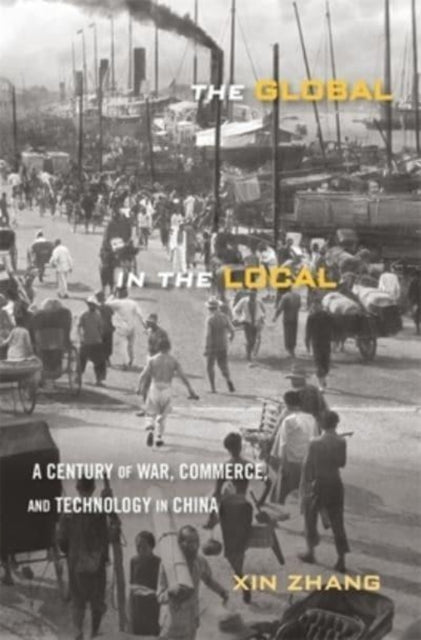
In the summer of 1842, British soldiers gathered outside the city walls of Zhenjiang, causing a wave of suicides and mercy killings among locals who were already suspicious of foreigners. This event was unique and resulted from colliding local and global forces in nineteenth-century China. Xin Zhang's history examines the negotiations between local societies and global changes that created modern China, offering a ground-level view of globalization in the city. The Chinese leveraged, resisted, and made change for themselves, arguing that globalization is inevitably refracted through local particularities.
Format: Hardback
Length: 288 pages
Publication date: 28 April 2023
Publisher: Harvard University Press
The story of globalization in the nineteenth and early twentieth centuries as experienced by ordinary people in the Chinese river town of Zhenjiang is a complex and multifaceted tale that encompasses a range of historical, social, and cultural factors. Fear swept Zhenjiang as British soldiers gathered outside the city walls in the summer of 1842, already suspicious of foreigners and having heard of the suffering the British inflicted two months earlier in Zhapu. A wave of suicides and mercy killings ensued, as hundreds of women killed themselves and their children or died at the hands of male family members rather than leave their families to the invaders. British observers decried an "Asian culture" of ritual suicide, but in reality, the event was sui generis—a tragic result of colliding local and global forces in nineteenth-century China.
Xin Zhang's groundbreaking history examines the intense negotiations between local societies and global changes that created modern China. In the nineteenth and early twentieth centuries, world-historic political, economic, and technological developments transformed the textures of everyday life in places like Zhenjiang, a midsize river town in China's prosperous Lower Yangzi region. Drawing on rare primary sources, including handwritten diaries and other personal writings, Zhang offers a ground-level view of globalization in the city. We see civilians coping with the traumatic international encounters of the Opium War; Zhenjiang brokers bankrolling Shanghai's ascendance as a cosmopolitan commercial hub; and merchants shipping goods to market, for the first time, on steamships.
Far from passive recipients, the Chinese leveraged, resisted, and made change for themselves. Indeed, The Global in the Local argues that globalization is inevitably refracted through local particularities.
The Opium War, which took place between 1839 and 1842, was a significant event in the history of globalization. It marked the first time that Western powers had intervened in Chinese affairs on a large scale, and it had far-reaching consequences for both China and the Western world. The war was fought primarily over the trade of opium, a drug that was highly addictive and had been introduced to China by the British.
The Chinese government had long been opposed to the opium trade, but it was unable to prevent the influx of the drug into the country. The British, on the other hand, saw the opium trade as a way to expand their empire and gain control over Chinese resources. They began to smuggle opium into China in large quantities, and the Chinese government responded by imposing heavy taxes on the drug.
However, the British refused to pay the taxes and continued to smuggle opium into China. This led to a series of clashes between British and Chinese troops, and eventually, the British declared war on China in 1839. The war was long and bloody, and it resulted in the deaths of thousands of Chinese soldiers and civilians.
One of the most significant consequences of the Opium War was the establishment of British colonial rule in China. The British gained control of Hong Kong, a small island off the coast of China, and they also established a series of colonies in mainland China. The Chinese government was forced to accept British rule, and the country was subjected to a series of economic and political reforms that were designed to promote British interests.
The Opium War also had a profound impact on Chinese society. It led to a sense of humiliation and resentment towards the Western world, and it contributed to the rise of nationalism in China. The Chinese people began to see themselves as a distinct and separate nation, and they began to demand greater autonomy and control over their own affairs.
The war also had a significant impact on the Chinese economy. The Chinese government was forced to spend a large amount of money on military expenses, and this led to a decline in the country's economic growth. The opium trade also contributed to the decline of traditional Chinese industries, such as silk production, as the Chinese government was unable to prevent the influx of cheap Western goods.
In conclusion, the Opium War was a significant event in the history of globalization. It marked the first time that Western powers had intervened in Chinese affairs on a large scale, and it had far-reaching consequences for both China and the Western world. The war led to the establishment of British colonial rule in China, the rise of nationalism in China, and the decline of traditional Chinese industries. It also had a profound impact on Chinese society, leading to a sense of humiliation and resentment towards the Western world.
Dimension: 235 x 156 (mm)
ISBN-13: 9780674278387
UK and International shipping information
UK and International shipping information
We deliver throughout the United Kingdom and to 128 countries and territories worldwide, including the United States, Australia, Canada, Germany, Spain and France.