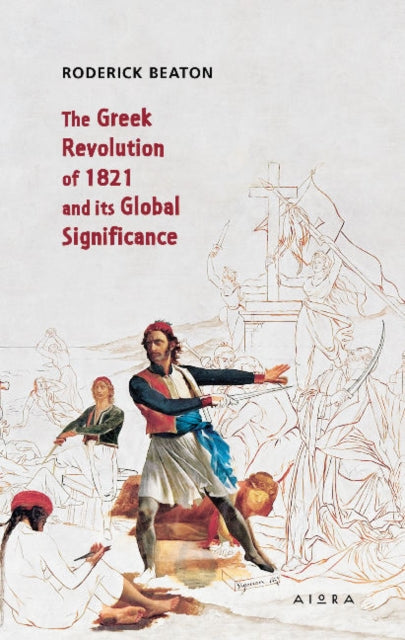
Roderick Beaton
The Greek Revolution of 1821 and its Global Significance
The Greek Revolution of 1821 and its Global Significance
💎 Earn 41 Points (£0.41) on this item.
YOU SAVE £1.74
- Condition: Brand new
- UK Delivery times: Usually arrives within 2 - 3 working days
- UK Shipping: Fee starts at £3.89. Subject to product weight & dimension
Bulk ordering. Want 15 or more copies? Get a personalised quote and bigger discounts. Learn more about bulk orders.
Couldn't load pickup availability
- More about The Greek Revolution of 1821 and its Global Significance
The Greek Revolution of 1821 was a pivotal point in the age of revolution, leading to the international recognition of Greece as a sovereign, independent state in 1830. This book explains why its significance is only now being appreciated two hundred years later.
\n Format: Paperback / softback
\n Length: 88 pages
\n Publication date: 01 September 2021
\n Publisher: Aiora Press
\n
The period spanning from the American Declaration of Independence in 1776 to the significant national unifications of Germany and Italy in the 1860s has been referred to as the "Age of Revolution." However, its impact extended for an entire century. In the midst of this transformative era, the Greek Revolution, which erupted in the spring of 1821, played a crucial role. Historians have been somewhat slow to acknowledge the significant impact of this revolution and the subsequent recognition of Greece as a sovereign and independent state in 1830. This book aims to shed light on the events that transpired during these nine years, leading to profound and unforeseen consequences, and explain why the full significance of these events is only now being recognized, two hundred years later.
The Greek Revolution of 1821 marked a significant turning point in European history. It was a period of intense political and social upheaval that led to the overthrow of the Ottoman Empire and the establishment of a new Greek state. The revolution was sparked by a series of factors, including economic depression, political oppression, and cultural nationalism.
The revolution began in Athens, where a group of young intellectuals and artists called the Philhellenes sought to overthrow the Ottoman rule and establish a democratic government. They were inspired by the ideas of the French Revolution and the Enlightenment, which emphasized the importance of individual rights, democracy, and social justice.
The Philhellenes organized a series of protests and uprisings, including the Siege of Missolonghi in 1821, which led to the capture of the city and the establishment of a provisional government. This government was led by a group of military officers, including Alexander Ypsilantis, who became known as the "Father of the Greek Nation."
Over the next few years, the revolution spread throughout Greece, with various regions declaring their independence from the Ottoman Empire. The revolutionaries faced fierce resistance from the Ottoman army, which was supported by local Turkish rulers and religious leaders. However, the revolutionaries were able to gain support from European powers, including Britain and France, who saw the establishment of a new Greek state as a way to expand their influence in the region.
In 1829, the Greek War of Independence began, with the revolutionaries facing off against the Ottoman army. The war was long and bloody, with the revolutionaries suffering significant losses. However, they were able to gain support from European powers, including Britain and France, who provided financial and military assistance.
In 1830, the Greek War of Independence was finally declared victorious, with the establishment of the Greek Republic. The new Greek state was led by a group of military officers, including Ypsilantis, who became the first president of the country. The Greek Republic was a constitutional monarchy, with a king as the head of state and a parliament as the legislative body.
The establishment of the Greek Republic had far-reaching consequences for Europe and the world. It marked the end of Ottoman rule in the Balkans and the beginning of a new era of European expansion and influence. The Greek Revolution also inspired other countries in the region to seek independence from Ottoman rule, leading to the creation of a series of new states in the region, including Bulgaria, Romania, and Serbia.
The Greek Revolution also had a significant impact on Greek culture and society. It led to the promotion of Greek language and literature, the development of a new Greek identity, and the establishment of a democratic government that emphasized the rights and freedoms of its citizens.
However, the Greek Revolution was not without its challenges. The country faced economic instability, political instability, and social unrest in the years following its independence. In 1863, a military coup d'état led to the establishment of a dictatorship, which lasted until 1974.
Despite these challenges, the Greek Revolution remains a significant moment in European history. It marked the beginning of a new era of democracy and freedom in the region and inspired other countries to seek their own independence from oppressive rule. The Greek Revolution also had a lasting impact on Greek culture and society, shaping the country's identity and values for generations to come.
In conclusion, the Greek Revolution of 1821 was a pivotal moment in European history that led to the overthrow of the Ottoman Empire and the establishment of a new Greek state. The revolution was sparked by a series of factors, including economic depression, political oppression, and cultural nationalism. The revolutionaries faced fierce resistance from the Ottoman army, but they were able to gain support from European powers and establish a constitutional monarchy. The establishment of the Greek Republic had far-reaching consequences for Europe and the world, marking the end of Ottoman rule in the Balkans and the beginning of a new era of European expansion and influence. The Greek Revolution also had a significant impact on Greek culture and society, leading to the promotion of Greek language and literature, the development of a new Greek identity, and the establishment of a democratic government that emphasized the rights and freedoms of its citizens. Despite its challenges, the Greek Revolution remains a significant moment in European history and a testament to the power of the people to seek their own freedom and democracy.
\n Weight: 108g\n
Dimension: 127 x 206 x 11 (mm)\n
ISBN-13: 9786185369439\n \n
UK and International shipping information
UK and International shipping information
We deliver throughout the United Kingdom and to 128 countries and territories worldwide, including the United States, Australia, Canada, Germany, Spain and France.