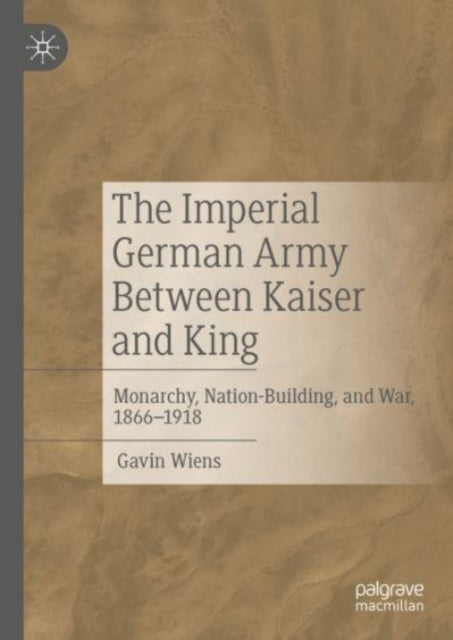
Gavin Wiens
The Imperial German Army Between Kaiser and King: Monarchy, Nation-Building, and War, 1866-1918
The Imperial German Army Between Kaiser and King: Monarchy, Nation-Building, and War, 1866-1918
💎 Earn 495 Points (£4.95) on this item.
We can order this item for you. Delivery usually takes about 4 to 6 weeks.
This item is not held in our immediate stock. We will order it for you after checkout.
Estimated delivery: About 4 to 6 weeks
YOU SAVE £20.88
- Condition: Brand new
- UK Delivery times: Usually arrives within 2 - 3 working days
- UK Shipping: Fee starts at £3.89. Subject to product weight & dimension
Bulk ordering. Want 15 or more copies? Get a personalised quote and bigger discounts. Learn more about bulk orders.
Couldn't load pickup availability
- More about The Imperial German Army Between Kaiser and King: Monarchy, Nation-Building, and War, 1866-1918
This book challenges the notion that the imperial German army was a school of the nation, arguing that it was far less homogenous and faction-ridden than previously believed.
Format: Hardback
Length: 313 pages
Publication date: 29 March 2023
Publisher: Springer International Publishing AG
This book provides a comprehensive reappraisal of Germany's military between the mid-nineteenth century and the end of the First World War. At its core, it delves into the question of how "German" the imperial German army truly was. This army, which emerged from the Wars of Unification in 1871, has often been regarded as the epitome of the nation, as it served as a training ground for tens of thousands of young men annually, who underwent an intensive program of patriotic education and returned to civilian life as fervent German nationalists and ardent supporters of the German emperor, or Kaiser. However, this book challenges this prevailing notion. It does not deny that devotion to the Fatherland and loyalty to the Kaiser were widespread among German soldiers in the decades following unification. Instead, it reveals that the imperial German army was far more diverse and faction-ridden than previously acknowledged.
The book explores the various social, cultural, and political factors that shaped the army's composition and dynamics. It sheds light on the diverse backgrounds and experiences of the soldiers, including their ethnicities, religions, and regional affiliations. It also examines the role of the military in shaping German society and culture, as well as the impact of the army on the broader political landscape of Europe.
One of the key findings of the book is that the imperial German army was not a monolithic entity but rather a complex network of factions and subcultures. These factions ranged from conservative and nationalist groups to more progressive and socialist organizations, each with their own distinct ideologies and goals. The army's leadership was also divided, with competing power centers and rivalries among the generals and officers.
This fragmentation and division within the army had significant consequences for its effectiveness and cohesion during times of war. The lack of a unified command structure and the presence of competing loyalties made it difficult for the army to coordinate its efforts and make strategic decisions. This was particularly evident in the First World War, where the German army faced a series of defeats and setbacks that were partly attributed to the internal divisions and conflicts within the army.
Despite these challenges, the imperial German army played a crucial role in shaping the course of German history. It served as a symbol of national pride and unity, and its soldiers were admired and respected for their loyalty and bravery. The army also played a significant role in the expansion and consolidation of German power in Europe, particularly during the period of Bismarck's rule.
In conclusion, this book provides a fresh and insightful perspective on the imperial German army, challenging the notion that it was a homogenous and cohesive entity. It reveals the army as a complex network of factions and subcultures, with diverse backgrounds and experiences of the soldiers. It also highlights the role of the military in shaping German society and culture, as well as its impact on the broader political landscape of Europe. By examining the internal dynamics and divisions of the imperial German army, this book sheds light on the complex and multifaceted nature of German history and society in the nineteenth and twentieth centuries.
Weight: 560g
Dimension: 210 x 148 (mm)
ISBN-13: 9783031228629
Edition number: 1st ed. 2023
UK and International shipping information
UK and International shipping information
We deliver throughout the United Kingdom and to 128 countries and territories worldwide, including the United States, Australia, Canada, Germany, Spain and France.