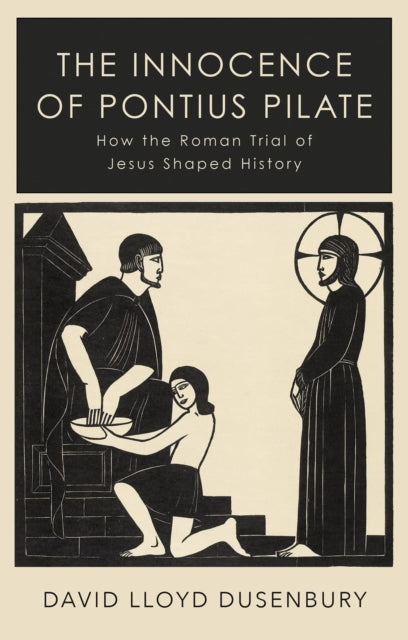
David Lloyd Dusenbury
The Innocence of Pontius Pilate: How the Roman Trial of Jesus Shaped History
The Innocence of Pontius Pilate: How the Roman Trial of Jesus Shaped History
💎 Earn 70 Points (£0.70) on this item.
YOU SAVE £2.96
- Condition: Brand new
- UK Delivery times: Usually arrives within 2 - 3 working days
- UK Shipping: Fee starts at £2.39. Subject to product weight & dimension
Bulk ordering. Want 15 or more copies? Get a personalised quote and bigger discounts. Learn more about bulk orders.
Couldn't load pickup availability
- More about The Innocence of Pontius Pilate: How the Roman Trial of Jesus Shaped History
Jesus was sentenced to death by Pontius Pilate, but Christians suggest that it was the Judaean authorities who had crucified him. David Lloyd Dusenbury argues that Jesus' interrogation by Pilate and Augustine of Hippo's sermon on that trial led to the concept of secularity and the logic of tolerance emerging in early modern Europe.
Format: Paperback / softback
Length: 448 pages
Publication date: 02 November 2023
Publisher: C Hurst & Co Publishers Ltd
The gospels and ancient historians provide compelling evidence that Jesus was sentenced to death by Pontius Pilate, the Roman imperial prefect in Jerusalem. This historical consensus is widely accepted among Christians of various denominations, who believe that Jesus died at the hands of Pontius Pilate. However, the exact meaning of this sentence has sparked considerable debate and speculation among scholars.
Within a few decades of Jesus' death, Christians began to propose various theories regarding his crucifixion. One such notion was that the Judaean authorities were responsible for his execution, a belief that was later echoed in the Qur'an. In the third century, a philosopher suggested that, although Pilate had condemned Jesus, he had done so justly. This idea persists in one of the primary strands of modern New Testament criticism.
The truth behind the matter and the history of its discovery are essential questions that require careful examination. In his book, "Pilate's Innocence: A Neglected Theological Question and a Recurring Theme in the History of European Political Thought," David Lloyd Dusenbury argues that Pilate's innocence has been overlooked as a theological question and a recurring theme in the history of European political thought. Dusenbury contends that Jesus' interrogation by Pilate and Augustine of Hippo's North African sermon on that trial played a crucial role in shaping the concept of secularity and the logic of tolerance that emerged in early modern Europe.
Without the Roman trial of Jesus and the subsequent debates over Pilate's innocence, the history of empire, from the first century to the twenty-first, would have taken a radically different course. The trial of Jesus not only shed light on the historical circumstances surrounding his death but also had profound implications for the development of Western civilization. It helped establish the principle of legal justice and the rule of law, which have been fundamental to the functioning of democratic societies throughout history.
Furthermore, the trial of Jesus also contributed to the development of the concept of secularism, which separates religious and political authority. The Roman authorities, who were primarily interested in maintaining order and stability, saw Jesus as a threat to their power and authority. By condemning him and executing him, they hoped to deter any further opposition and maintain control over the Roman Empire.
However, the trial of Jesus also sparked a debate about the nature of God and the role of religion in society. Pilate, who was a Roman governor, was tasked with carrying out the execution of Jesus, but he was deeply conflicted about his decision. He questioned whether it was right to condemn an innocent man and whether he had the authority to do so. This debate continues to resonate in contemporary society, as people grapple with the intersection of religion, politics, and justice.
In conclusion, the trial of Jesus and the subsequent debates over Pilate's innocence have had a profound impact on the history of Western civilization. Dusenbury's book sheds light on the neglected theological question of Pilate's innocence and highlights its significance in shaping the concept of secularity and tolerance. The trial of Jesus not only sheds light on the historical circumstances surrounding his death but also has profound implications for the development of Western society and the ongoing debate about the role of religion in society.
Weight: 518g
Dimension: 215 x 140 x 43 (mm)
ISBN-13: 9781805260288
UK and International shipping information
UK and International shipping information
UK Delivery and returns information:
- Delivery within 2 - 3 days when ordering in the UK.
- Shipping fee for UK customers from £2.39. Fully tracked shipping service available.
- Returns policy: Return within 30 days of receipt for full refund.
International deliveries:
Shulph Ink now ships to Australia, Belgium, Canada, France, Germany, Ireland, Italy, India, Luxembourg Saudi Arabia, Singapore, Spain, Netherlands, New Zealand, United Arab Emirates, United States of America.
- Delivery times: within 5 - 10 days for international orders.
- Shipping fee: charges vary for overseas orders. Only tracked services are available for most international orders. Some countries have untracked shipping options.
- Customs charges: If ordering to addresses outside the United Kingdom, you may or may not incur additional customs and duties fees during local delivery.