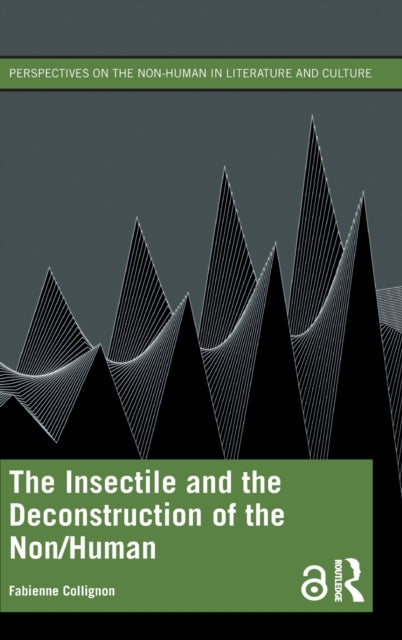
Fabienne Collignon
The Insectile and the Deconstruction of the Non/Human
The Insectile and the Deconstruction of the Non/Human
We can order this item for you. Delivery usually takes about 4 to 6 weeks.
This item is not held in our immediate stock. We will order it for you after checkout.
Estimated delivery: About 4 to 6 weeks
YOU SAVE £12.84
- Condition: Brand new
- UK Delivery times: Usually arrives within 2 - 3 working days
- UK Shipping: Fee starts at £3.89. Subject to product weight & dimension
Bulk ordering. Want 15 or more copies? Get a personalised quote and bigger discounts. Learn more about bulk orders.
Couldn't load pickup availability
- More about The Insectile and the Deconstruction of the Non/Human
The Insectile and the Deconstruction of the Non/Human explores the foundational but often overlooked role of the insectile in subject formation, tracking entomological events across psychoanalysis, seventeenth-century still life painting, nineteenth-century novels, and post-1970s film. It argues that entomological fascination, driven by the dynamic between form and formlessness, is a resistance to and a fantasy of total form. By examining Lacanian psychoanalysis, the book aims to undertake a broader deconstruction of the human by emphasizing its implications in the insectile, offering a valuable resource for posthumanities debates.
Format: Hardback
Length: 202 pages
Publication date: 30 December 2022
Publisher: Taylor & Francis Ltd
The Insectile and the Deconstruction of the Non/Human delves into the profound yet often overlooked significance of the insectile in the formation of subjects, tracing the entomological events like buzzing, hatching, and molting across various archives, including psychoanalysis, seventeenth-century still life painting, nineteenth-century novels, and post-1970s films. Through meticulous analysis, the book explores a fascinating phenomenon known as entomological fascination, which it defines as the interplay between subjectivity, fascination, and the insectile. This exploration is propelled by the central dynamic between form and formlessness, leading to a comprehensive understanding of entomological fascination that encompasses both a resistance to and a fantasy of total form.
To support its argument, the book turns to Lacanian psychoanalysis, recognizing the pivotal role of fascination and the insectile in Lacan's work. Lacan's ultimate objective is to undertake a broader deconstruction of the so-called human by emphasizing its implications in the insectile. Interestingly, Lacan is often overlooked in discussions within posthumanities, thereby missing a valuable resource: the Lacanian archive can be explored to unravel the dimensions of the posthuman in its insectile 'forms.'
In the first chapter, the book establishes the foundational role of the insectile in subject formation. It explores how the insect's physical characteristics, such as its small size, fragility, and invisibility, have shaped human perceptions and interpretations of the natural world. The chapter also highlights the historical and cultural significance of insects, from their symbolic meanings in ancient civilizations to their role in scientific discovery and artistic representation. By examining the insectile's presence in various artistic and cultural contexts, the book establishes a framework for understanding the complex relationship between humans and insects.
The second chapter delves into the entomological fascination phenomenon. It defines entomological fascination as the constellation between subjectivity, fascination, and the insectile, and explores how this fascination has been expressed and interpreted across different historical periods and artistic mediums. The chapter examines the ways in which insects have been depicted in art, literature, and film, highlighting the ways in which they have been fetishized, feared, and admired. It also explores the psychological and symbolic implications of entomological fascination, including the ways in which it can be linked to issues of power, control, and the uncanny.
In the third chapter, the book turns to Lacanian psychoanalysis to further explore the relationship between fascination and the insectile. It argues that Lacan's concept of the mirror stage is crucial in understanding the dynamics of entomological fascination. The mirror stage, according to Lacan, is a critical phase in the development of the child's subjectivity, during which the child experiences a sense of self-recognition and identification with the image of the other. The book suggests that entomological fascination can be seen as a continuation of this mirror stage, in which the subject experiences a sense of fascination with the insectile as a symbol of the Other. Through the analysis of Lacan's work, the book demonstrates how entomological fascination can be understood as a form of identification with the insectile, which can lead to a deeper exploration of the self and the Other.
In the fourth chapter, the book explores the implications of entomological fascination for the broader deconstruction of the so-called human. It argues that entomological fascination can be seen as a means of challenging the boundaries between human and non-human, and of questioning the hierarchical structures that govern our understanding of the world. By examining the ways in which insects are often marginalized and excluded from human discourse, the book highlights the ways in which our perception of the natural world is shaped by cultural and social norms. It also suggests that entomological fascination can be used as a tool for subverting these norms and challenging the dominant narratives that shape our understanding of the world.
In the fifth chapter, the book concludes by reflecting on the potential of entomological fascination as a means of promoting empathy and understanding between humans and insects. It argues that by recognizing the shared vulnerabilities and complexities of both human and insect life, we can cultivate a sense of respect and compassion for the natural world. It also suggests that entomological fascination can be used as a catalyst for environmental activism and conservation efforts, as it can inspire individuals to take action to protect and preserve the natural world.
In conclusion, The Insectile and the Deconstruction of the Non/Human offers a comprehensive exploration of the foundational yet often overlooked role of the insectile in subject formation, tracking entomological events across various archives. Through its analysis of entomological fascination, Lacanian psychoanalysis, and the broader implications of the insectile for the deconstruction of the human, the book provides a rich and nuanced understanding of the complex relationship between humans and insects. By opening up the Lacanian archive to follow the dimensions of the posthuman in its insectile 'forms,' the book offers a valuable resource for scholars and researchers interested in exploring the boundaries between human and non-human, and in challenging the dominant narratives that shape our understanding of the world.
Weight: 540g
Dimension: 229 x 152 (mm)
ISBN-13: 9781032345505
UK and International shipping information
UK and International shipping information
We deliver throughout the United Kingdom and to 128 countries and territories worldwide, including the United States, Australia, Canada, Germany, Spain and France.