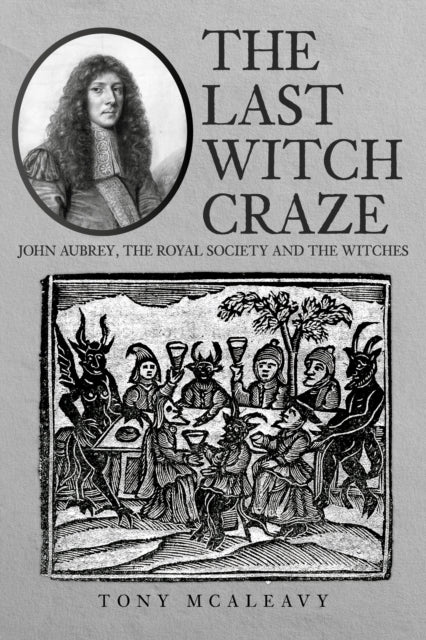
Tony McAleavy
The Last Witch Craze: John Aubrey, the Royal Society and the Witches
The Last Witch Craze: John Aubrey, the Royal Society and the Witches
💎 Earn 70 Points (£0.70) on this item.
YOU SAVE £5.84
- Condition: Brand new
- UK Delivery times: Usually arrives within 2 - 3 working days
- UK Shipping: Fee starts at £3.89. Subject to product weight & dimension
Bulk ordering. Want 15 or more copies? Get a personalised quote and bigger discounts. Learn more about bulk orders.
Couldn't load pickup availability
- More about The Last Witch Craze: John Aubrey, the Royal Society and the Witches
John Aubrey was a seventeenth-century man of letters who wrote pioneering works on education, geology, languages, archaeology, history, place-name study, and folklore. He was a Fellow of the Royal Society and promoted new thinking about the natural world and the use of experimental science. He also believed in demons and angels and the authenticity of witchcraft and recommended ways of countering it through horseshoe magic. The Last Witch Craze tells the story of these men and others who attempted to reconcile science and sorcery, and reveals that Aubrey had a dark secret, as his magical notebook survives in the archives of Oxford University.
Format: Hardback
Length: 288 pages
Publication date: 15 June 2022
Publisher: Amberley Publishing
John Aubrey, a prominent figure in the seventeenth century, is renowned for his extensive biographical work, Brief Lives. However, his contributions extend far beyond this, encompassing pioneering works in various fields such as education, geology, languages, archaeology, history, place-name study, and folklore. Aubrey held the esteemed position of a Fellow of the Royal Society, an organization that counted among its early members renowned figures like Robert Boyle, widely regarded as the greatest scientist of his generation, and Henry More, a prominent philosopher in England. Together, Aubrey, Boyle, and More fostered a revolutionary mindset that challenged traditional beliefs about the natural world and championed the use of experimental science. They also held unconventional beliefs, including the existence of demons and angels and the authenticity of witchcraft. Aubrey offered practical solutions to counter witchcraft, advocating for the use of horseshoe magic and suggesting that gifted schoolboys should be trained to communicate with benevolent spirits through the use of crystal balls. Notably, Boyle publicly endorsed the reality of witchcraft based on a case study from France. Henry More attempted to scientifically explain how witches could seemingly leave their physical bodies during sabbat meetings.
The Last Witch Craze delves into the lives of these individuals and others who sought to reconcile science and sorcery. Their ideas garnered significant attention and provided an intellectual framework for the last deadly witch craze in Britain and America. Two Fellows of the Royal Society, Joseph Glanvill and James Long, actively participated in witch hunts. In New England, those who persecuted the witches of Salem were well aware that several prominent members of the Royal Society of London believed in the existence of witchcraft. Furthermore, the book unveils a dark secret associated with John Aubrey. His magical notebook, preserved in the archives of Oxford University, reveals that Aubrey personally practiced a form of black magic and theurgy.
In conclusion, John Aubrey's multifaceted legacy encompasses his remarkable biographical work, his pioneering contributions to various fields, and his unconventional beliefs, including his involvement in witch hunts and his practice of black magic. The Last Witch Craze sheds light on his life and ideas, contributing to our understanding of the seventeenth century and the complex interplay between science, religion, and superstition.
Weight: 562g
Dimension: 241 x 164 x 33 (mm)
ISBN-13: 9781445698427
UK and International shipping information
UK and International shipping information
We deliver throughout the United Kingdom and to 128 countries and territories worldwide, including the United States, Australia, Canada, Germany, Spain and France.