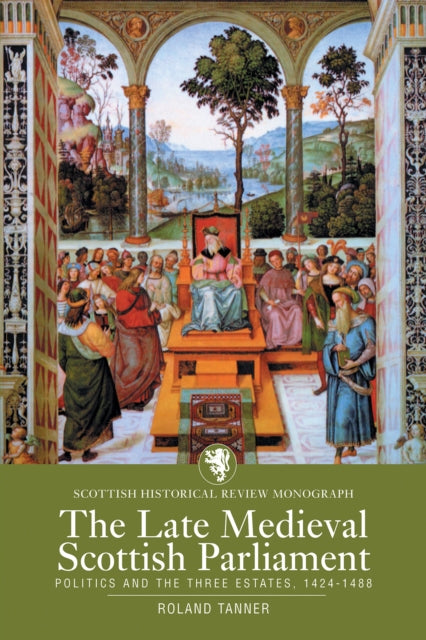
Roland Tanner
The Late Medieval Scottish Parliament: Politics and the three Estates, 1424-1488
The Late Medieval Scottish Parliament: Politics and the three Estates, 1424-1488
💎 Earn 106 Points (£1.06) on this item.
YOU SAVE £8.76
- Condition: Brand new
- UK Delivery times: Usually arrives within 2 - 3 working days
- UK Shipping: Fee starts at £2.39. Subject to product weight & dimension
Bulk ordering. Want 15 or more copies? Get a personalised quote and bigger discounts. Learn more about bulk orders.
Couldn't load pickup availability
- More about The Late Medieval Scottish Parliament: Politics and the three Estates, 1424-1488
Roland Tanner's study of the medieval parliament reveals that the Scottish Parliament was as powerful as the English institution, with the 'Three Estates' able to wield control over the Crown. He has avoided a dry constitutional approach and brought Parliament to life through the people who attended.
Format: Paperback / softback
Length: 328 pages
Publication date: 07 April 2022
Publisher: John Donald Publishers Ltd
In his groundbreaking study of the medieval parliament, Roland Tanner offers a fresh perspective on the Scottish Parliament by delving into the actions and motivations of those who attended. Historically, the Scottish Parliament has been perceived as a weak and ineffective institution, often criticized for failing to emulate its English counterpart. However, Tanner's research reveals a different narrative. The Scottish Parliament, in its unique way, possessed significant power and influence. The "Three Estates" (the clergy, nobility, and burgh representatives) who attended Parliament wielded a surprising degree of control over the Crown during the fifteenth century. They exerted their influence through various means, such as threatening to lock James I's taxation in a box from which he would have no access, compelling James II to swear not to alter acts of Parliament, preventing him from using his own lands and wealth as patronage for his supporters, and forbidding James III from leaving the country.
Tanner has approached his study with a refreshing perspective, avoiding a dry constitutional approach. Instead, he has sought to bring Parliament to life by exploring the individuals who attended, the reasons behind their attendance, and the intricate dynamics that unfolded when the most influential, wealthy, and ambitious people in the kingdom gathered in one place. Through his meticulous research, Tanner sheds light on the complex web of relationships, alliances, and rivalries that characterized the Scottish Parliament. He reveals the personal struggles and ambitions of the attendees, as well as the political maneuvering and power plays that shaped the decisions made during those crucial times.
One of the key findings of Tanner's study is that the Scottish Parliament was not merely a passive institution but a dynamic force that played a crucial role in shaping the political landscape of Scotland. The "Three Estates" worked together to balance the power of the Crown and ensure that the interests of the kingdom were protected. They collaborated to pass legislation, raise taxes, and regulate trade, all of which had a significant impact on the lives of the Scottish people. Tanner's analysis also highlights the role of the monarch in the Scottish Parliament. While the king had certain powers and privileges, he was not immune to the influence of the Estates. They were able to hold him accountable for his actions and demand reforms that would benefit the kingdom.
In conclusion, Roland Tanner's study of the medieval parliament offers a valuable contribution to our understanding of Scottish history. By humanizing the Scottish Parliament and exploring the actions and motives of those who attended, Tanner provides a fresh perspective on an institution that has often been overlooked or misunderstood. His research reveals the Scottish Parliament as a powerful and dynamic force that played a crucial role in shaping the political landscape of Scotland. Through his meticulous research and engaging storytelling, Tanner invites readers to reevaluate their understanding of this important period in Scottish history.
Weight: 505g
Dimension: 230 x 155 x 20 (mm)
ISBN-13: 9781910900703
UK and International shipping information
UK and International shipping information
UK Delivery and returns information:
- Delivery within 2 - 3 days when ordering in the UK.
- Shipping fee for UK customers from £2.39. Fully tracked shipping service available.
- Returns policy: Return within 30 days of receipt for full refund.
International deliveries:
Shulph Ink now ships to Australia, Belgium, Canada, France, Germany, Ireland, Italy, India, Luxembourg Saudi Arabia, Singapore, Spain, Netherlands, New Zealand, United Arab Emirates, United States of America.
- Delivery times: within 5 - 10 days for international orders.
- Shipping fee: charges vary for overseas orders. Only tracked services are available for most international orders. Some countries have untracked shipping options.
- Customs charges: If ordering to addresses outside the United Kingdom, you may or may not incur additional customs and duties fees during local delivery.