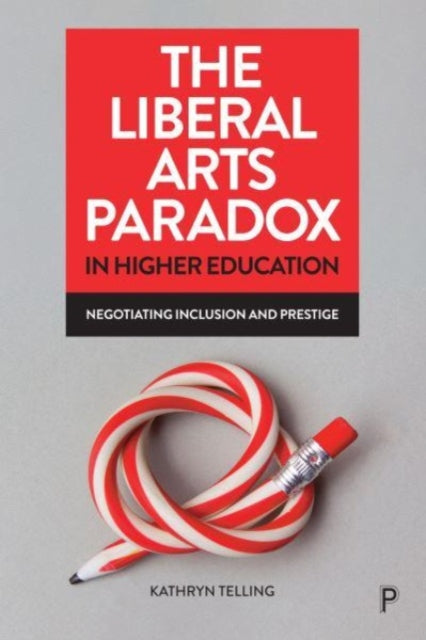
KathrynTelling
The Liberal Arts Paradox in Higher Education: Negotiating Inclusion and Prestige
The Liberal Arts Paradox in Higher Education: Negotiating Inclusion and Prestige
💎 Earn 401 Points (£4.01) on this item.
We can order this item for you. Delivery usually takes about 4 to 6 weeks.
This item is not held in our immediate stock. We will order it for you after checkout.
Estimated delivery: About 4 to 6 weeks
YOU SAVE £4.76
- Condition: Brand new
- UK Delivery times: Usually arrives within 2 - 3 working days
- UK Shipping: Fee starts at £3.89. Subject to product weight & dimension
Bulk ordering. Want 15 or more copies? Get a personalised quote and bigger discounts. Learn more about bulk orders.
Couldn't load pickup availability
- More about The Liberal Arts Paradox in Higher Education: Negotiating Inclusion and Prestige
The liberal arts approach to higher education is a growing trend globally, providing mental dexterity and independent, questioning spirit. This book explores the growth of these degrees in England and argues that sociology must pay attention to how students and academics attempt to disentangle meritocracy and elitism.
Format: Hardback
Length: 168 pages
Publication date: 28 April 2023
Publisher: Bristol University Press
The liberal arts approach to higher education is gaining widespread recognition globally. It is argued that the mental agility and independent, questioning spirit fostered by these interdisciplinary degrees equip individuals with the best preparation for the unknown executive roles of tomorrow. This book delves into the substantial recent expansion of these degrees in England, aiming to address a longstanding challenge in higher education: the interplay between meritocracy and elitism. Contrary to the notion that meritocracy is merely a rhetorical device used to justify elitism, the book posits that these two value systems are intertwined but distinct. Sociology, in particular, must now examine how students and academics navigate and differentiate between these values.
The liberal arts approach to higher education is a growing trend globally, with proponents asserting that the mental dexterity and independent, questioning spirit cultivated by these interdisciplinary degrees are the best preparation for the as-yet unknown executive jobs of tomorrow. This book explores the significant recent growth of these degrees in England, addressing an enduring problem in higher education: the relationship between meritocracy and elitism.
Against the view that meritocracy is a myth serving as a rhetorical cover for elitism, the book argues that these two value systems are intertwined but discrete. Sociology, in particular, must pay attention to how students and academics attempt to disentangle these values, as they play a crucial role in shaping the educational landscape and societal dynamics.
The liberal arts approach emphasizes the importance of a broad and comprehensive education, encompassing various disciplines such as literature, philosophy, history, and the arts. This multidisciplinary approach allows students to develop a holistic understanding of the world and to cultivate critical thinking, problem-solving, and communication skills that are essential for success in any field. The growth of liberal arts degrees in England is driven by several factors, including the increasing demand for specialized knowledge and skills in the job market, the desire for a more personalized and interdisciplinary education, and the recognition of the value of liberal arts education in promoting social mobility and equality.
However, the expansion of liberal arts degrees also raises concerns about the potential dilution of academic standards and the loss of focus on core disciplines. There are debates about the appropriate balance between breadth and depth in education, as well as the need for vocational training and practical skills to meet the demands of the job market. Additionally, there are concerns about the affordability of higher education and the impact of student debt on graduates' economic prospects.
In conclusion, the liberal arts approach to higher education is a complex and multifaceted phenomenon that offers both benefits and challenges. While it provides a well-rounded education and prepares individuals for a wide range of careers, it also raises questions about the relationship between meritocracy and elitism, the appropriate balance between breadth and depth in education, and the affordability of higher education. As society evolves, sociology must continue to study and analyze these trends to inform policy and practice in higher education.
Dimension: 234 x 156 (mm)
ISBN-13: 9781447359470
UK and International shipping information
UK and International shipping information
We deliver throughout the United Kingdom and to 128 countries and territories worldwide, including the United States, Australia, Canada, Germany, Spain and France.