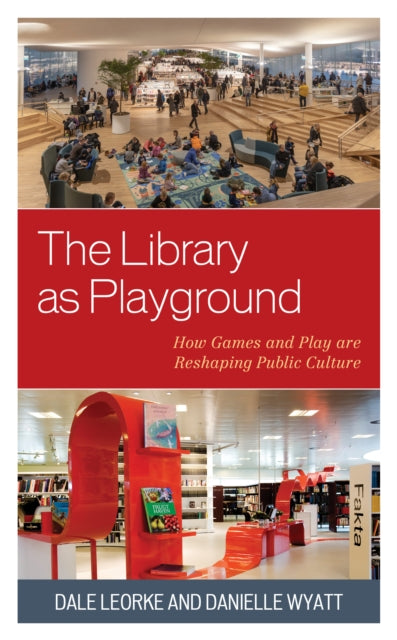
Dale Leorke,Danielle Wyatt
The Library as Playground: How Games and Play are Reshaping Public Culture
The Library as Playground: How Games and Play are Reshaping Public Culture
💎 Earn 169 Points (£1.69) on this item.
We can order this item for you. Delivery usually takes about 4 to 6 weeks.
This item is not held in our immediate stock. We will order it for you after checkout.
Estimated delivery: About 4 to 6 weeks
- Condition: Brand new
- UK Delivery times: Usually arrives within 2 - 3 working days
- UK Shipping: Fee starts at £2.39. Subject to product weight & dimension
Bulk ordering. Want 15 or more copies? Get a personalised quote and bigger discounts. Learn more about bulk orders.
Couldn't load pickup availability
- More about The Library as Playground: How Games and Play are Reshaping Public Culture
Digital and analog games have been used as educational tools and drawcards for modern public libraries, but their wider role in transforming libraries as public institutions remains unexplored. This book draws on ethnographic research to provide a rich portrait of the intersection between games, play, and public libraries, and how they are being connected to policies agendas around economic and cultural development.
Format: Paperback / softback
Length: 168 pages
Publication date: 19 February 2024
Publisher: Bloomsbury Publishing Plc
Digital and analog games have long been used as educational tools and drawcards for new patrons in modern public libraries, ranging from dedicated gaming zones and children's spaces to Minecraft gaming days, makerspaces, and virtual reality collections. However, their broader role in transforming libraries as public institutions remains unexplored. In this book, the authors draw on ethnographic research to provide a rich portrait of the intersection between games, play, and public libraries. They examine how games and play are increasingly spilling out of designated zones within libraries and beyond their walls, as part of a broader reconfiguration and "reimagining" of libraries in the digital era. The library's association with play has historically been understood through its classification as a "third place": a place to relax, socialize, and experiment outside of the utilitarian demands of work and home. However, far from just offering patrons an opportunity for detached leisure, this book illustrates how libraries are connecting games and play to policies and agendas around their municipality's economic and cultural development. By attending to the institutionalization of play, the book sheds new light on the contradictions at the heart of play as a theoretical concept and what libraries are in contemporary public life.
One of the key findings of the book is that games and play are becoming increasingly embedded in the fabric of libraries. Libraries are no longer just places where people go to borrow books or use computers; they are also spaces where people can engage in playful activities and interact with others. This has led to a shift in the way that libraries are designed and operated, with many libraries now incorporating game-based learning programs, interactive exhibits, and even gaming tournaments.
Another important aspect of the book is the way that games and play are being used to address social and economic issues. For example, libraries are using games to teach financial literacy, promote healthy eating habits, and encourage community engagement. They are also using games to address issues related to social isolation and loneliness, such as virtual reality programs that allow people to connect with others in a safe and supportive environment.
However, the book also highlights some of the challenges that libraries face in incorporating games and play into their programming. One of the biggest challenges is the lack of funding and resources. Many libraries are struggling to keep up with the rapidly changing technology and the demand for new and innovative programs. This has led to a situation where some libraries are unable to provide the same level of access to games and play as their more affluent counterparts.
Another challenge is the perception that games and play are only for children. This has led to a situation where many libraries are reluctant to incorporate games and play into their programming for adults. However, the book argues that games and play can be beneficial for adults as well, and that libraries should be more proactive in promoting games and play for all ages.
To address these challenges, the book offers a range of recommendations. One of the most important recommendations is for libraries to increase their funding and resources. This can be done through grants, donations, and partnerships with other organizations. Libraries can also work to promote games and play to a wider audience by partnering with schools, community organizations, and businesses.
Another recommendation is for libraries to be more proactive in promoting games and play for all ages. This can be done by creating game-based learning programs, interactive exhibits, and gaming tournaments that are designed for adults as well as children. Libraries can also work to address the perception that games and play are only for children by providing a range of games and play options that are suitable for all ages.
In addition to these recommendations, the book also provides a range of case studies that illustrate the impact of games and play on public libraries. These case studies include libraries in the United States, Canada, and Europe, and cover a range of topics, including financial literacy, healthy eating habits, and community engagement.
One of the most interesting case studies in the book is the story of the Toronto Public Library's "Game On" program. This program was launched in 2014 and has since become one of the most popular programs in the library's history. The program offers a range of game-based learning programs, interactive exhibits, and gaming tournaments for children and adults. The program has been successful in attracting new patrons to the library and has helped to improve the library's reputation as a fun and engaging place to visit.
Another interesting case study is the story of the Vancouver Public Library's "MakerSpace" program. This program was launched in 2015 and has since become one of the most popular programs in the library's history. The program offers a range of maker-based activities, including 3D printing, robotics, and coding. The program has been successful in attracting new patrons to the library and has helped to improve the library's reputation as a hub for innovation and creativity.
In conclusion, digital and analog games have long been used as educational tools and drawcards for new patrons in modern public libraries. However, their broader role in transforming libraries as public institutions remains unexplored. In this book, the authors draw on ethnographic research to provide a rich portrait of the intersection between games, play, and public libraries. They examine how games and play are increasingly spilling out of designated zones within libraries and beyond their walls, as part of a broader reconfiguration and "reimagining" of libraries in the digital era. The book highlights the importance of games and play in addressing social and economic issues, and offers a range of recommendations for libraries to increase their funding and resources and to be more proactive in promoting games and play for all ages. By doing so, libraries can help to ensure that they remain relevant and valuable to their communities in the digital age.
Weight: 264g
Dimension: 228 x 152 x 13 (mm)
ISBN-13: 9781538164334
This item can be found in:
UK and International shipping information
UK and International shipping information
UK Delivery and returns information:
- Delivery within 2 - 3 days when ordering in the UK.
- Shipping fee for UK customers from £2.39. Fully tracked shipping service available.
- Returns policy: Return within 30 days of receipt for full refund.
International deliveries:
Shulph Ink now ships to Australia, Belgium, Canada, France, Germany, Ireland, Italy, India, Luxembourg Saudi Arabia, Singapore, Spain, Netherlands, New Zealand, United Arab Emirates, United States of America.
- Delivery times: within 5 - 10 days for international orders.
- Shipping fee: charges vary for overseas orders. Only tracked services are available for most international orders. Some countries have untracked shipping options.
- Customs charges: If ordering to addresses outside the United Kingdom, you may or may not incur additional customs and duties fees during local delivery.