Shulph Ink
The Limits to Power: Soviet Policy in the Middle East
The Limits to Power: Soviet Policy in the Middle East
💎 Earn 775 Points (£7.75) on this item.
We can order this item for you. Delivery usually takes about 4 to 6 weeks.
This item is not held in our immediate stock. We will order it for you after checkout.
Estimated delivery: About 4 to 6 weeks
- Condition: Brand new
- UK Delivery times: Usually arrives within 2 - 3 working days
- UK Shipping: Fee starts at £2.39. Subject to product weight & dimension
Bulk ordering. Want 15 or more copies? Get a personalised quote and bigger discounts. Learn more about bulk orders.
Couldn't load pickup availability
- More about The Limits to Power: Soviet Policy in the Middle East
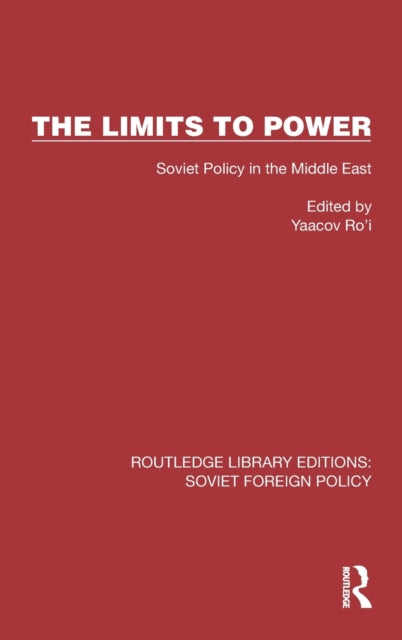
The Limits of Power (1979) examines the spectrum of Soviet interests and policies in the Middle East following the Yom Kippur War, analyzing how the Soviets handled oil, military and economic aid, policy toward Egypt, Syria, Iraq, and the Palestinian organizations, and toward Israel itself.
Format: Hardback
Length: 376 pages
Publication date: 28 December 2022
Publisher: Taylor & Francis Ltd
The Limits to Power (1979) is a comprehensive analysis of Soviet interests and policies in the Middle East following the Yom Kippur War of October 1973. It delves into how the Soviets approached various aspects such as oil, military and economic aid, relations with Egypt, Syria, Iraq, Palestinian organizations, and Israel itself. In 1970, the Soviet Union held a dominant position in the Middle East, but this book explores the events and actions that led to a significant reversal in Soviet fortunes over a decade later. The text examines in detail the ebb and flow of Soviet diplomacy, drawing from a wealth of official statements and press material.
The book begins by examining the Soviet approach to oil in the Middle East. The Soviets had a strong interest in the region's oil resources, and they sought to maintain their influence by supporting various Middle Eastern governments and organizations. However, the book notes that the Soviets' policies towards oil were often unpredictable and inconsistent, and they were often influenced by internal political considerations rather than strategic interests.
Next, the book discusses the Soviet military and economic aid to Middle Eastern countries. The Soviets provided significant assistance to Egypt, Syria, and Iraq, particularly during the Cold War. This aid included military equipment, technical expertise, and economic assistance. However, the book also highlights the challenges that the Soviets faced in maintaining their military presence in the region, particularly in light of the growing opposition from the United States and other Western powers.
The Soviet policy towards Egypt, Syria, and Iraq is also examined in detail. The Soviets supported these countries in their conflicts with Israel and other Western powers, but they also had their own interests in the region. For example, the Soviets were concerned about the growing influence of the United States in the Middle East and sought to counterbalance it by supporting their allies. However, the book notes that the Soviets' policies towards these countries were often driven by domestic political considerations rather than strategic interests.
The Soviet relationship with Palestinian organizations is also explored. The Soviets supported various Palestinian groups, including the PLO and Fatah, in their struggle against Israel. However, the book notes that the Soviets' approach to the Palestinian issue was often complex and multifaceted, and they were often influenced by internal political considerations rather than strategic interests.
Finally, the book examines the Soviet policy towards Israel itself. The Soviets had a long-standing hostility towards Israel, and they sought to undermine its legitimacy and influence in the Middle East. The book notes that the Soviets provided support to various Palestinian groups and organizations that were opposed to Israel, but they also had their own interests in the region. For example, the Soviets were concerned about the growing influence of the United States in the Middle East and sought to counterbalance it by supporting their allies.
In conclusion, The Limits to Power (1979) is a valuable contribution to the study of Soviet foreign policy in the Middle East. It provides a comprehensive analysis of Soviet interests and policies in the region following the Yom Kippur War of October 1973. The book explores how the Soviets approached various aspects such as oil, military and economic aid, relations with Egypt, Syria, Iraq, Palestinian organizations, and Israel itself. It also highlights the challenges that the Soviets faced in maintaining their military presence in the region and the complex and multifaceted nature of their relationship with Palestinian organizations. The book is a valuable resource for scholars and researchers interested in the history of Soviet foreign policy and the Middle East.
Weight: 884g
Dimension: 234 x 156 (mm)
ISBN-13: 9781032373959
UK and International shipping information
UK and International shipping information
UK Delivery and returns information:
- Delivery within 2 - 3 days when ordering in the UK.
- Shipping fee for UK customers from £2.39. Fully tracked shipping service available.
- Returns policy: Return within 30 days of receipt for full refund.
International deliveries:
Shulph Ink now ships to Australia, Belgium, Canada, France, Germany, Ireland, Italy, India, Luxembourg Saudi Arabia, Singapore, Spain, Netherlands, New Zealand, United Arab Emirates, United States of America.
- Delivery times: within 5 - 10 days for international orders.
- Shipping fee: charges vary for overseas orders. Only tracked services are available for most international orders. Some countries have untracked shipping options.
- Customs charges: If ordering to addresses outside the United Kingdom, you may or may not incur additional customs and duties fees during local delivery.